
Why Repurposing Is Not Lazy, It Is Leverage
The conventional assumption about content repurposing is that it is a shortcut taken by creators who have run out of original ideas. The reality is the exact opposite. Repurposing is the single highest-leverage move available to anyone who publishes on more than one social network. The most prolific, most consistent creators on the internet are not generating brand-new ideas every day for every platform. They are taking one genuinely good idea and translating it into the native language of each platform their audience lives on.

Think about the actual economics of content. The expensive part is never the typing. The expensive part is the thinking: the original insight, the data you gathered, the story you lived through, the framework you tested. That intellectual work is what makes a piece of content worth reading. Once you have done it, throwing it away after a single post on a single platform is the wasteful choice, not the efficient one. Repurposing simply respects the value of the thinking you already did.
Each social network has its own format requirements, cultural norms, and audience expectations. A long-form essay that performs beautifully on LinkedIn will fall flat if you paste it verbatim into a tweet, and a punchy nine-tweet thread will look thin and underbaked as a LinkedIn document. But the underlying idea is equally valid in both places. Repurposing is the discipline of translating that idea into the native format of each platform, not just copying it across. Done well, it lets one person produce the output of a small content team. Done badly, it produces five identical, awkward posts that nobody finishes reading. This guide is about doing it well.
Key idea: Repurposing is not making the same post five times. It is doing the hard thinking once, then translating that thinking into five formats that each feel native to their platform. The thinking is the asset. The posts are just distribution.
The Content Pyramid (or Atomization Model)
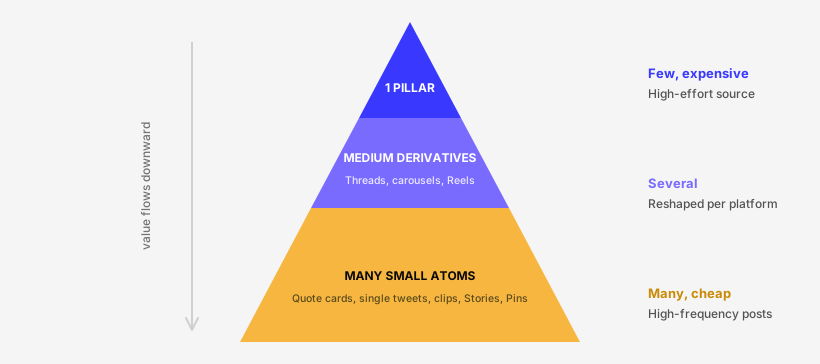
The mental model that makes all of this click is the content pyramid, sometimes called atomization. At the top of the pyramid sits a single substantial piece of content: a long article, a podcast episode, a webinar recording, a research report. This is your pillar. Below it sit a handful of medium-sized derivatives: a LinkedIn carousel, a Twitter thread, an Instagram carousel, an email newsletter. At the base sit the smallest atoms: individual quote cards, single tweets, short-form video clips, Stories, Pinterest pins.
The pyramid works because value flows downward. A single hour-long webinar can yield one detailed blog post, that blog post can yield three threads and two carousels, and each of those can yield five or six standalone atoms. One pillar can comfortably become twenty to forty pieces of distributed content without a single repeated word. The shape matters: you produce a small number of expensive, high-effort assets at the top and a large number of cheap, high-frequency atoms at the bottom. Your audience never sees the pyramid. They just see a creator who shows up everywhere, consistently, with something useful to say.
Choosing a Pillar Piece
Effective repurposing starts with the right pillar. A pillar piece is a substantial piece of content rich enough in ideas, data, and structure to be broken into many smaller pieces. The more substantive the original, the more derivative content you can extract. Not everything qualifies. A shower thought that works perfectly as a single tweet is not a pillar. A framework you used to generate a specific, measurable result, with the methodology, the examples, and the numbers behind it, absolutely is.
There is a simple test for whether something can serve as a pillar: can you imagine pulling at least five distinct, standalone ideas out of it, each strong enough to hold a post on its own? If yes, it is a pillar. If the whole thing is really just one idea wearing a long coat, it is a single post, and you should treat it as one.
Different pillar formats have very different repurposing profiles. Some are dense with extractable ideas but slow to produce. Others are fast to produce but yield fewer derivatives. Here is how the common pillar types compare.
| Pillar type | Production effort | Derivative yield | Best for | Watch out for |
|---|---|---|---|---|
| Long-form article (1,500 to 3,000 words) | Medium to high | Very high | Frameworks, guides, opinion pieces, SEO | Easy to over-pad; structure it as discrete sections so each becomes an atom |
| Podcast episode (30 to 60 min) | Medium (if you talk anyway) | High | Conversations, interviews, audio-grams, quote clips | Needs transcription before text derivatives are fast |
| Webinar or workshop (45 to 90 min) | High | Very high | Teaching content, slide carousels, lead capture | Live energy can be hard to translate to text without editing |
| Livestream / AMA | Low to medium | Medium | Q&A atoms, hot takes, reactive content | Unstructured, so you must mine it for the gold afterward |
| Long-form video (10 to 30 min) | High | Very high | Shorts, Reels, TikToks, thumbnails, threads | Editing labour is real; budget for clip extraction |
| Research report / original data | High | Extremely high | Data cards, stat threads, charts, PR, citations | Slow to produce, but each data point is its own atom |
If you are choosing where to invest, research reports and long-form video give the most derivatives per pillar, but they are the most expensive to produce. Long-form articles are the sweet spot for most solo creators and small teams: moderate effort, very high yield, and the text is already in the format most other derivatives start from. A useful rhythm is one substantial article per week as your primary pillar, supplemented by a podcast or video pillar when your schedule allows. For more on planning that cadence as a one-person operation, see The Content Calendar System for Solo Founders.
Tip: Write your pillar in clearly delineated sections with their own subheads from the start. Each section then becomes a pre-cut atom: one section equals one thread, one carousel slide, or one standalone post. You are doing the slicing work upfront, before you have forgotten what you meant.
The Atomization Map
Once you have a pillar, the next question is brutally practical: exactly how many pieces, of what kind, can one pillar produce? Vague encouragement to repurpose is useless. What you need is a map that tells you, for a given pillar, the concrete output across every platform. Below is a realistic atomization map for a single strong long-form article used as the pillar.
| Platform | Derivative output from one pillar | Format | Typical count |
|---|---|---|---|
| 1 text post + 1 document carousel | Text + PDF carousel | 2 | |
| Twitter / X | 1 thread + 2 to 3 standalone tweets | Thread + singles | 3 to 4 |
| 1 carousel + 1 Reel + 2 to 3 Stories | Carousel + video + Stories | 4 to 5 | |
| TikTok | 1 to 2 short videos | Short video | 1 to 2 |
| YouTube Shorts | 1 to 2 short videos | Vertical short | 1 to 2 |
| 1 conversational post | Text or link | 1 | |
| Threads | 1 to 2 casual posts | Short text | 1 to 2 |
| 2 to 3 pins (different angles) | Vertical graphic | 2 to 3 | |
| Email newsletter | 1 issue | Long-form email | 1 |
Add that up and a single article comfortably produces between eighteen and twenty-three pieces of distributed content across nine surfaces. You will not always run a pillar through every single platform, and you should not feel obligated to. But the map shows the ceiling, and it reframes the work. You are not staring at nine blank boxes every week. You are slicing one finished thing.
Notice that the map is not symmetrical. Instagram and Twitter absorb the most derivatives because their formats are flexible and their feeds move fast, so they can hold more pieces without feeling repetitive. Facebook and the email newsletter take a single, more complete adaptation each. This asymmetry is intentional. You match the volume of derivatives to how each platform consumes content, not to some fairness principle. For a deeper treatment of how the platforms differ structurally, see How to Adapt One Idea for Every Platform.
Plan every platform from one calendar
Postprism schedules and auto-publishes to all 9 networks from a single content calendar. Start your 7-day free trial.

Per-Platform Derivative Playbooks
This is the core of the system: the exact transformation recipe for turning your pillar into each platform's native format. Each playbook below assumes you are starting from a finished long-form article pillar. Adjust the inputs if your pillar is a video or podcast, but the transformation logic holds.
LinkedIn: Text Post and Document Carousel
From a pillar, LinkedIn wants one of three things: a personal reflection on the core insight with a professional angle, a structured "what I learned" narrative, or a clean framework extracted from the pillar and presented with examples. The transformation recipe is to take the single most career-relevant or business-relevant idea in your pillar and re-anchor it around professional consequence. Why does this matter for someone's career, their team, their revenue? LinkedIn audiences respond to specificity and utility, so ground every claim in a concrete professional application.
Format the text post at 900 to 1,400 characters, with a strong one-line hook, a single line break after it (the line that survives the "see more" truncation does the heavy lifting), short paragraphs, and a closing line that invites a comment. For the document carousel, take a framework or numbered list from the pillar and put one step per slide: a title slide, six to ten content slides, and a final slide with a soft call to action. The full structure is laid out in The Perfect LinkedIn Post Formula.
Twitter / X: The Distilled Thread
From the same pillar, a Twitter thread extracts the three to seven most striking insights and presents each as its own tweet. The recipe demands radical compression. Read each section of your pillar and ask: what is the single most interesting sentence here, the one carrying the essential insight? Build the tweet around that sentence and cut everything else from the section. A LinkedIn paragraph collapses into one tweet. A whole article section collapses into one thread post.
The hook tweet should be the most counterintuitive or surprising claim in the entire pillar, not a polite throat-clear like "Here are some thoughts on X." Each subsequent tweet delivers one standalone point that could be screenshotted and still make sense alone. The final tweet points back to the full pillar for readers who want the depth. Pull two or three of the strongest individual lines and also schedule them as standalone tweets on later days. The detailed method is in The Twitter / X Thread Strategy That Actually Grows Your Audience.
Instagram: Carousel, Reel, and Stories
Instagram is the most generous platform for atomization because it has three distinct formats that each consume part of your pillar. The carousel is the workhorse: take a framework or list, design one idea per slide, lead with a scroll-stopping cover slide, and end with a "save this" or "follow for more" slide. Eight to ten slides is the range that gets the most saves, and saves are the signal Instagram rewards.
The Reel takes the single most quotable or visual idea from the pillar and turns it into a fifteen to thirty second talking-head or text-on-screen video. The hook has to land in the first second. The Stories take supporting atoms: a poll about the topic, a single stat as a sticker, a "swipe up to read the full thing" link to your pillar. Three Stories spaced through the day keep you present without flooding the feed.
TikTok: The Hook-First Video
TikTok rewards a different energy than Instagram. The recipe is to pick one tension or surprising claim from your pillar and open the video with it as a verbal hook in the first second, before any intro, before saying your name. "Most people schedule posts completely wrong, and here is the proof" beats "Hey guys, today I want to talk about scheduling." Deliver one idea in fifteen to forty seconds, talk directly to camera or over simple b-roll, and let the personality carry it. TikTok punishes polish that reads as corporate, so keep it loose. One dense pillar section usually yields one or two TikToks.
YouTube Shorts: The Repurposed Vertical
YouTube Shorts can often reuse the exact same vertical video you cut for TikTok or Reels, but the audience skews more toward search and how-to intent. Lean the framing slightly more educational: state the problem, give the answer, and add a single line pointing viewers to a longer video or the pillar for depth. The same clip with a tweaked first three seconds and a clearer payoff line will frequently perform differently across the three short-video surfaces, which is reason enough to post it to all three rather than picking one.
Facebook: The Conversational Post
Facebook's algorithm strongly favours comments and reactions, so the recipe is conversational rather than declarative. Take the core finding from your pillar and frame it as a shared experience that invites response: "We tested this approach for 90 days and the thing that surprised us most was not what we expected." End with a genuine question. The goal is to make replying feel natural. Facebook also still surfaces link posts to engaged audiences, so a short conversational lead-in plus a link to your pillar works well when your audience there is warm.
Threads: The Casual Aside
Threads rewards a looser, more conversational register than Twitter and far looser than LinkedIn. The recipe is to take a single opinion or observation from your pillar and post it almost like a text message to a friend, without the thread scaffolding. Threads punishes anything that feels like cross-posted marketing, so strip the hooks and the calls to action. One or two relaxed posts per pillar is plenty, and they often spark replies that become their own content ideas.
Pinterest: The Evergreen Pin
Pinterest behaves like a visual search engine rather than a feed, which changes the recipe entirely. Each pin is a vertical graphic with a keyword-rich title and description, linking back to your pillar. Because Pinterest content has a long shelf life, make two or three pins from the same pillar, each targeting a different search angle: one keyword-led, one benefit-led, one curiosity-led. A single evergreen pillar can drive traffic from Pinterest for months or years after you post it, which makes it the highest-ROI surface for evergreen pillars specifically.
Email Newsletter: The Director's Cut
The email newsletter is the one derivative that can be longer than the pillar, not shorter. The recipe is to take the pillar's core argument and add the personal context that does not fit a public post: the backstory, the mistake you made, the thing you would not say on a feed. Email audiences chose to be there, so reward them with depth and a more intimate voice. End with a single link back to the pillar or to a relevant product. The newsletter is also where you can link to everything else you published that week, turning your repurposing cycle into a recap.

A Repeatable Weekly Repurposing Workflow
A content repurposing workflow is the repeatable, step-by-step process you use to turn one pillar into a full slate of platform-native derivatives, every week, without reinventing the process each time. The value of defining it explicitly, rather than improvising, is speed and consistency: the thinking happens once in the pillar, and every downstream post follows the same predictable path. Here is a concrete weekly version you can adopt as-is.
- Monday, produce the pillar (2 to 3 hours). Write the long-form article, or record the podcast or video. This is the only deep-thinking block of the week. Structure it in clear sections so the slicing is easy later.
- Tuesday, extract the atoms (45 minutes). Read the pillar and pull every standalone idea into a list: the strongest insights, the best lines, the data points, the framework steps. Aim for fifteen to twenty extracted atoms. You are not writing posts yet, just mining.
- Tuesday, map atoms to platforms (15 minutes). Assign each atom to the platform and format it best suits, using your atomization map. The big framework becomes the LinkedIn carousel and the Instagram carousel. The single surprising stat becomes the thread hook and a Pinterest pin.
- Wednesday, write the derivatives (60 to 90 minutes). Now adapt, in batch. Write all the text derivatives in one sitting because the thinking is done. This is where the workflow pays off: adaptation is fast when you are translating rather than inventing.
- Thursday, produce the visuals (60 minutes). Create the carousels, the quote cards, the pins, and cut the short videos. Stay in "design mode" and do them all together rather than switching contexts.
- Friday, schedule everything (30 minutes). Load every derivative into one content calendar, set the times, and let it publish automatically over the coming week. By Friday afternoon, next week is done.
That is roughly six to eight hours of focused work for a full week of presence across nine platforms. Compare that to the alternative of waking up each morning and trying to invent something for each network in real time, and the leverage is obvious. The discipline that makes it sustainable is batching: doing each type of work in its own dedicated block rather than scattering it. For the full case on why batching beats one-at-a-time creation, see Batch Content Creation: Make a Month of Posts in One Afternoon.
A Sample Weekly Calendar
Here is how the derivatives from a single Monday pillar might land across the following days. Spreading them out gives each piece its own engagement window instead of making all nine platforms compete at once.
| Day | Twitter / X | Other | ||
|---|---|---|---|---|
| Monday | Text post (core insight) | Thread | Rest day | Facebook conversational post |
| Tuesday | Rest day | Standalone tweet 1 | Carousel | Pinterest pin 1 |
| Wednesday | Document carousel | Rest day | Reel + 2 Stories | TikTok video |
| Thursday | Rest day | Standalone tweet 2 | Rest day | YouTube Short, Threads post |
| Friday | Comment-bait question post | Thread recap | 3 Stories | Pinterest pin 2, Email newsletter |
Every cell in that table traces back to Monday's single pillar. Nothing was invented from scratch after Monday. That is the entire point.
Batching and Scheduling: The Distribution Layer
Producing twenty derivatives does you no good if publishing them becomes a daily manual chore across nine apps. The workflow above only stays sustainable because the final step, scheduling, removes you from the loop. This is where a scheduling tool stops being a convenience and becomes the load-bearing layer of the whole system.
The model to aim for is one content calendar that auto-publishes to all nine networks. You load every derivative once, set the time for each, and the tool handles the actual posting at the right moment for each platform, with the correct aspect ratios and formatting. You stop logging into nine separate apps. You stop setting nine reminders. You see your entire week as a single visual calendar and adjust it in one place.
This is exactly what Postprism is built to be: the distribution layer for a repurposing system. You do the slicing and adapting, and Postprism publishes the finished derivatives to LinkedIn, Twitter / X, Instagram, Facebook, TikTok, YouTube, Threads, Bluesky, and Pinterest from one calendar, automatically. Its Prismatic image tool also generates platform-optimized visuals for each derivative, so the carousel cover and the quote card and the pin graphic do not become their own bottleneck. The repurposing thinking stays human. The publishing becomes invisible. For how this fits into an overall multi-platform plan, see The Cross-Platform Social Media Strategy for Time-Strapped Founders.
Repurposing vs Reposting vs Recycling vs Cross-Posting
These four terms get used interchangeably, but they describe genuinely different practices with different results. Confusing them is a common reason repurposing efforts underperform, because people think they are repurposing when they are really just cross-posting.
- Repurposing is transforming one pillar idea into a new, platform-native format for each network. The LinkedIn version and the Twitter version share an idea but share almost no words. This is the high-leverage practice this guide is about.
- Cross-posting is publishing the identical post to multiple platforms with no adaptation. Same text, same image, everywhere. It is fast, but it ignores platform norms, so it usually underperforms on every platform except the one the content was originally written for.
- Reposting is sharing someone else's content, or re-sharing your own existing post, in its original form (a retweet, a Story re-share, a quote post). It is amplification, not creation.
- Recycling is re-publishing your own past content again later, often months after the original, to reach people who missed it the first time. Evergreen content is the natural candidate for recycling.
The useful way to hold these apart: repurposing changes the format, recycling changes the timing, reposting changes the audience, and cross-posting changes nothing but the destination. Repurposing is the one that compounds, because each derivative is a genuinely native asset rather than a copy.
Evergreen vs Timely Content
How a pillar repurposes depends heavily on whether it is evergreen or timely, and the two demand different strategies.
Evergreen content stays relevant indefinitely: frameworks, how-to guides, foundational explanations, lessons learned. These are the ideal pillars for maximum leverage because they support the full pyramid and, crucially, they support recycling. An evergreen pillar can be atomized this week, and then the same atoms (or fresh ones from the same pillar) can be re-posted three months later with little or no editing. Pinterest, in particular, will keep surfacing evergreen pins for months. Build the bulk of your pillar library from evergreen content if your goal is durable leverage.
Timely content is tied to a moment: a product launch, a news reaction, a seasonal event, a live result. It repurposes intensely but briefly. The atomization should happen fast, ideally all in the same day, because the relevance decays quickly. There is little point spacing a reaction to today's news across the next week. Run timely pillars through the full platform map immediately, accept that they will not recycle, and move on. A healthy content library is mostly evergreen pillars (for compounding leverage) with a steady stream of timely pillars layered on top (for relevance and presence).
Tools That Help You Repurpose
You do not need a sprawling stack, but a few tool categories meaningfully speed up the workflow. Think in categories rather than specific brands, because the right pick depends on your platforms and budget.
- Transcription tools turn podcasts, videos, and webinars into text fast, which is the prerequisite for extracting written atoms from audio or video pillars.
- Video clipping tools automatically find the most engaging moments in long-form video and cut them into vertical shorts, removing the biggest bottleneck in video repurposing.
- Design tools with carousel and quote-card templates let you produce the visual derivatives quickly once you have a saved style, so each carousel is a fill-in rather than a fresh design.
- AI writing assistants help with the mechanical part of adaptation, like compressing a paragraph into a tweet or expanding a bullet into a caption, though the core idea selection should stay human.
- Image generation tools create platform-sized graphics on demand, which matters because each derivative often needs its own correctly-proportioned visual. Postprism's Prismatic covers this directly.
- Scheduling and distribution tools are the layer that actually publishes everything from one calendar. This is the non-negotiable category, because without it the whole system collapses back into manual daily posting.
The trap is acquiring tools to feel productive rather than to remove a specific bottleneck. Add a tool only when you have felt the pain it solves. For most people, a transcription tool plus a scheduler plus an image generator covers ninety percent of the need.
Measuring Repurposing ROI
Repurposing generates a lot of output, which makes it tempting to measure success by volume. Resist that. The point of the system is not to post more; it is to learn which derivatives earn their keep so you can scale those and quietly drop the rest. Measure at two levels.
At the format level, track which derivative types consistently outperform for you. Maybe your LinkedIn carousels reliably out-save your text posts, or your Twitter threads drive far more profile visits than your standalone tweets. This tells you where to invest more adaptation effort per pillar. At the pillar level, track which pillar topics produce the highest-performing derivatives across the board. A pillar whose atoms over-perform on every platform is a topic worth revisiting, going deeper on, and recycling.
The metric that matters most depends on your goal. For reach, watch impressions and shares. For audience growth, watch follows and profile visits. For business, watch link clicks, email signups, and ultimately conversions. A useful habit is to tag each derivative by which pillar it came from, so after a month you can see not just which posts won but which source pillars generated the most total value. Scale the pillars and formats that win. Stop forcing the ones that do not. This is how repurposing gets sharper over time instead of just louder.
Tip: Run a monthly ten-minute review where you list your three best-performing derivatives and identify the pillar and format behind each. Three data points a month compounds into a clear picture of what your specific audience rewards within a quarter.
Common Repurposing Mistakes (and How to Fix Them)
Most repurposing failures are not exotic. They are the same handful of mistakes, repeated. Here are the most common, each with the fix.
- Mistake: copy-pasting instead of adapting. Posting the identical text everywhere is cross-posting wearing a repurposing costume. Fix: for every platform, rewrite at least the hook and the format to match native norms. If two versions share more than half their words, you have not adapted enough.
- Mistake: choosing weak pillars. A thin idea cannot support twenty derivatives, so the atoms come out forced and repetitive. Fix: apply the five-ideas test before treating anything as a pillar. If you cannot pull five standalone ideas out, it is a single post.
- Mistake: over-repurposing personal stories. A narrative has one arc, so retelling it five ways feels like the same story five times. Fix: use stories as pillars sparingly, and when you do, extract the lesson as the reusable atom rather than re-narrating the events.
- Mistake: ignoring platform context. A formal LinkedIn voice on Threads, or a corporate hook on TikTok, reads as a tourist. Fix: learn each platform's register and translate the tone, not just the text.
- Mistake: front-loading all derivatives on the same day. Dumping all nine versions at once makes them compete and exhausts your audience. Fix: spread derivatives across the week so each gets its own engagement window, as in the sample calendar above.
- Mistake: skipping the visual adaptation. Using one image across formats means wrong aspect ratios and weak performance. Fix: produce a correctly-sized visual per format in your batch design block, or generate them with an image tool.
- Mistake: no measurement, so no learning. Repurposing on autopilot without review just multiplies whatever you were already doing, good or bad. Fix: run the monthly format-and-pillar review and let the data redirect your effort.
Adapt once, publish everywhere
Write your idea once, tailor it per platform, and let Postprism publish to all 9 networks on schedule.
Frequently Asked Questions
What is a content repurposing workflow?
A content repurposing workflow is the repeatable, step-by-step process you use to turn one pillar piece into several platform-native posts. A simple workflow looks like this: pick a substantial pillar piece, extract its strongest standalone ideas, map each idea to the platform and format it suits best, write the derivatives in batch, create the matching visuals, schedule everything in one calendar, and review performance to learn which derivatives win. The point of a defined workflow rather than improvising is speed and consistency: the thinking happens once in the pillar, and every downstream post follows the same predictable path.
How many platforms should I repurpose to at once?
Start with two or three platforms where your audience actually is, and master the adaptation for each before expanding. Repurposing to nine platforms badly is worse than repurposing to three platforms well. Once your workflow is smooth and your scheduling is automated, adding platforms costs very little extra effort, because the pillar and the atoms already exist. The constraint is rarely the platforms; it is whether you have a clean workflow and a distribution layer that publishes for you.
Does the algorithm penalise repurposed content?
Platform algorithms do not detect that content originated on a different platform. What they detect is whether content is formatted appropriately for the current platform: correct aspect ratios, appropriate length, native video rather than external links. Repurposing that involves genuine adaptation to platform norms is never penalised. Lazy copy-pasting underperforms, but not because of a penalty; it underperforms because the format does not match what the platform and its audience expect.
How long should I wait between posting the same idea on different platforms?
There is no technical reason to stagger, because the platforms do not share data about what you posted elsewhere. Spreading distribution over several days is still beneficial, because it gives each derivative its own engagement window instead of making all your platforms compete simultaneously. A common pattern is to post the LinkedIn and Twitter versions on the same day, then schedule the Instagram, Facebook, and other derivatives across the following days.
Should I tell my audience that content is repurposed?
No disclosure is required or expected. An adapted derivative is original content on each platform, formatted specifically for that audience and context. The fact that the underlying idea came from a pillar is no different from a journalist writing about the same research study for several publications, each version shaped to its readers. Your audience cares whether the post is useful where they see it, not where the idea was born.
What types of content repurpose best?
Framework and process content repurposes most effectively, because the underlying structure can be expressed in many formats: a list on Twitter, a carousel on LinkedIn, a diagram on Instagram, a numbered email. Data-driven content also repurposes well, because each data point can lead a different platform's version. Personal stories are the hardest to repurpose without becoming repetitive, since the arc is the same regardless of format. If maximum leverage is your goal, lean toward frameworks and data as pillars and use stories sparingly.
How do I keep repurposed content from feeling repetitive to followers who see me everywhere?
Two tactics. First, change the format and the angle, not just the wording, so the LinkedIn carousel and the Twitter thread feel like genuinely different pieces even to someone who sees both. Second, accept that very few followers actually follow you on every platform; the overlap is far smaller than it feels from the inside. The handful who do see everything tend to appreciate the reinforcement rather than resent it, as long as each version is genuinely native and adds something.
How much time does a full repurposing workflow actually take?
For one strong pillar producing derivatives across nine platforms, budget roughly six to eight hours of focused work spread across a week: two to three hours on the pillar itself, then shorter blocks for extraction, writing, visuals, and scheduling. The pillar is the only expensive part. Every derivative after it is fast because you are translating finished thinking rather than inventing from a blank page. Automated scheduling removes the daily publishing time entirely.
Can I repurpose old content, or only new pillars?
Your back catalogue is one of the richest repurposing sources you have, especially anything evergreen. An article you published a year ago that still holds up can be atomized today exactly as if it were a fresh pillar, and most of your current audience never saw it the first time. A productive habit is to keep a running list of your best past pieces and feed one back into the repurposing workflow whenever a week's new pillar is not ready.
What is the single most important tool for repurposing?
A scheduling and distribution tool that publishes to all your platforms from one calendar. Every other tool speeds up production, but the scheduler is what makes the system sustainable, because it removes the daily manual posting that otherwise causes people to abandon repurposing within a few weeks. With one calendar feeding nine networks, the only recurring work is the creative slicing, which is the part that should stay human. You can start a free trial and load a full week of derivatives in a single sitting.


