
Why Threads Are the Growth Engine of Twitter/X
If you want engagement on Twitter/X, single tweets are wonderful. They spark replies, they get quote-tweeted, they let you join a conversation in real time. But if you want to grow a following, the format that does the heavy lifting is the thread. This is not a stylistic preference. It is structural. A thread gives a stranger enough of your thinking to make a considered decision about whether to follow you, and a follow earned that way is worth far more than a follow won by a single clever line that the person forgets an hour later.

Think about the psychology of the follow button. When someone reads one tweet they like, the most they will usually do is hit the heart. Following requires a bigger commitment: it means "I expect this account to be worth seeing again." A single tweet rarely clears that bar because it is a sample size of one. A well-built thread of eight to fourteen tweets is a sustained demonstration of how you think, how you structure ideas, and what you know. By the time a reader reaches the last tweet, they have effectively auditioned you, and the follow is the natural conclusion of that audition.
The algorithm reinforces this. Twitter/X distribution is driven heavily by what the platform internally weighs as meaningful engagement: replies, dwell time, profile visits, and completion. Threads are engineered to generate all four. Each tap on "show this thread," each scroll down to the next tweet, each pause to read a point counts as continued interaction. A reader who moves from tweet one through to the payoff produces a dense cluster of positive signals in a short window, which tells the ranking system that this content held attention. That signal is what pushes the thread beyond your existing followers into the feeds of people who have never heard of you. We go deeper on the mechanics in Twitter/X Algorithm in 2026: What You Need to Know, but the short version is that the algorithm rewards content people stay with, and threads are the format most likely to keep people staying.
There is also a compounding effect that single tweets cannot match. A great thread earns retweets and quote-tweets from larger accounts. Each of those exposes the thread to a new audience, who follow you, who then form the launch audience for your next thread, which now starts with more initial velocity and a better chance of breaking out again. Single tweets occasionally go viral, but they rarely build the staircase of repeatable growth that a disciplined thread practice produces.
Single tweets win conversations. Threads win followers. If audience growth is the goal, the thread is the highest-leverage format on the platform, because it is the only one that gives a stranger enough evidence to commit to the follow.
The Anatomy of a High-Performing Thread
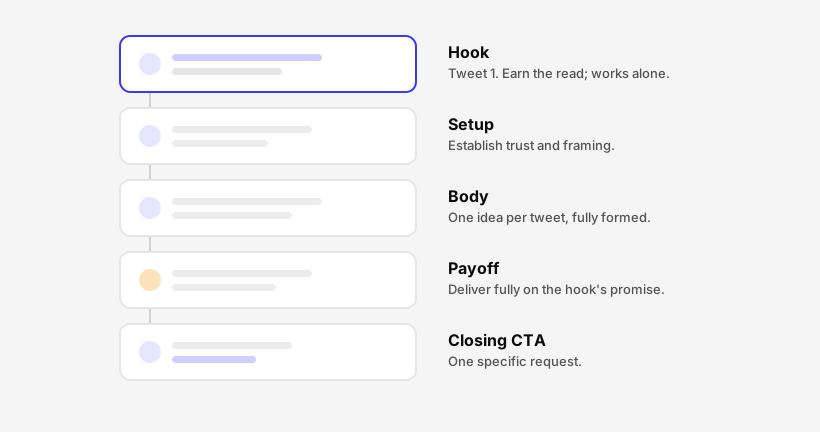
Every thread that consistently grows an audience follows the same underlying skeleton. The topics change, the voice changes, the length changes, but the load-bearing parts are always present. Once you can see the skeleton, you stop writing threads by feel and start engineering them deliberately. There are five parts: the hook, the setup, the body, the payoff, and the closing CTA.
The Hook Tweet
This is tweet one, and it is the single most important sentence you will write all week. The hook is the only tweet the algorithm shows to non-followers as a preview, the only tweet most people see before they decide whether to read the rest, and the tweet that appears when someone retweets the whole thread. It must work completely on its own, with zero context from the tweets below it. If the hook needs tweet two to make sense, the hook has failed. We will spend an entire section on writing hooks, because the return on that one tweet is enormous.
The Setup
Tweets two and sometimes three establish why the reader should trust what is coming. This is where you earn the right to be believed: a credential, a result, a specific period of experience, or simply a sharp framing of the problem. The setup is short. Its job is to bridge the promise of the hook into the substance of the body without losing momentum. Many threads skip the setup entirely and jump straight from hook into body, which is fine for some formats but costs you credibility on others.
The Body: One Idea Per Tweet
The body is the substance, and it follows one non-negotiable rule: one idea per tweet. Each tweet should make a single point that is complete and useful on its own. The reason is the way people actually read threads. They do not read linearly and patiently. They skim, they jump, they screenshot the one tweet that resonated and share it. If a single idea is split across two tweets, the screenshot breaks and the shareability dies. If two ideas are crammed into one tweet, the reader cannot absorb either. One tweet, one idea, fully formed.
The Payoff
The payoff is the moment the thread delivers on the promise made in the hook. If the hook said "here is exactly how I doubled my reply rate," the payoff is the part where the reader feels they now actually know how. Weak threads withhold the payoff to force a click somewhere; strong threads give it freely. Generosity in the payoff is what earns the follow, because it proves you will keep delivering value if the reader sticks around.
The Closing CTA Tweet
The final tweet is where you ask for the thing you want. Most people leave this off and quietly hope readers will follow on their own. They mostly will not, because you never asked. The close should do two things: briefly recap the value just delivered, then make one clear request. If you want followers, ask for the follow and say what they will get by following. If you want traffic, point to the deeper resource, but put the actual link in a reply rather than in this tweet, for reasons we cover later. One ask. Specific. Clear.
| Part | Position | Its one job | Failure mode |
|---|---|---|---|
| Hook | Tweet 1 | Make reading the thread feel necessary | Vague, polite, needs context to parse |
| Setup | Tweets 2 to 3 | Establish trust and framing | Long, self-indulgent, kills momentum |
| Body | Middle tweets | Deliver one standalone insight per tweet | Two ideas per tweet, or one idea split across two |
| Payoff | Late body | Fully deliver on the hook's promise | Withholding the value to force a click |
| Closing CTA | Final tweet | Make one specific request | No ask at all, or three competing asks |
Writing the Hook Tweet
The hook tweet is the highest-leverage writing in the entire thread, and it deserves disproportionate attention. A reasonable working rule: spend as much time on the hook as you spend on every other tweet combined. The reason is brutal arithmetic. If the hook fails, nobody reads the rest, so the quality of tweets two through fourteen becomes irrelevant. A mediocre thread with a great hook outperforms a brilliant thread with a weak hook, every time.
The most effective hooks share three traits: they are specific, they create tension, and they promise a concrete payoff. Specificity beats vagueness because numbers and named outcomes feel real. Tension creates the itch the reader needs to scratch by continuing. The promise of a payoff tells them the scratch is worth it. "I have some thoughts on Twitter growth" has none of these. "I grew from 0 to 10,000 followers in 90 days. Here is exactly what I did, and the three things I stopped doing" has all three.
Hook Formulas That Work
You do not need to invent a hook from nothing each time. A handful of repeatable patterns produce strong hooks reliably. Treat these as scaffolding, then make them specific to your topic.
- The transformation: "I went from [bad starting point] to [impressive result] in [timeframe]. Here is exactly how." Example: "I went from zero email subscribers to 4,000 in five months without paid ads. Here is the entire playbook."
- The contrarian claim: "Everyone tells you to [common advice]. They are wrong, and here is what actually works." Example: "Everyone says post more to grow on X. Posting less is what doubled my reach. Here is why."
- The numbered promise: "[Number] [things] that [outcome]. Number [X] surprised me." Example: "7 cold email mistakes that kill your reply rate. Number 4 is the one everyone makes."
- The mistake confession: "I wasted [time or money] doing [thing] wrong. Learn from my mistakes so you do not repeat them." Example: "I burned 18 months building features nobody wanted. Here are the 5 lessons that finally turned it around."
- The curated list: "I read [large number] of [things] so you do not have to. Here are the [small number] worth your time." Example: "I tested 30 scheduling tools this year. Here are the 4 actually worth paying for."
- The question hook: "Why do [surprising observation]? The answer changed how I [do something]." Example: "Why do the best threads almost never use hashtags? The answer reshaped my entire content strategy."
Concrete Example Hooks
To make the patterns less abstract, here are finished hooks you could adapt today, each ending with the colon or sentence that signals a thread is coming:
- "Most people use Twitter/X to broadcast. The accounts that actually grow use it to listen first. Here is the difference:"
- "I analyzed 200 of my own tweets to find what the top 10 percent had in common. The pattern was not what I expected:"
- "You do not have a content problem. You have a distribution problem. Here is the fix that took me three years to learn:"
- "A thread that adds 500 followers and a thread that adds 5 look almost identical in the editor. The difference is six small decisions:"
- "I stopped chasing virality and started chasing replies. My follower growth tripled. Here is the counterintuitive math:"
Common Hook Mistakes
Most weak hooks fail in predictable ways. The polite throat-clear ("Some thoughts on X") signals low confidence and zero urgency. The buried lede hides the most interesting claim in tweet four where nobody reaches it; the most surprising thing you have to say belongs in tweet one. The context-dependent hook does not parse without the tweets below it, so it dies as a standalone preview. The overpromise sets up a payoff the thread never delivers, which trains your audience to distrust your hooks. And the everything hook tries to tease five different ideas at once, leaving the reader with no single reason to keep reading. Pick one sharp claim and lead with it.
Write five different hooks for every thread, then pick the strongest. The first hook you write is almost never the best one, and the cost of writing four more is ten minutes against a thread that may run all week.
Schedule Your Twitter/X Threads in Advance
Write your thread once, plan it on a calendar, and let Postprism publish it at your peak time across all 9 networks. Start your 7-day free trial.

Structuring the Body
Once the hook earns the read, the body has to keep it. The body is where most threads quietly lose their audience, not through one catastrophic tweet but through a slow leak of attention caused by poor pacing, crammed tweets, and ideas that do not stand alone. Structuring the body well is mostly about discipline applied to a few specific decisions.
Numbered Versus Unnumbered
Numbering your points (1, 2, 3 or sometimes a clean "Tip 1, Tip 2") gives readers a progress bar. They can see how far through they are, which reduces the anxiety that causes people to bail. Numbering works beautifully for listicles, how-to threads, and anything where the points are discrete and parallel. It works poorly for story threads and arguments that build, where imposing numbers on a flowing narrative feels mechanical. The rule: number when the points are a list, do not number when the points are a journey.
One Idea Per Tweet, Enforced
We touched on this in the anatomy, but it deserves a hard rule because it is the single most violated principle in thread writing. Before you publish, read each body tweet and ask: does this contain exactly one idea, and is that idea complete? If a tweet says "do X, and also remember Y, and watch out for Z," it is three tweets pretending to be one. Split it. If a tweet ends mid-thought and the point only lands in the next tweet, you have one idea split in two. Merge or rewrite. The discipline is tedious and it is exactly what separates threads that get shared from threads that get scrolled past.
The Screenshot Test
Here is the most useful single test for thread quality. Imagine each tweet in your body being screenshotted on its own, with no thread around it, and posted by a stranger. Does it still make sense? Does it still deliver value? Is it still quotable? If yes, that tweet passes. If it only works as part of the chain, it is structurally weak. The screenshot test matters because shareable threads spread through individual tweets being lifted out and circulated. Every tweet that passes the screenshot test is a potential entry point that can pull new readers back into your full thread and onto your profile.
Pacing and Rhythm
Vary tweet length deliberately. A wall of maximum-length tweets exhausts the reader; a string of one-liners feels thin. Mix them. Use a short, punchy tweet to land a key point after two longer explanatory tweets, the way a paragraph break gives the eye a rest. Front-load your strongest body points; do not save your best material for tweet twelve, because attention decays as the thread runs and many readers will not reach the bottom. Put your two best insights early, and let the back half reinforce rather than escalate.
Visuals and Charts Inside Threads
Images inside a thread are powerful when they carry information and harmful when they are decoration. A chart that visualizes the data you are describing, a screenshot of the actual result, a diagram that makes a process clearer: these earn their place because they let the reader absorb in one glance what would take three tweets to explain. A generic stock photo dropped into tweet six adds visual noise, interrupts the reading rhythm, and signals padding. The hook tweet is the exception worth a strong visual regardless, because an eye-catching image on tweet one increases the stop rate in the feed and lifts the click-through into the full thread. For the body, the test is simple: does this image teach something the text alone cannot? If not, leave it out. Creating clean, on-brand charts and diagrams at the right 16:9 ratio is exactly what Prismatic is built for, so you are not wrestling a design tool every time a tweet needs a visual.

Thread Types That Grow Audiences
Not every thread is the same shape, and matching the thread type to your content is part of the craft. Six types reliably grow audiences, each suited to a different kind of material and a different goal. Knowing which to reach for saves you from forcing a story into a listicle or padding a how-to into a saga.
The Listicle Thread
A numbered set of discrete tips, tools, examples, or mistakes. This is the workhorse format because it is easy to skim, easy to screenshot, and the numbering gives readers a clear structure. Use it when your material is a collection of parallel points that do not depend on each other. "9 free tools that replaced 600 dollars of software for my business" is a listicle thread.
The Story Thread
A narrative with a beginning, tension, and resolution. Stories are the most engaging format because humans are wired for them, but they are the hardest to execute because a flat middle loses readers. Use it when you have a genuine arc: a failure that turned into a lesson, a launch that went sideways, a decision that changed everything. Do not number a story thread; let it flow.
The How-To Thread
A step-by-step walkthrough of a process the reader can replicate. These perform well because they are immediately actionable and highly saveable, which is a strong signal to the algorithm. Use it when you can teach a concrete, repeatable method. The key is that each step must actually be doable from the tweet alone.
The Contrarian Take
A thread that challenges a widely held belief in your niche and backs the challenge with reasoning. Contrarian threads earn outsized replies and quote-tweets because they invite disagreement, which the algorithm reads as high engagement. Use it when you genuinely hold a defensible minority view, not as a cheap provocation, because manufactured hot takes erode trust fast.
The Case Study Thread
A deep look at one specific example: a campaign, a result, a teardown of how something worked. Case studies build authority because they show your thinking applied to real specifics rather than generic advice. Use it when you have detailed, concrete material and a result worth dissecting.
The Curation Thread
A handpicked collection of the best resources, accounts, articles, or examples on a topic. Curation threads grow audiences because they are useful to save and easy to share, and they position you as a trusted filter. Use it when you have done genuine sorting work that saves the reader time.
| Thread type | Best when | Primary growth driver | Number the points? |
|---|---|---|---|
| Listicle | Material is discrete parallel points | Skimmable, screenshot-friendly | Yes |
| Story | You have a genuine narrative arc | Emotional engagement, dwell time | No |
| How-to | You can teach a repeatable method | Saves and bookmarks | Yes |
| Contrarian take | You hold a defensible minority view | Replies and quote-tweets | Optional |
| Case study | You have detailed real specifics | Authority and credibility | Optional |
| Curation | You have done real sorting work | Saves and shares | Yes |
The Closing Tweet
The final tweet is the most undervalued part of a thread. People pour effort into the hook and body, then end with "Anyway, that is it" and wonder why nobody followed. The close is where you convert a reader's goodwill into an action, and it has to be deliberate.
A strong close does three things in a tight sequence. First, a one-line recap that reminds the reader of the value they just received, which crystallizes the takeaway. Second, a single, specific call to action. Third, if you want them off-platform, a pointer to where they can go deeper. Resist the urge to stack multiple asks. "Follow me, and retweet this, and check out my newsletter, and reply with your thoughts" splits attention and the reader does none of them. Pick the one outcome that matters most for this thread and ask for that.
If the goal is followers, make the ask concrete and value-framed: not "follow me" but "I post one thread like this every week on building an audience from zero. Follow so you do not miss the next one." The specificity tells the reader exactly what they are signing up for, which raises the conversion rate.
Why Links Go in a Reply, Not the Main Tweet
This is one of the most important tactical details on the platform. External links in a tweet receive less algorithmic amplification than native content, because Twitter/X wants to keep users on-platform and ranks link-bearing tweets lower in distribution. If you put your link in the hook or in a high-visibility tweet, you suppress the reach of the very tweet that needs maximum reach. The fix is to keep all your main thread tweets link-free, then place the link in a reply to your own first tweet, or in the final tweet's reply, where it is visible to anyone reading the thread but does not drag down the distribution of the core content. This thread-to-traffic structure is covered in depth in How to Write Twitter/X Posts That Drive Real Traffic to Your Website, and it is the difference between a thread that reaches 50,000 people and sends 300 to your site versus one that reaches 5,000 and sends 30.
Keep every tweet in the main thread link-free for maximum reach, then drop your link in the first reply and reference it once in your closing tweet ("link in the first reply"). You get the distribution of native content and the click-through of a clear call to action.
Posting Cadence and Timing
The instinct when you discover threads work is to post one every day. Resist it. Thread quality compounds and thread quantity does not, and a feed full of rushed threads trains your audience to expect low-density content and tune you out. One genuinely excellent thread per week beats five mediocre ones, because the excellent one is the kind that earns the influential retweet that triggers the growth loop.
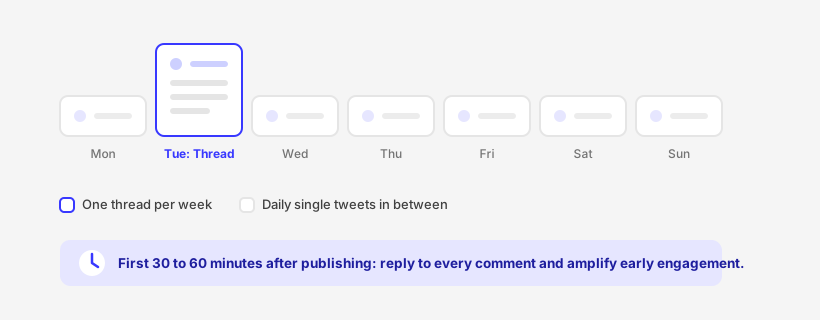
A sustainable rhythm for most accounts: one well-crafted thread per week, supported by daily single tweets that keep you visible and in conversations between threads. The single tweets do the relationship-building and the threads do the audience-building. This division of labor is more durable than trying to make every post a magnum opus.
Timing matters because of how the algorithm front-loads distribution. Twitter/X decides how aggressively to push a piece of content largely based on engagement velocity in the first 30 to 60 minutes. Publish when your specific audience is most active so that early window catches the most eyes. For many audiences that is Tuesday through Thursday, roughly 8am to 10am in their primary timezone, but your own analytics will tell you the truth better than any general rule. Publish, then stay present for the next half hour to an hour: reply to every comment, thank the early sharers, and keep the conversation alive. That early reply activity is itself a strong quality signal that extends distribution, so the engagement phase is not optional housekeeping, it is part of the strategy.
Repurposing a Thread Into Other Formats
A thread is one of the highest-effort formats you will produce, which makes it one of the best candidates for repurposing. The research, the structure, and the writing have already been done; squeezing a single thread into a feed and then letting it disappear is leaving most of the value on the table. A 10-tweet thread can become a LinkedIn carousel where each tweet becomes a slide, a newsletter section, a blog post section, a short video script, and a set of standalone single tweets pulled from the strongest individual lines.
The mindset shift is to treat the thread not as a one-time post but as a content seed. Each platform has its own conventions, so a straight copy-paste underperforms; the thread needs light adaptation to fit where it lands. Our guide on how to repurpose content across social media walks through the full workflow, and how to adapt content for different platforms covers why a thread that crushes on X needs reshaping before it works on LinkedIn or Instagram. Because the audiences and norms diverge so sharply, it also helps to understand the platforms themselves; Twitter/X versus LinkedIn lays out exactly how differently the two reward content, which tells you how much to reshape.
This is where the workflow side of growth stops being a willpower problem and becomes a systems problem. Writing one great thread a week is sustainable; writing one great thread, then manually reformatting it for four other platforms, then remembering to publish each at the right time, is not. This is the reason a content calendar matters. Postprism lets you write a thread once, plan it on a calendar alongside the repurposed versions for every other network, schedule the whole set, and have it auto-publish across all nine platforms without you babysitting each post. You see your entire thread cadence laid out visually, you spot the gaps before they become dry weeks, and the repurposing pipeline runs as a plan rather than a scramble. If you are coordinating threads with content on other networks, our piece on building a cross-platform strategy ties the calendar approach together. AI platform-adaptation is available as an optional enhancement when you want a head start on reshaping a thread for LinkedIn, but the core value is simple: write once, schedule, publish everywhere, on a calendar you actually control.
Plan a week of threads from one calendar
Postprism schedules and auto-publishes your threads and the repurposed versions to 9 networks. Start free in minutes.
Measuring Thread Performance
You cannot improve what you do not measure, and most people measure the wrong things on threads. Likes feel good and tell you almost nothing about growth. The metrics that actually correlate with building an audience are different, and tracking them changes what you optimize for.
The Metrics That Matter
- Profile visits: The number of people who, after reading your thread, clicked through to your profile. This is the truest leading indicator of follower growth, because the profile visit is the step immediately before the follow. A thread with high profile visits but low follows means your profile is failing to convert; a thread with low profile visits means the content itself did not compel curiosity.
- Follows attributed to the thread: The follower gain in the 24 to 48 hours after publishing. For most accounts, a thread that adds 50 or more followers is performing very well. Track this per thread so you learn which topics and formats drive followers for your specific audience.
- Reply rate: Replies relative to impressions. A high reply rate signals the thread sparked genuine interest, and replies are weighted heavily by the algorithm. Threads that ask a good closing question tend to outperform here.
- Completion: How far down the thread readers actually get, visible through declining impressions or engagement per tweet as the thread runs. A sharp drop-off after tweet three tells you the body lost people; steady engagement to the end tells you the structure held.
- Hook impressions: The reach of tweet one is your baseline. Compared against follows and profile visits, it tells you whether your problem is reach (low hook impressions) or conversion (high impressions, low follows).
Iterating Based on the Data
The point of measurement is the feedback loop. If hook impressions are low, your hook or your timing needs work. If impressions are high but profile visits are low, your body is not compelling enough to make people curious about you. If profile visits are high but follows are low, fix your profile: the bio, the pinned tweet, the consistency of your recent posts. If completion drops off a cliff at a particular tweet, that tweet is your leak; rewrite it. Keep a simple running log of each thread with its type, hook, and these five numbers, and after ten threads you will see patterns that no generic advice could have told you, because they are specific to your audience.
Common Thread Mistakes and How to Fix Them
Most underperforming threads fail for a small set of recurring reasons. Here are the most common, each with the fix.
- A weak hook. The most expensive mistake, because it caps the reach of everything below it. Fix: write five hooks, lead with your single most surprising claim, and make it work as a standalone tweet.
- Two ideas crammed into one tweet. Readers cannot absorb either, and the screenshot test fails. Fix: enforce one idea per tweet, splitting any tweet that uses "and also" to introduce a second point.
- Burying the payoff. Saving the best material for the bottom where attention has decayed and few readers arrive. Fix: front-load your two strongest insights and let the back half reinforce.
- A link in the main thread. Suppressing the reach of your highest-visibility tweets. Fix: keep all main tweets link-free and put the link in the first reply.
- No call to action. Ending with "that is it" and hoping readers follow on their own. Fix: close with one specific, value-framed ask for the single outcome that matters most.
- Padding to hit a tweet count. Stretching a six-tweet idea into fourteen tweets, diluting density and training the audience to expect filler. Fix: let the content set the length, and cut any tweet that does not pass the screenshot test.
- Publishing and disappearing. Posting the thread and then ignoring the crucial first hour. Fix: block 30 to 60 minutes after publishing to reply to every comment and amplify early engagement.
- Decorative images in the body. Generic visuals that interrupt reading rhythm and signal padding. Fix: include images only when they teach something the text cannot, and reserve the strong visual for the hook.
Frequently Asked Questions
How long should a Twitter/X thread be?
Length should be set by the content, not by a target number. In practice, most high-performing threads land between 7 and 15 tweets. Under 5 tweets rarely earns the depth that justifies the thread format over a single post, and over 20 tweets is hard to keep dense and exceeds most readers' attention. If your idea genuinely needs more than 20 tweets, it is probably a blog post or newsletter piece that you can then tease as a shorter thread. The honest test is whether every tweet earns its place; if you are padding to hit a number, the thread is too long.
How do I write a thread hook?
Start with the single most surprising, specific, or counterintuitive claim you can make about your topic, and put it in tweet one so it works completely on its own. Use a proven pattern as scaffolding: a transformation ("I went from X to Y in Z, here is how"), a contrarian take ("everyone says X, they are wrong"), a numbered promise ("7 mistakes that kill your X"), or a mistake confession. Make it specific, with real numbers or named outcomes, create a little tension the reader wants to resolve, and promise a concrete payoff. Then write four more hooks and pick the strongest, because the first one you write is rarely the best.
Should I number the tweets in my thread?
Number them when your points are a discrete, parallel list (listicles, how-tos, sets of tips), because numbering gives readers a progress bar that reduces drop-off. Do not number them when the thread is a story or a building argument, where numbers feel mechanical and interrupt the flow. The rule of thumb: number a list, do not number a journey.
Where should I put the link in a thread?
Never in the main thread tweets. External links reduce a tweet's algorithmic distribution because the platform wants to keep users on-site, so a link in your hook or body suppresses the reach of your most important tweets. Instead, keep every main tweet link-free and place the link in a reply to your own first tweet, then reference it once in your closing tweet ("link in the first reply"). You get full native reach plus a clear path for readers who want to go deeper.
How often should I post threads?
One excellent thread per week is the sweet spot for most accounts, supported by daily single tweets that keep you in conversations between threads. Thread quality compounds and thread quantity does not, so resist the urge to post a rushed thread every day. The weekly thread builds your audience; the daily singles build your relationships. That division is far more sustainable than trying to make every post a major effort.
What is the best time to publish a thread?
For many audiences, Tuesday through Thursday between 8am and 10am in the audience's primary timezone delivers the strongest early engagement, but your own analytics are more reliable than any general rule. What matters most is engagement velocity in the first 30 to 60 minutes, because the algorithm front-loads its distribution decision on that early window. Publish when your specific audience is most active, then stay present to reply and amplify for the next half hour to an hour.
Should I use Twitter's native composer or a scheduling tool?
The algorithm does not distinguish between natively published and scheduled threads, so both work from a reach standpoint. The practical advantage of scheduling is that you write and review the entire thread before it goes live, which eliminates the typos and broken pacing that come from composing live. Drafting in a separate document first is best practice regardless. A tool like Postprism lets you write the thread, schedule it for your peak window, and auto-publish it, while also planning the repurposed versions for other platforms on the same calendar, so the whole cadence runs as a plan instead of a daily scramble.
How do I know if a thread performed well?
Look past likes. The metrics that matter for growth are profile visits (the step right before a follow), followers gained in the 24 to 48 hours after publishing, reply rate, completion, and hook impressions as your reach baseline. For most accounts, a thread that adds 50 or more followers is performing very well. If a thread generates well under your usual engagement, the hook or topic is the likely culprit; keep a simple log per thread so you can spot which formats and topics actually move followers for your specific audience.
Should I add images to my threads?
Add a strong image to the hook tweet almost always, because it increases the stop rate in the feed and lifts click-through into the full thread. Inside the body, add images only when they teach something the text cannot: a chart, a data screenshot, a process diagram. Decorative or generic images in the middle of a thread interrupt reading rhythm and signal padding, so they tend to hurt more than help. The test is simple: does this image convey information faster than words would? If yes, include it; if no, leave it out.
Can I reuse the same thread later?
Yes, and you should, with light updates. A high-performing thread can be refreshed with new examples or current numbers and reposted months later to reach the large share of your audience who never saw it the first time. Beyond reposting, repurpose it into other formats: a LinkedIn carousel, a newsletter section, a blog post, a short video script, and standalone single tweets pulled from its best lines. The research is already done, so the marginal effort of getting five more pieces of content from one thread is small, and a calendar-based workflow makes running that pipeline routine rather than a chore.


