
The Difference Between Cross-Posting and Content Adaptation
The mistake that quietly sabotages most cross-platform content strategies is treating social media as a single broadcast channel where the same words go out everywhere at once. The platforms are not different distribution pipes for the same fluid. They are different cultures with different norms, different reading speeds, different attention spans, and different ideas about what counts as good. LinkedIn is a professional conference. Twitter/X is a fast pub argument. Instagram is a glossy magazine. TikTok is a late-night variety show. Posting conference-speak into a pub, or pub arguments into a magazine, produces jarring results that underperform and can actively erode your credibility with each platform's native audience.

Cross-posting is the act of publishing identical content across multiple platforms with no changes. You write one caption, hit a button, and the same text and image land on nine networks. It is fast and it feels efficient, which is exactly why so many brands do it. The hidden cost is that the post is, by definition, optimised for none of the platforms it lands on. A 280-character take with a trailing link looks thin on LinkedIn, gets its link buried on Instagram (where in-caption links are not clickable), and feels robotic on Threads. The reach you lose is invisible because you never see the version that would have worked.
Content adaptation is the process of taking one underlying idea and reshaping its format, length, tone, hook, and visuals so that each version feels native to the platform it lands on. The idea stays constant. The delivery changes. Done well, an adapted post reads as if it was created specifically for that audience rather than translated from somewhere else, because in a real sense it was. This is the single highest-leverage shift you can make in how you publish, and it is the difference between a content calendar that compounds and one that quietly stalls.
The Real Cost of Copy-Pasting, in Concrete Terms
Imagine your core idea is: "Most teams confuse being busy with making progress." Here is what happens when you cross-post a single LinkedIn-shaped version of it everywhere.
- On LinkedIn it works. The 900-character post with a specific story and a closing question gets comments and reshares, because LinkedIn rewards substance and professional reflection.
- On Twitter/X the same 900 characters get truncated behind a "Show more" fold. The hook is buried in paragraph three. The algorithm reads the low dwell time and stops showing it. You lose the take that would have travelled.
- On Instagram there is no image, so the post barely registers in a visual feed. The caption that felt tight on LinkedIn reads as a wall of text under a stock graphic. The link you added is not clickable.
- On TikTok there is nothing to post at all, because the network is video-first and a text block has no home there.
One post, four very different outcomes, three of them quietly bad. The copy-paste did not fail loudly. It failed silently, which is worse, because nothing told you to fix it. This is the core argument for adaptation: the cost of cross-posting is not a penalty you can see in your analytics. It is the reach, engagement, and follower growth you never earned. For a full system on turning a single piece into many native versions, see How to Repurpose One Post Across 5 Social Media Platforms.
Key takeaway: Cross-posting optimises for your time. Adaptation optimises for your audience. The first feels efficient and underperforms everywhere. The second takes minutes more per platform and compounds for years.
A Repeatable Adaptation Framework
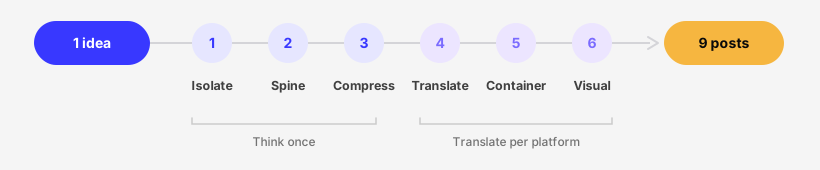
Adaptation sounds like it should be slow and artisanal, a bespoke rewrite for every network every time. It is not, if you have a process. The goal is a repeatable pipeline that takes one core idea and ships native versions everywhere without starting from a blank page nine times. Here is the framework, in six steps.
Step 1: Isolate the core idea in one sentence
Before you write anything platform-specific, force the idea down to a single, unhedged sentence. Not a paragraph, not a topic, a sentence with a verb and a claim. "Reversibility, not stakes, should decide how fast you make a decision." "Founders should write the way they talk, not the way they think they should write." If you cannot state the idea in one sentence, you do not yet have a piece of content, you have a vibe. The single sentence becomes the constant that every platform version must preserve.
Step 2: Choose the spine platform
Pick the one platform where this idea naturally lives the largest, most complete version of itself. For a substantive professional insight, that is usually LinkedIn or a Twitter/X thread. For a visual or emotional idea, it might be Instagram or TikTok. Write the full, native version for that spine platform first. This becomes your source of truth, the version with all the substance, the framework, the example, the story. Every other version is a compression or a translation of it.
Step 3: Compress to the sharpest version
Now write the single-tweet or single-line version: the hardest, most defensible compression of the idea that can stand entirely alone. This is your test of whether the idea is actually good. If the idea is boring at 280 characters, it was boring at 900 and you were hiding it behind nuance. The compressed version becomes the hook bank you draw from for every other platform's opening line.
Step 4: Translate the tone for each culture
Take the spine version and shift its register for each platform's culture without changing the idea. LinkedIn gets professional grounding. Twitter/X gets sharpened opinion. Instagram gets warmth and a first-person opening. TikTok gets a spoken, slightly informal hook in the first two seconds. Threads gets a conversational, lowercase-friendly tone. You are not rewriting from scratch. You are turning the same dial up or down.
Step 5: Build the platform-native container
Decide the format each version lives in: a paragraph-broken post, a numbered thread, a carousel, a 30-second Reel script, a vertical Short, a Pin with a tall graphic. The container is as much a part of the adaptation as the words. The same idea can be a LinkedIn text post, a Twitter/X thread, an Instagram carousel, and a TikTok talking-head, and each container forces different choices about pacing and emphasis.
Step 6: Match the visual and the link norms
Finally, attach the right visual and follow each platform's link conventions. LinkedIn tolerates a link in-post but prefers it in the first comment. Instagram links are not clickable in captions, so you point to the bio or a Story sticker. Pinterest is the link, the whole point is the click-through. Threads and Bluesky handle links in-post fine. Get this layer wrong and a perfectly adapted message still leaks reach.
Run those six steps and a single idea becomes nine native posts in a fraction of the time it would take to write nine from scratch, because steps 1 to 3 are done once and steps 4 to 6 are mechanical adjustments. The whole pipeline is the practical core of a cross-platform content strategy that scales.
Plan every platform from one calendar
Postprism schedules and auto-publishes to all 9 networks from a single content calendar. Start your 7-day free trial.

Per-Platform Adaptation Playbooks
This is the heart of the work: knowing exactly how each platform wants the same idea served. Below is a deep playbook for each of the nine networks, covering format, ideal length, tone, hook style, hashtag and link norms, and visual conventions. Read these as recipes, not rules. The point is to internalise each platform's grammar so adaptation becomes second nature.
LinkedIn: professional, educational, substantive
LinkedIn content is judged against a single silent question in the reader's head: "Is this useful for my career or business?" Content that passes gets engaged with. Content that does not, however interesting elsewhere, gets scrolled past. The tonal register is confident but not arrogant, specific but not jargon-heavy, personal but professionally anchored.
The structural pattern that works is the broken-line opener. Your first line and second line each sit on their own, because LinkedIn truncates the preview after roughly two lines and the reader decides in that moment whether to tap "see more." Front-load the most surprising part of the idea there. A post about resilience should anchor to a concrete professional moment, a failed launch, a hard client call, a strategic mistake, rather than abstract psychology. The abstraction fit for a personal blog feels distant on LinkedIn; the specificity fit for a case study feels too narrow. LinkedIn lives in the middle: specific enough to feel real, general enough to apply.
- Length: 800 to 1,400 characters for standard posts; document carousels for deeper teaching
- Format: short paragraphs, generous white space, a broken-line hook, occasional lists
- Tone: confident, educational, grounded in lived professional experience
- Hook style: a counterintuitive claim or a specific situation ("The worst hire I ever made looked perfect on paper.")
- Hashtags and links: three to five hashtags maximum; put external links in the first comment to protect reach
- Visuals: clean document carousels, simple data graphics, or a single relevant photo; avoid busy stock imagery
For a complete structural breakdown, see the perfect LinkedIn post formula.
Twitter/X: sharp, direct, opinionated
Adapting an idea for Twitter/X means radical compression and opinion sharpening. Take the single most striking sentence from your spine version and make it the entire tweet. Everything else is cut or saved for a reply or a thread. LinkedIn can afford nuance and multiple perspectives; Twitter/X cannot, because the format is too compressed for nuance to survive the first read. Ask yourself, "What is the hardest, most defensible version of this idea?" and lead with that. Qualifications go below the fold.
Single tweets work for a complete, standalone take. Threads work when the idea has genuine depth and a sequence: a hook tweet that promises a payoff, then one clear point per tweet, then a closing tweet that summarises and asks for a reply or reshare. The hook tweet does all the heavy lifting; if it does not earn the tap, the rest is never read.
- Length: 200 to 280 characters for single posts; 6 to 12 tweets for a thread
- Format: no paragraph breaks in single tweets; one idea per tweet in threads, numbered if it aids skimming
- Tone: sharp, direct, willing to take a position and provoke a reply
- Hook style: the most striking claim you can defend, often phrased as a contrarian truth
- Hashtags and links: zero to one hashtag; links suppress reach, so put them in a reply, not the main tweet
- Visuals: optional; a chart, screenshot, or single bold image can lift a thread's first tweet
For where the same effort pays off most between these two networks, see Twitter/X vs LinkedIn: where to focus your content.
Instagram: visual-first, emotionally resonant
Instagram inverts the normal creation order. On LinkedIn and Twitter/X the text is primary and the image is support. On Instagram the image is primary and the caption provides context and depth to an impression the visual has already made. Adapting for Instagram means starting with the visual concept, then writing the caption to it. There are four distinct surfaces, and each adapts the idea differently.
- Feed posts are a single strong image plus a caption. The first line of the caption is the hook (the rest collapses behind "more"), and the tone runs warmer and more personal than LinkedIn.
- Carousels turn an idea into a swipeable teaching sequence: a bold cover slide that states the promise, one point per slide, and a final slide with a call to save or follow. This is where substantive ideas thrive on Instagram.
- Reels are short vertical video. The idea becomes a 15 to 45 second spoken hook plus payoff, with the first two seconds earning the watch. Captions and on-screen text reinforce the spoken line.
- Stories are ephemeral and intimate. Use them for the behind-the-scenes, the poll, the quick reaction, and the link sticker that captions cannot carry.
- Length: caption hook in the first 125 characters; 5 to 10 carousel slides; 15 to 45 second Reels
- Tone: warm, human, a degree of vulnerability LinkedIn and Twitter/X rarely allow
- Hashtags and links: 3 to 8 relevant hashtags; captions cannot hold clickable links, so use the bio link or a Story link sticker
- Visuals: high-contrast, on-brand, readable on a small screen; abstract imagery that conveys a feeling beats literal illustration
Facebook: conversational, community-driven
Facebook sits tonally between LinkedIn and Instagram: more personal than LinkedIn, less aesthetic than Instagram. It rewards content that sparks conversation in comments, particularly within Groups and among an established community. Adapt your idea into a slightly more casual, story-led version, often a touch longer than Twitter/X but shorter than LinkedIn, and end with a genuine question. Native photos and short native video outperform shared links, because Facebook's algorithm dampens reach on posts that send people off-platform.
- Length: 100 to 250 words; shorter for higher reach, longer when storytelling
- Tone: conversational, warm, community-minded
- Hashtags and links: hashtags add little; prefer native media over external links, and put links in a comment when needed
- Visuals: native photos and short video; avoid link-preview-only posts
TikTok: hook-driven, native, entertaining
TikTok is video-first and unforgiving in its first two seconds. The same idea becomes a spoken hook that creates an open loop ("Most people get decision-making completely backwards, here is the fix"), then a fast payoff, then a reason to rewatch or comment. The aesthetic is native and unpolished; over-produced corporate video underperforms a phone-shot talking head with a strong hook. Trends, sounds, and on-screen captions are part of the grammar, not decoration.
- Length: 15 to 60 seconds for most ideas; the hook lives in seconds zero to two
- Tone: energetic, spoken, slightly informal, native to the platform
- Hashtags: a small mix of broad and niche tags; lean on trending sounds where they fit
- Visuals: vertical, captioned, fast-cut; authenticity beats polish
YouTube: Shorts and community posts
YouTube hosts two adaptation surfaces beyond long-form. Shorts behave like TikTok: vertical, hook-first, 15 to 60 seconds, with the opening line carrying everything. Community posts are text, poll, and image updates to your subscriber base, closer to a Facebook or Threads register, useful for testing ideas, teasing a long-form video, or asking your audience a direct question. The same core idea can be a Short that hooks new viewers and a community post that deepens the relationship with existing ones.
- Length: Shorts 15 to 60 seconds; community posts a tight paragraph plus an optional poll
- Tone: Shorts spoken and punchy; community posts conversational and direct to subscribers
- Visuals: Shorts vertical and captioned; community posts a single clear image or poll
Threads: conversational, low-friction, text-native
Threads rewards a relaxed, conversational tone closer to early Twitter/X than to the sharpened-take culture X has now. Lowercase, plain-spoken, reply-friendly content thrives. Adapt your idea into a short observation that invites a back-and-forth rather than a definitive pronouncement. Links work in-post without the heavy reach penalty X applies, but the culture still favours native discussion over broadcasting.
- Length: 1 to 3 short paragraphs; chains for longer thoughts
- Tone: casual, human, conversational, low-ego
- Hashtags and links: hashtags are light-touch; links are fine in-post
- Visuals: optional; a single image or none, text carries the post
Pinterest: search-driven, evergreen, click-out
Pinterest is not a social feed, it is a visual search engine, and that changes everything about adaptation. The same idea becomes a tall, text-overlaid graphic with a keyword-rich title and description, designed to be discovered months from now by someone searching the topic. The click-through is the entire point: every Pin should drive to a useful destination. Evergreen framing beats timely framing, because Pins compound slowly over a long tail.
- Length: short keyword-led title; 1 to 2 descriptive sentences with natural search terms
- Tone: helpful, descriptive, search-aware rather than opinionated
- Visuals: vertical 2:3 graphics with bold, readable text overlay
- Links: always link out; the destination is the purpose
Bluesky: early-adopter, candid, text-native
Bluesky's culture echoes early Twitter/X: candid, technically literate, allergic to marketing-speak, and quick to reward genuine voices. Adapt your idea into an honest, slightly more raw version than you would post on LinkedIn, with links working freely in-post. The audience skews toward people who value substance and authenticity over polish, so the sharpened-but-sincere register works best.
- Length: single posts up to roughly 300 characters; threads for depth
- Tone: candid, sincere, opinion-friendly without being performative
- Links and hashtags: links fine in-post; hashtags emerging but light-touch
- Visuals: optional; text-led culture
Platform Specification Comparison
The playbooks above contain the detail. This table is the reference card you keep open while you adapt, so you can match length, format, tone, and visual at a glance.
| Platform | Ideal length | Primary format | Tone | Best visual | Posting cadence |
|---|---|---|---|---|---|
| 800 to 1,400 characters | Text post or document carousel | Professional, educational | Document carousel or clean graphic | 3 to 5 times per week | |
| Twitter/X | 200 to 280 chars; 6 to 12-tweet threads | Single take or thread | Sharp, opinionated | Chart, screenshot, bold image | 1 to 5 times per day |
| Caption hook in 125 chars; 5 to 10 slides | Carousel, feed, Reel, Story | Warm, visual, personal | High-contrast image or short video | 3 to 5 times per week | |
| 100 to 250 words | Native post with photo or video | Conversational, community | Native photo or short video | 3 to 7 times per week | |
| TikTok | 15 to 60 seconds | Vertical video | Energetic, native, fun | Captioned phone-shot video | 4 to 7 times per week |
| YouTube | Shorts 15 to 60s; community a paragraph | Short video or community post | Punchy or direct-to-subscriber | Vertical captioned Short | 2 to 4 times per week |
| Threads | 1 to 3 short paragraphs | Text post or chain | Casual, conversational | Optional single image | 1 to 3 times per day |
| Short title; 1 to 2 sentence description | Vertical Pin graphic | Helpful, search-aware | 2:3 text-overlay graphic | 3 to 10 Pins per week | |
| Bluesky | Up to ~300 characters | Text post or thread | Candid, sincere | Optional single image | 1 to 3 times per day |
Tip: Cadence numbers are starting points, not quotas. It is far better to post three genuinely native pieces a week than seven copy-pasted ones. Volume without adaptation just spreads thin content wider.
Three Worked Examples: One Idea, Many Native Versions
Frameworks click when you see them applied. Below are three core insights, each written natively for four or more platforms. Notice that the one-sentence idea never changes, but almost everything around it does.
Worked example one: the decision-speed insight
Core idea: Reversibility, not stakes, should decide how fast you make a decision.
- LinkedIn: "The worst decision I made last year took 48 hours. The best took three weeks. The difference was not the stakes, it was the reversibility." Then a 1,000-character post that unpacks the framework, gives one concrete example from a real project, and closes with: "What is your rule for deciding how long to spend on a decision?"
- Twitter/X: "Most teams treat every decision as equally urgent. The real skill is knowing which to make in 10 minutes and which to spend 3 weeks on. The test is reversibility: fast on reversible, slow on irreversible. That is basically Amazon's whole framework."
- Instagram carousel: Cover slide: "Stop spending equal time on every decision." Slide two: the reversibility test. Slide three: a reversible example. Slide four: an irreversible example. Final slide: "Save this for your next big call." Caption opens warm: "I used to agonise over tiny decisions and rush the huge ones. Here is the fix that changed how my team operates."
- TikTok Short: "You are making decisions completely backwards, and here is how to fix it in fifteen seconds." Spoken payoff: fast on reversible, slow on irreversible, with on-screen captions and one clean example.
- Threads: "spent years thinking the big decisions were the ones to slow down on. turns out it is the irreversible ones, not the high-stakes ones. most high-stakes calls are actually reversible. anyone else learn this the hard way?"
Worked example two: the writing-voice insight
Core idea: Founders should write the way they talk, not the way they think they should write.
- LinkedIn: A grounded post: "I rewrote the same product announcement four times. Every version sounded more 'professional' and less like a human. The version that finally landed was the one I dictated out loud in two minutes." Followed by why corporate polish kills trust, and a closing question about the reader's experience.
- Twitter/X: "The fastest way to make your writing worse is to make it sound 'professional.' Write the way you talk. Read it out loud. If you would never say it to a smart friend, delete it."
- Instagram Reel: A 30-second talking-head: "Your writing sounds robotic and here is exactly why." Spoken explanation, captioned, ending on "read it out loud, that is the whole trick."
- Pinterest: A 2:3 graphic titled "Write the way you talk: 5 fixes for stiff business writing," linking to a longer guide, with a keyword-rich description for people searching "how to improve business writing."
- Bluesky: "the 'professional voice' most founders adopt is just fear wearing a tie. write like you talk. read it aloud. if you would not say it to a smart friend over coffee, cut it."
Worked example three: the busy-versus-progress insight
Core idea: Most teams confuse being busy with making progress.
- LinkedIn: "Our most productive quarter had the fewest meetings. That was not a coincidence." A post on the difference between activity and outcome, with one metric the team started tracking instead of hours, closing with a question.
- Twitter/X thread: Hook: "Busy is not the same as productive. A short thread on the trap that quietly kills startups." Then one point per tweet: the activity illusion, the outcome metric, the meeting audit, the weekly question to ask, a closing line inviting replies.
- Instagram carousel: Cover: "Busy is a decision, not a destiny." Five slides separating activity from outcome, ending on a save prompt.
- Facebook: A conversational, story-led version aimed at a founder community Group: "Be honest, how many of your meetings this week actually moved something forward? We cut ours in half and shipped more. Curious what others have tried." Ends with a genuine question to spark comments.
Three ideas, fourteen native posts, and not one of them is a copy-paste. The thinking happened once per idea; the rest was translation. For a deeper system on stretching a single source piece, revisit repurposing one post across platforms.
Keeping One Brand Voice Across Very Different Tones
The obvious worry about adaptation is that posting professionally on LinkedIn, sharply on Twitter/X, warmly on Instagram, and casually on Threads will fracture your brand into four different personalities. It will not, if you understand what voice actually is. Voice is your underlying perspective and values. Tone is the surface register you deliver them in. Voice is constant; tone flexes by platform.
Think of a sharp journalist who writes op-eds, news pieces, and a chatty newsletter. Each format sounds different, yet you can tell within a paragraph that it is the same writer, because the underlying way of seeing the world, the values, the recurring obsessions, the intellectual honesty, stay the same. Apply that to adaptation: your point of view, your principles, and your particular way of framing problems should be recognisable across all nine platforms even when length, format, and tone vary wildly.
Practically, define three things and apply them everywhere regardless of tone:
- Core beliefs: the two or three opinions you will defend in any register. These show up in every post no matter how casual or formal the wrapper.
- Vocabulary and metaphors: the words and analogies you reach for. Keeping these consistent makes a casual Threads post and a formal LinkedIn post feel like the same source.
- Values and lines you will not cross: what you stand for and what you refuse to do for engagement. This is the spine that keeps a sharper Twitter/X tone from tipping into something off-brand.
With those fixed, you can turn the tone dial freely. The LinkedIn version and the Threads version of the same idea will sound different, but a reader who follows you on both will feel they are hearing from one consistent mind. That recognisability across platforms is the entire payoff of doing adaptation rather than running four disconnected accounts.
Six Common Adaptation Mistakes and Their Fixes
Most adaptation problems are not subtle. They are the same handful of errors made over and over. Here are six, each with the fix.
Mistake 1: writing one version and trimming it for everywhere else
People write the LinkedIn post, then chop it to fit Twitter/X and Instagram. The result reads like a long post that has been amputated. Fix: compress to the sharpest standalone version first (step 3 of the framework), then expand outward. A great tweet expanded into a post beats a post hacked down into a tweet.
Mistake 2: keeping the same hook on every platform
A hook that works in LinkedIn's two-line preview dies as a TikTok opener and bores a Twitter/X reader. Fix: rewrite the first line for each platform's specific attention pattern. The LinkedIn hook earns a tap; the TikTok hook earns the first two seconds; the Twitter/X hook earns a stop in a fast feed. Same idea, different door.
Mistake 3: ignoring link norms
Dropping a clickable link in an Instagram caption (where it is not clickable), or a bare link in a main tweet (where it suppresses reach), quietly throttles otherwise good content. Fix: learn each platform's link convention and follow it. First comment on LinkedIn, reply on Twitter/X, bio or sticker on Instagram, in-post on Threads and Bluesky, the destination itself on Pinterest.
Mistake 4: forcing every idea onto every platform
Not every idea has a native home everywhere. A dense B2B pricing insight has no good TikTok form; a pure visual aesthetic idea has no good Twitter/X form. Forcing it produces awkward, off-brand posts. Fix: adapt an idea only to the platforms where it can be native. Three strong native versions beat nine, six of which are strained.
Mistake 5: matching format but not culture
You can get the length and structure right and still feel foreign because the tone is wrong for the culture: corporate stiffness on Threads, breezy informality on LinkedIn, hard selling on Bluesky. Fix: read the room before you adapt. Spend ten minutes scrolling each platform as a user, not a marketer, and absorb the register before you write for it.
Mistake 6: skipping the visual adaptation
Reusing one 16:9 graphic everywhere means it is cropped wrong on a vertical Reel, too small to read on Pinterest, and generic on Instagram. Fix: match the aspect ratio and visual style to each surface. A vertical 9:16 for Reels and Shorts, a tall 2:3 for Pinterest, a clean square or document for Instagram, a 16:9 for LinkedIn and Twitter/X. This is exactly the kind of per-platform image work a tool like Prismatic exists to handle.
Key takeaway: Almost every adaptation failure comes down to treating format as the whole job. Format is half. The other half is culture, hook, link norm, and visual fit. Get all four right and the post simply reads as native.
How Scheduling Tools and AI Speed Up Adaptation
Adaptation done by hand for nine platforms, several times a week, is real work. This is where tooling earns its place, not by removing your judgement but by removing the mechanical friction around it. The right workflow keeps the editor in control and lets software handle the repetition.
A scheduling tool's first job is to collapse nine separate publishing flows into one calendar. Instead of logging into nine apps, you draft once, hold a per-platform variant of the content side by side, and schedule the whole set from a single view. That alone is most of the time saving, because the cost of adaptation is rarely the thinking, it is the context-switching between nine interfaces.
The second job is per-platform editing in one place. A good tool gives you a tab or field per network so you can take your spine version, then tune the LinkedIn variant, sharpen the Twitter/X variant, and rewrite the Instagram caption without leaving the editor. The adaptation framework from earlier maps directly onto this: one draft, then mechanical per-platform translation, all in a single workspace.
AI fits in as an optional accelerant on top of that workflow, never as the author. Postprism's approach is to treat AI platform adaptation as an enhancement to a core scheduling workflow, not a replacement for your voice. You write the idea; the AI can propose a first-draft adaptation for each platform that respects that platform's length, tone, and format norms; and you, the editor, revise it to remove the generic quality AI drafts tend to have and to restore your actual voice. The control stays with you at every step. AI gives you a faster starting point for steps four and five of the framework; it does not get to decide what you believe or how you sound.
Used this way, the time per idea drops sharply. The thinking still happens in your head, the voice still comes from you, but the translation, formatting, image sizing, and scheduling, the parts that are genuinely mechanical, get compressed from an hour into a few minutes. That is the realistic promise of tooling here: not content written for you, but the friction around adaptation removed so that doing it properly for every platform stops being a reason to fall back on copy-pasting. You can start a free trial and run a single idea through the whole nine-platform flow to feel the difference.
Adapt once, publish everywhere
Write your idea once, tailor it per platform, and let Postprism publish to all 9 networks on schedule.
How to Measure Whether Your Adaptation Is Working
Adaptation is an investment, and like any investment you need to know whether it is paying off. The trap is judging every platform by the same yardstick. A LinkedIn post and a TikTok video that "perform well" look nothing alike in the numbers. Measure each platform against its own definition of good, and compare your adapted era against your copy-pasted era.
Per-platform KPIs and what good looks like
| Platform | Primary KPI | What good looks like | Leading signal of a strong adaptation |
|---|---|---|---|
| Comments and reshares | Comments from people not in your immediate network | High dwell time and "see more" taps on the hook | |
| Twitter/X | Reposts and replies | Replies that argue or build on your take | Strong impressions-to-engagement ratio on the lead tweet |
| Saves and shares | Saves on carousels, shares to Stories | Non-follower reach climbing on a post | |
| Comments and reactions | A live comment thread inside a Group | Native media reach beating your link-post reach | |
| TikTok | Watch time and completion | High completion rate and rewatches | Strong two-to-three second retention on the hook |
| YouTube | Shorts views; community votes | Shorts shown to non-subscribers; active poll voting | Swipe-away rate falling on Shorts |
| Threads | Replies | A genuine back-and-forth in the thread | Conversation depth, not just like count |
| Outbound clicks and saves | Steady click-through over weeks, not days | Pins resurfacing in search months later | |
| Bluesky | Reposts and replies | Reshares from accounts in your niche | Replies that treat you as a credible voice |
Two practical habits make this measurable rather than vague. First, run a before-and-after: pick a month of copy-pasted posting and a month of adapted posting and compare each platform's primary KPI. The lift from adaptation usually shows up clearest on the platforms furthest from where you originally wrote, your Instagram and TikTok numbers when you used to write LinkedIn-first, for example. Second, watch the leading signals in the right-hand column above. They move before the headline numbers do, so they tell you an adaptation is working while a post is still young, which lets you double down on the patterns that land.
The single most important comparison is non-follower reach. Across nearly every platform, the algorithm decides whether to show your content to people who do not yet follow you, and it makes that decision based on how native and engaging the content looks to existing viewers. Well-adapted content reads as native, earns early engagement, and gets pushed to non-followers, which is the entire growth mechanism. Poorly adapted content stalls inside your existing audience. If your non-follower reach rises across platforms after you start adapting, the work is paying off, regardless of what any single post's like count says.
Frequently Asked Questions
What is content adaptation in social media?
Content adaptation is the process of taking one core message and reshaping its format, length, tone, hook, and visuals so that it feels native to each platform you post it on. It is the opposite of cross-posting, where the identical post is broadcast everywhere unchanged. Adaptation keeps the underlying idea constant while changing the delivery: a 1,000-character LinkedIn post, a 280-character Twitter/X take, and a visual-first Instagram caption can all carry the same insight, yet each reads as though it was made specifically for that audience. That is why adapted content consistently outperforms copy-pasted content on every platform.
How different does the adapted content need to be?
Different enough to feel native, not so different that the underlying idea becomes unrecognisable. The core insight, your one-sentence idea, should stay the same across versions. The format, length, tone, hook, and visual language should change to fit each platform. A good test is to show your three or four versions to someone with no context and ask which platform each was written for. If they can identify the platform from the content alone, the adaptation is working. If every version looks interchangeable, you are still cross-posting with light edits.
Is it worth adapting content for platforms where I have a small following?
Yes, because adaptation quality directly affects how fast you grow on each platform. Generic, poorly adapted content underperforms and slows follower growth, regardless of audience size. Well-adapted content, even with a tiny following, is far more likely to be picked up by the algorithm and shown to non-followers, which is the actual mechanism of growth. Treat adaptation as an investment in each platform's long-term potential rather than an optimisation for the audience you have today. The platforms where you are smallest are often where good adaptation pays off fastest.
Can AI tools help with content adaptation?
Yes, and they are increasingly good at it, provided you treat them as a drafting accelerant rather than the author. Current AI writing tools can take a source piece and produce platform-adapted drafts when you specify the platform, format, tone, and length. The output usually needs editing to remove the generic quality AI text tends to have and to restore your actual voice, but it meaningfully speeds up the mechanical steps of the adaptation framework. The model gives you a faster starting point for each platform; you stay in control of the idea and the voice. That is exactly how Postprism positions its AI platform adaptation: an optional enhancement layered on a scheduling workflow where the editor remains in charge.
How do I maintain a consistent voice across platforms when the tone differs so much?
By separating voice from tone. Your voice is your underlying perspective, values, vocabulary, and way of framing problems, and it stays constant. Tone is the surface register, and it flexes by platform. A journalist who writes op-eds, news pieces, and a casual newsletter sounds different in each yet is recognisably the same writer, because the perspective underneath is consistent. Define two or three core beliefs, a set of recurring metaphors, and the lines you will not cross, then apply them everywhere. With those fixed, you can run a professional tone on LinkedIn and a casual one on Threads and still sound like one mind.
Should I post to every platform or focus on a few?
Focus beats spread, especially early. It is better to adapt genuinely native content for three platforms than to spread thin, half-adapted content across nine. Pick the two or three platforms where your audience actually is and where your content type has a natural home, and do those properly. As your system matures and adaptation becomes faster, you can expand. The decision of where to concentrate, particularly the professional-network question, is covered in depth in Twitter/X vs LinkedIn and in the broader cross-platform strategy guide.
How long does adapting one idea for all platforms actually take?
With the six-step framework and a scheduling tool, a single idea adapted to five or six platforms typically takes 20 to 40 minutes once you are practised, because the thinking happens once and the rest is translation. Without a process, the same work can take two hours, mostly lost to switching between platforms and starting from a blank page each time. The biggest time savings come from doing steps one to three (isolate, spine, compress) once, then treating the per-platform versions as mechanical adjustments rather than fresh writing. AI drafting can compress that further, leaving you to edit rather than originate each version.
Does adapted content hurt SEO or create duplicate-content problems?
No. Social platforms are not search-indexed the way web pages are, and the same idea expressed natively in different formats across networks does not trigger duplicate-content penalties. If anything, adaptation helps discoverability, because each native version is more likely to be surfaced and engaged with on its own platform. Pinterest is the one place where search wording matters directly, so there you should write keyword-aware titles and descriptions. Everywhere else, the concern is engagement and native fit, not search penalties.
What is the single highest-impact change if I only fix one thing?
Rewrite the first line for every platform. The hook is the highest-leverage element on every network, and it is the thing copy-pasting gets most wrong, because a hook tuned for one platform's attention pattern fails on the others. If you do nothing else, compress your idea to its sharpest single line, then craft a distinct opening for each platform: one that earns the "see more" tap on LinkedIn, one that stops the scroll on Twitter/X, one that earns the first two seconds on TikTok. Same idea, different door, and that one change alone meaningfully lifts performance across the board.
How do I know which platforms an idea should not be adapted for?
Ask whether the idea can live natively on the platform without being forced. A dense, text-heavy B2B insight has no honest TikTok form; a purely visual or aesthetic idea has no honest Twitter/X form; a timely hot take has little value on evergreen-driven Pinterest. If adapting an idea to a platform requires distorting it beyond recognition or producing something that obviously does not belong, skip that platform for that idea. Maintaining the standard that every post must feel native is more valuable than hitting all nine networks with every idea. Save the platform for an idea that fits it.


