
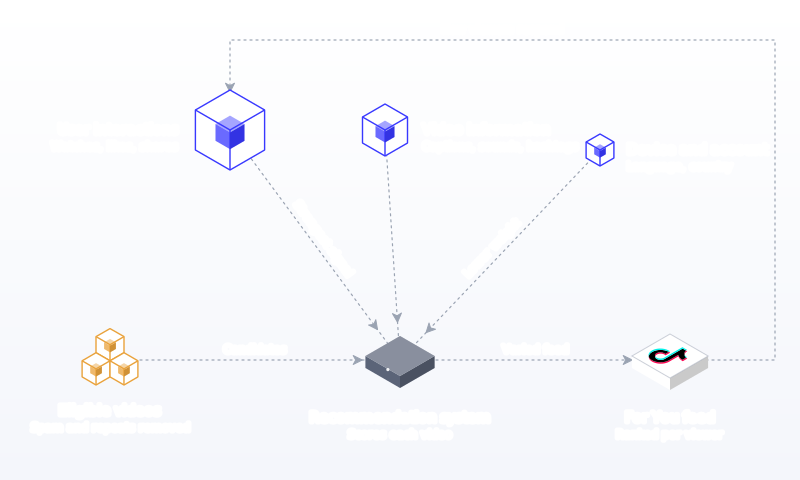
The TikTok algorithm ranks videos for each viewer using three groups of signals: what that viewer does (watches, rewatches, likes, shares, comments, follows, skips), information about the video (captions, sounds, hashtags) and lighter device and account settings. TikTok says follower count is not a direct ranking factor. Every video is judged on how real viewers respond.
That is the official version, and it is accurate as far as it goes. What it leaves out is how much the picture has shifted since TikTok first explained it in 2020: search has become a real traffic source, a Local feed launched in the US in February 2026, viewers can now dial down whole topics (including AI-generated video), and the US version of the recommendation system is being retrained by a new American joint venture. This guide separates what TikTok has officially said from what independent audits and large datasets show, breaks distribution down by surface, stage, format, account size and account type, and ends with a method you can run on your own analytics this week.
Key findings
- Followers are not a direct factor. TikTok states that neither follower count nor previous high-performing videos are direct factors in For You recommendations, although a bigger follower base can still mean more views.
- Strong signals outweigh weak ones. TikTok's own example: finishing a longer video counts for more than whether the viewer and creator are in the same country.
- Personalisation is only part of the feed. An audit of 347 real users' viewing histories found TikTok exploits known interests in between 30% and 50% of recommended videos in the first 1,000; the rest is exploration.
- Volume raises your ceiling, not your floor. Buffer's study of 11.4 million TikTok posts found median views per post stayed roughly flat (about 460 to 510) whatever the posting frequency, while the top 10% of posts rose from 3,722 views to 14,401.
- Small accounts lost reach in 2025. Socialinsider's benchmark of about 2 million videos shows average views per post for 1K to 5K follower accounts fell from 860 in 2024 to 350 in 2025, while 100K to 1M accounts rose from 25,198 to 34,900.
- Search is a real entry point. In Adobe's January 2026 survey, 49% of US consumers said they have used TikTok as a search engine, up from 41% in 2024.
- The US system is being rebuilt. TikTok's US joint venture said in January 2026 it will retrain, test and update the recommendation algorithm on US user data.
What's changed in 2026
Most TikTok algorithm guides still describe the 2020 newsroom explainer as if nothing has moved. The core logic has not changed, but the environment around it has. These are the changes that matter for anyone posting in late 2026, oldest first.
| Date | Change | What it means for reach |
|---|---|---|
| April 2025 | Footnotes test in the US (community-added context on videos) | Claims and statistics in videos can be annotated by other users; accuracy matters more for informational content |
| June 2025 | Manage Topics and Smart Keyword Filters | Viewers can turn whole categories up or down and filter synonyms of words they dislike |
| July 2025 | Content Check Lite in TikTok Studio on the web | Creators can check For You eligibility before posting |
| November 2025 | AI-generated content added to Manage Topics | Viewers can see less AI-generated video; AI-heavy accounts face a new filter |
| January 2026 | US joint venture formed; algorithm to be retrained on US data | US ranking may drift from the global system over time |
| February 2026 | Local feed launched across the US | A new surface that ranks by location, topic and recency |
The US joint venture and a retrained algorithm
On 22 January 2026, TikTok confirmed that TikTok USDS Joint Venture LLC had been established. Its statement, as reported by Social Media Today, said the venture "will retrain, test, and update the content recommendation algorithm on U.S. user data" and that the algorithm will be secured in Oracle's US cloud. Nobody outside the company knows how different the retrained model will be. What we do have is anecdote: in April 2026, Spectrum News spoke to US users and creators who described more repetitive recommendations and a drop in views on a song-cover account, with a project coordinator at Syracuse University's Center for the Creator Economy warning that falling views can reflect platform decisions rather than anything the creator did. Treat that as a reason to watch your own numbers closely, not as proof of a new ranking rule.
The Local feed
TikTok announced the Local feed on 11 February 2026 as a new tab on the home screen. It selects posts "based on location, the topic of the content, and when the content was posted." Content from under-18 accounts, private accounts and posts set to Friends or Only You does not appear. Precise location sharing is opt-in, limited to adults and off by default. TikTok framed the feed around local travel, events, restaurants, shopping and museums, and said 7.5 million US businesses use TikTok. For a restaurant, gym or shop, this is the first TikTok surface where recency and geography are stated ranking inputs.
Viewers got more control over what they see
In June 2025 TikTok added Manage Topics, which lets people adjust how often more than 10 popular topics (such as Creative Arts, Travel, Nature and Sports) appear, and Smart Keyword Filters that also catch synonyms. TikTok said keyword filters had already filtered over 200 million words globally and that it would double the keyword limit to 200. The same announcement said TikTok would interrupt frequent recommendations of content that is fine occasionally but may be problematic when seen repeatedly, with extreme fitness content as the example. In November 2025, AI-generated content joined Manage Topics as a slider. TikTok said the setting is meant to help people "tailor the diverse range of content in their feed, rather than removing or replacing content in feeds entirely," and announced invisible watermarks for AI content made with its own tools or uploaded with C2PA Content Credentials.
Eligibility checks moved before posting
In July 2025 TikTok introduced Content Check Lite, which lets creators check whether a video may be eligible for the For You feed before it goes live, starting with TikTok Studio on the web. TikTok said a similar pre-check for TikTok Shop sellers produced a 27% reduction in low-quality uploads. If you have ever posted a video that quietly got zero For You views, this is the tool to run first.
Community context on claims
Footnotes, announced in April 2025, lets approved US contributors add context to videos, such as correcting a misleading statistic. A footnote only becomes visible once contributors with differing views rate it helpful. It is not a ranking signal TikTok has described, but a visible correction under your video is not a good look for a brand that sells expertise.
How the TikTok algorithm works, according to TikTok
TikTok's foundational explainer, How TikTok recommends videos #ForYou, was published in June 2020 and remains the company's clearest public description of the system. Its main points are below, followed by what independent research adds.
| Signal group | What TikTok lists | How TikTok describes its weight |
|---|---|---|
| User interactions | Videos you like or share, accounts you follow, comments you post, and how much of a video you watch or replay | The main input; strong indicators such as finishing a longer video carry the most weight |
| Video information | Captions, sounds, hashtags | Used to understand what a video is about and who it suits |
| Device and account settings | Language preference, country setting, device type | Lower weight, because people do not actively express them as preferences |
Four other statements from that explainer still shape how creators should think:
- Follower count is not a direct factor. TikTok adds the honest caveat that an account with more followers may still get more views simply because more people follow it.
- The feed is deliberately varied. Your For You feed "generally won't show two videos in a row made with the same sound or by the same creator."
- Some things are never recommended. Duplicated content, content a viewer has already seen and spam are excluded.
- Exploration is built in. TikTok intentionally includes videos that do not match a viewer's stated interests, to help people discover new creators.
Two later official statements fill in the edges. In Europe, TikTok said in 2023 that users could turn off personalisation, in which case the For You feed shows popular videos from their local area and around the world, while Following and Friends show followed creators in chronological order. And in 2024 TikTok said its Creator Rewards Program pays only for videos over a minute long and prioritises four things: originality, play duration (watch time and completion), search value and audience engagement. That list is not the ranking formula, but it is the clearest statement TikTok has made about what it wants more of.
Plain-English version: TikTok shows a video to some people, watches what they do, and shows it to more people who look like the ones who responded well. Your follower count only matters because followers are often among the first people shown the video.
What independent research shows
Official explainers tell you what a platform wants you to believe. Audits tell you what the system does. Two peer-reviewed studies are worth knowing.
Following and liking move the feed most
Maximilian Boeker and Aleksandra Urman ran a sock-puppet audit, published at The Web Conference 2022, testing language, location, following, liking and watch time. They found all of the tested factors influence recommendations, with "the follow-feature" having the strongest influence, followed by likes and video view rate. For creators, the implication is subtle: a follow does not just add one viewer to your audience, it changes what that person's feed looks like, including how often your next video is shown to them.
Between 30% and 50% of the feed is exploitation
Karan Vombatkere and colleagues analysed data donated by 347 real TikTok users, covering 4.9 million videos viewed 9.2 million times. Their 2024 paper estimates TikTok exploits a user's known interests in between 30% and 50% of the first 1,000 recommended videos. The rest is exploration, which is exactly where unknown creators get their chance. They also compared the most and least personalised users: the most personalised had liked 14% of videos (versus 3%) and had about 30% of their feed from followed creators (versus 2%). Watch percentage differed less (93% versus 84%) and early skip rate did not differ significantly.
That does not mean watch time is unimportant. It means that, from the viewer's side, liking and following are the actions that most sharpen what TikTok shows them. From the creator's side, every viewer who likes or follows becomes a more reliable future audience for your videos.
| Question | What TikTok says | What research and data show | Practical verdict |
|---|---|---|---|
| Do followers matter? | Not a direct factor | Follows are the strongest personalisation signal in the 2022 audit; larger accounts gained views in 2025 while small ones lost | Followers do not unlock reach, but they make your first test audience warmer |
| Is watch time everything? | Finishing a longer video is a strong signal | Watch percentage separated users less than likes and follows in the 2024 audit | Completion gets you through tests; likes, shares and follows build lasting audience |
| Does the feed only show what I like? | Diversity and exploration are built in | 30% to 50% exploitation in the first 1,000 videos | Half or more of every feed is open to creators the viewer has never seen |
| Does posting more help? | Not addressed | Median views flat; top posts much higher at higher cadence (Buffer, 11.4M posts) | More videos means more chances at a breakout, not more views per average post |
| Is there a points system? | Never confirmed | Industry guides such as Hootsuite's note TikTok has not confirmed any point weighting | Ignore anyone quoting exact point values for likes or shares |
The algorithm by surface
"The TikTok algorithm" is really several ranking systems sharing data. Each surface uses a different mix of signals, and a video can succeed on one while failing on another.
| Surface | Who sees your video | Main ranking inputs | What to optimise |
|---|---|---|---|
| For You | Anyone, follower or not | Predicted interest from interactions, video information, settings | Hook, completion, shares, rewatches |
| Following and Friends | People who follow you or are mutual connections | Relationship; chronological in the EU's non-personalised mode | Consistency, recognisable series |
| Search | People typing a query | Text match from caption, on-screen text and speech, plus engagement | Spoken and written keywords, evergreen topics |
| Local | Nearby adults who opted in to location | Location, topic and recency, per TikTok | Location tags, timely local content |
| Profile | People who tap through from a video | Your grid, pinned videos, bio | Pinned videos that explain what you post |
For You feed
This is where most views come from for most accounts, and it is the surface everything above describes. The important practical point is that For You is a prediction per viewer. Your video does not have a single score; it has a different predicted value for every person it could be shown to. That is why a video can be a dud with one audience and take off a week later when it reaches a group that responds better.
Following and Friends
Following is the closest thing TikTok has to a traditional feed. It is a minority of most people's viewing, but it is where loyal viewers catch every video in a series. A recurring format ("Fixing your houseplant mistakes, part 14") gives followers a reason to check this tab and gives TikTok a clean signal that your audience returns.
Search
TikTok search is no longer a novelty. Adobe's January 2026 survey of 807 US consumers found 49% have used TikTok as a search engine, and 61% preferred video tutorials as a content type. The same survey adds a useful reality check: the share of Gen Z who said they rely on TikTok more than Google fell from 8% in 2024 to 4% in 2026. People use TikTok search alongside Google, mainly for how-tos, reviews and recommendations. Videos built around a searchable question keep collecting views for months, long after their For You push ends. TikTok itself tells creators that Creator Rewards favours content aligned with popular search terms.
Local feed
The Local feed is the newest surface and, for physical businesses, the most promising. Because TikTok names recency as an input, a café posting "today's specials" content has a reason to post on the day rather than batch a month of evergreen clips. Location must be relevant to the video; a generic product video tagged to a city is unlikely to satisfy viewers who opened a tab specifically for local content.
Profile visits
Profile views do not rank anything directly, but they convert a single viewer into a follower. A viewer who taps through to a messy grid of unrelated videos leaves. A viewer who finds three pinned videos that explain your series follows. Since follows are the strongest personalisation signal in the research above, the profile is where For You reach turns into durable audience.
The algorithm by stage of distribution
TikTok has not published a stage-by-stage distribution model, so treat this as a practical framework built from TikTok's statements and creator observation, not an official pipeline.
Stage 0: Eligibility
Before any ranking, a video must be eligible for For You. TikTok excludes duplicated content and spam, and its eligibility standards keep content unsuitable for a general audience out of recommendations. Reposts with another app's watermark, content lifted from other creators and content under review fall at this step. Content Check Lite in TikTok Studio is the official way to check before posting.
Stage 1: The first audience
A new video is shown to a small group. Practitioners disagree on exactly who. Some, such as Micky Weis in a 2026 guide, describe followers as the primary initial testing audience; this is reported, not confirmed by TikTok or backed by published data. What is consistent with both TikTok's statements and the audits is that the first viewers are people the system predicts will be interested, which often includes followers and viewers of similar content.
Stage 2: Expansion
If the first audience watches through, rewatches, shares, comments or follows at a better rate than comparable videos, TikTok shows it to more people with similar interests. If they swipe away early or tap Not Interested, distribution slows. This can repeat in widening rings.
Stage 3: Plateau and the long tail
Eventually the video reaches people who are less interested, response rates fall and the For You push fades. For many videos that is the end. For videos that answer a searchable question or suit the Local feed, a long tail of search and local views can continue for weeks. TikTok's "already seen" and anti-repetition rules also mean a viewer who has seen your video will not be shown it again, so re-posting the same file rarely helps.
| Stage | Typical timing | Signal to watch in analytics | If it stalls here |
|---|---|---|---|
| Eligibility | Before and at upload | Zero or near-zero For You views; account status notices | Run Content Check Lite; remove watermarks and borrowed clips |
| First audience | First hours | Average watch time and retention in the first seconds | Rework the hook and first frame |
| Expansion | First one to three days | Shares, follows from the video, completion rate | Tighten the middle; add a reason to share |
| Long tail | Weeks to months | Search traffic and search terms | Add spoken and on-screen keywords next time |
The algorithm by content format
Different formats send different signals, and TikTok rewards them for different reasons.
Short videos under a minute
Short videos make completion easy. A 12-second video that loops cleanly can rack up rewatches, which is one of the strongest signals TikTok describes. The risk is that a short video gives little room to deliver value, so share and follow rates can be low. Short videos suit trends, quick tips and visual payoffs.
Videos over a minute
TikTok has openly pushed longer content. Creator Rewards only pays for videos over a minute long and names play duration and search value among its priorities. Longer videos rarely achieve high completion, but they earn more total watch time per viewer and work well for tutorials, explainers and stories. The test is not length but density: every 10 seconds must earn the next 10.
Photo posts and carousels
Photo posts let viewers swipe at their own pace and often carry auto-added music. They suit step-by-step guides, lists and before-and-after content, and they are cheap to produce. Our guide to making TikTok slideshows covers formats that work. Creator Rewards only counts videos over a minute, so creators who rely on it should keep video as the core and use photo posts as a supplement.
LIVE
LIVE has its own feed and its own recommendations, and in the EU's non-personalised mode TikTok said LIVE also shows popular content from the local area and globally. LIVE is a relationship format: it rewards accounts that already have an audience and is a poor first move for a new account.
| Format | Strongest signals it produces | Best use | Watch out for |
|---|---|---|---|
| Video under 1 minute | Completion, rewatches | Trends, tips, visual payoffs | Low follow rate if there is no clear series |
| Video over 1 minute | Total watch time, search value, saves | Tutorials, explainers, stories | Mid-video drop-off from slow pacing |
| Photo post | Swipe-through, saves, shares | Lists, guides, before and after | Monetisation limits; weak first slide |
| LIVE | Time spent, gifts, comments | Q&A, launches, community | Needs an existing audience |
The algorithm by account size
TikTok's insistence that followers are not a ranking factor is true per video. Across a year, though, account size clearly changes outcomes. Socialinsider's benchmark of about 2 million videos from 214,507 profiles (January 2024 to December 2025) shows a widening gap.
| Followers | Avg views per post, 2024 | Avg views per post, 2025 | Avg posting frequency, 2024 to 2025 |
|---|---|---|---|
| 1K to 5K | 860 | 350 | 6 to 8 |
| 5K to 10K | 1,575 | 945 | 7 to 12 |
| 10K to 50K | 3,655 | 3,240 | 9 to 16 |
| 50K to 100K | 8,688 | 9,900 | 11 to 18 |
| 100K to 1M | 25,198 | 34,900 | 15 to 23 |
Source: Socialinsider 2026 TikTok Benchmarks. The same report found average posting frequency rose 40% across the sample, engagement rate by views rose from 3.85% to 4.20% in 2025 before dipping back to 3.85% in Q2 2026, and follower growth rates fell in every tier.
New and small accounts (under 10K)
Views per post fell sharply for small accounts in 2025 even as they posted more often. One reading: there is simply more competition from accounts posting more, and the exploration slots are being shared among more videos. The fix is not more volume alone. Small accounts need sharper topic focus so their first test audiences are the right people, and they need searchable videos that keep earning after the For You push fades.
Mid-sized accounts (10K to 100K)
Mid-sized accounts held roughly steady or grew. They have enough followers that their first audience is usually warm, but not so many that every video is guaranteed a big first wave. The lever here is series formats that bring viewers back and convert For You viewers into followers.
Large accounts (100K and above)
Large accounts gained views and shares. Socialinsider found shares per post for 100K to 1M accounts rose from 330 to 477. Large accounts benefit from a warm first audience, but they also face a risk smaller accounts do not: if they drift from the topics their audience followed them for, that warm audience responds coldly and the video stalls early.
Posting frequency by size
Buffer's analysis of 11.4 million posts from over 150,000 accounts found accounts posting 2 to 5 times a week got 17% more views per post than once-a-week accounts, rising to 29% at 6 to 10 posts and 34% at 11 or more. Buffer notes the sample skews toward small and medium businesses using its platform. The useful finding is the distribution: median views barely moved, but top-performing posts rose sharply with cadence. Posting more buys more lottery tickets; it does not make each ticket better. Our guide on how often to post on social media compares cadence across networks.
The algorithm by account type and goal
The ranking system is the same for everyone, but what counts as success, and therefore what you should optimise for, differs.
Creators
Creators living on TikTok income should optimise for what Creator Rewards pays for: videos over a minute, original, with strong play duration and search value. Search and Local traffic still matter, because they keep older videos working and bring in viewers who arrive with a clear need.
Consumer brands
Brands get the most from shares and saves, because both signal content people want to keep or pass on, and both survive the move from For You into private messages. Socialinsider's 2025 data shows shares per post grew faster than comments in most follower tiers, which matches what most brand accounts see: people send good brand content to friends rather than commenting on it.
Local businesses
Restaurants, salons, gyms and shops now have the Local feed, where recency and location are named inputs. That changes the content mix: some same-day, location-specific posts on top of evergreen content. Our guide to social media for restaurants has planning ideas that translate well.
B2B and professional services
B2B accounts rarely win on trends. They win on search: "how to file a VAT return as a freelancer" or "what is a fractional CFO" are real queries, and Pew found that 55% of adult TikTok users regularly get news there, up from 22% in 2020, which shows how far TikTok has moved beyond entertainment. B2B teams usually get more from LinkedIn's algorithm for pipeline, and use TikTok for reach among younger buyers and hires.
| Account type | Primary goal | Signal to optimise | Surface to prioritise |
|---|---|---|---|
| Creator | Income and audience | Play duration, originality, follows | For You |
| Consumer brand | Awareness and sales | Shares, saves, profile visits | For You and Search |
| Local business | Foot traffic | Recency, location relevance | Local and Search |
| B2B or services | Trust and leads | Search value, watch time on explainers | Search |
Who is on TikTok, and why it matters for ranking
The algorithm can only show your video to people who use the app. According to Pew Research Center's 2025 survey, 32% of US adults use TikTok, rising to 63% of adults aged 18 to 29. The same 2025 Pew news study found 43% of adults under 30 regularly get news on TikTok. If your buyers are over 50, TikTok's algorithm can work perfectly and still show your video mostly to people outside your market. Compare platforms before committing; our explainers on how the Instagram algorithm works and the broader guide to social media algorithms help with that decision.
A step-by-step method to diagnose your own TikTok distribution
General advice only goes so far. This method uses your own analytics to find where your videos stall, then fixes one thing at a time. It takes about an hour to set up and 15 minutes a week to run.
- Pull your last 20 videos. From TikTok Studio, record for each: views, average watch time, completion rate, shares, saves, follows from the video and the traffic source breakdown TikTok shows for each video (how much came from For You, search, your profile and followers). Twenty videos gives you enough to see patterns without going back to old content that no longer reflects your style.
- Find your medians. Calculate the median views, median completion rate and median shares. Use medians, not averages, because one viral video wrecks an average. Buffer's data shows exactly this: medians are stable, outliers swing wildly. Our TikTok engagement calculator speeds this up, and the TikTok metrics and KPIs guide explains each number.
- Sort videos into stall points. Videos with near-zero For You views likely failed eligibility. Videos with low retention in the first seconds failed the first audience. Videos with decent completion but low shares and follows stalled at expansion. Videos with rising search traffic are in the long tail.
- Check eligibility first. For any video in the first group, run Content Check Lite and check your account status. Fixing an eligibility problem is worth more than any hook.
- Rewrite the first two seconds. For first-audience failures, compare the opening frame and line of your top three and bottom three videos. Write the difference down as a rule.
- Add one shareable element. For expansion failures, add a reason to send the video: a list worth keeping, a surprising fact, a reaction someone will recognise in a friend.
- Turn your search winners into a series. Any video with meaningful search traffic is evidence of demand. Make two follow-ups on the same query, say the keyword in the first sentence and put it on screen.
- Set a cadence you can hold for 8 weeks. Buffer's data suggests 2 to 5 posts a week is where the biggest jump happens. Pick a number you can sustain. Batch-film once a week and schedule the posts so publishing does not depend on your energy that day; see our batch content creation guide.
- Change one variable at a time. If you change hook style, length and posting time in the same week, you learn nothing. Change one, run it for at least six videos, compare medians.
- Review monthly, not daily. Individual videos are noisy. Monthly medians tell you whether a change worked.
Worked example: a neighbourhood bakery's eight-week plan
Consider a fictional bakery, Crumb and Co, with 2,400 followers, posting once a week, median 380 views. Its analytics show most videos get a short For You burst and almost no search traffic. One exception, "why your sourdough is flat," has gained search views for two months.
| Week | Plan | Why, in algorithm terms |
|---|---|---|
| 1 to 2 | Three posts a week: two sourdough troubleshooting videos (searchable), one same-day Local post about the morning bake | Moves from 1 to 2 to 5 posts a week, where Buffer saw the biggest jump; uses proven search demand; tests the Local feed |
| 3 to 4 | Introduce a named series, "Flat Bread Fixes," with a pinned explainer on the profile | Series gives For You viewers a reason to follow; pinned video converts profile visits |
| 5 to 6 | Test 70 to 90 second tutorials against 20 second versions of the same fix | One variable at a time; longer videos compete on total watch time and search value |
| 7 to 8 | Keep the better length; add one photo post per week with a printable checklist | Photo posts drive saves and shares; cheap to produce |
The bakery is not chasing a viral moment. It is building three things the system can use: a clear topic for first-audience matching, search demand that keeps paying out, and a series that converts viewers into followers.
Copy-ready hook templates
| Goal | Template | Example |
|---|---|---|
| Search | "[Exact question], here is the fix." | "Why is my sourdough flat? Here is the fix." |
| Completion | "[Result] in [time]. Watch the last step." | "Bakery-level crust at home. Watch the last step." |
| Shares | "Send this to the person who [relatable habit]." | "Send this to the person who opens the oven every five minutes." |
| Follows | "Part [n] of [series]: [specific promise]." | "Flat Bread Fixes, part 6: the shaping mistake." |
| Local | "[Today] at [place]: [timely thing]." | "Saturday at Crumb and Co: cardamom buns until 11am." |
Our TikTok caption generator and hashtag generator help with the text side once the hook is decided.
How to run this workflow in Postprism
None of the above works without consistency, and consistency is a scheduling problem, not a willpower problem. Postprism is a social media scheduler: you plan TikTok on the same content calendar as your other networks and it publishes for you through TikTok's official API.
- Videos and photo posts: schedule TikTok videos and photo posts (carousels) in advance, with the caption written and the time set.
- TikTok's posting settings: choose who can view the post, whether comments, Duets and Stitches are allowed, and disclose commercial content (your own brand or branded content), all checked against what your TikTok account allows at publish time.
- Drafts when you want to finish in the app: send a video to your TikTok inbox as a draft if you want to add a trending sound or effect in TikTok before it goes live.
- Batch in one sitting: load a week or a month at once with bulk scheduling, so your cadence holds when you are busy.
- Optional AI help: if you post the same idea to YouTube Shorts, AI content adaptation can draft platform-specific captions from your original. You stay in control of every word.
See the TikTok scheduler page for the full list of what Postprism supports, and our guide to the best time to post on TikTok for choosing slots.
Common mistakes and how to fix them
- Reading one video as a verdict. One flop is noise. Fix: judge changes on the median of at least six videos.
- Deleting and reposting the same file. TikTok does not recommend duplicated content or content viewers have already seen. Fix: re-edit with a new hook, new first frame and new caption, or leave it up and make a better follow-up.
- Uploading with another app's watermark. Signals reused content and can fail eligibility. Fix: export clean files from your editor.
- Treating follower count as a reach entitlement. Followers are not a direct factor. Fix: write every video as if it will be shown to strangers first.
- A slow first two seconds. Logos, intros and "hey guys" cost you the first audience. Fix: open on the problem, the result or the most striking frame.
- Hooks that over-promise. A clickbait opening that the video does not deliver produces early swipes and Not Interested taps. Fix: make the hook a true summary of the payoff.
- Covering ten unrelated topics. The system finds better first audiences when your topics are consistent. Fix: pick two or three related themes and stay there for a quarter.
- No spoken or on-screen keywords. Search cannot match what it cannot read or hear. Fix: say the main phrase in the first sentence and show it as text.
- Text hidden under the interface. Captions and buttons cover the bottom and right edges. Fix: check framing with our TikTok safe zone checker.
- Posting in bursts, then going quiet. Five videos in a day followed by three silent weeks gives you fewer chances and a confused audience. Fix: schedule a steady cadence ahead of time.
- Cross-posting without adapting. A video with a "link in bio" line from Instagram or a horizontal YouTube crop underperforms. Fix: adapt captions and framing per platform; our piece on whether cross-posting hurts your reach covers the details.
- Blaming a shadowban first. Most drops come from weaker videos, a topic change or an eligibility issue. Fix: check account status and run Content Check Lite before assuming anything else.
Schedule Your TikToks in Advance
Film in batches, then let Postprism publish your TikTok videos and photo posts at your best times, alongside every other network you use.

Frequently Asked Questions
How does the TikTok algorithm decide what to show?
It predicts what each viewer will enjoy using their interactions (watches, rewatches, likes, shares, comments, follows, skips), information about the video (captions, sounds, hashtags) and lighter settings such as language, country and device. Strong signals, such as finishing a longer video, carry more weight than weak ones.
Does follower count affect TikTok reach?
Not directly. TikTok says follower count and past viral videos are not direct ranking factors. In practice, larger accounts often get more views because followers are part of their early audience, and Socialinsider's 2025 data shows bigger accounts gained views while small ones lost them.
What is the most important signal in the TikTok algorithm?
TikTok has not published weights. Its own example highlights finishing a longer video as a strong signal, and independent audits found following and liking had the strongest effect on personalisation. For creators, completion gets a video through early tests and shares and follows build lasting reach.
How many times a week should I post on TikTok?
Buffer's study of 11.4 million posts found the biggest gain comes from moving from one to two to five posts a week, with 17% more views per post. Higher frequencies help further but mainly by increasing your chance of a breakout video, not by lifting your typical video.
Is TikTok's US algorithm different now?
It may become so. In January 2026 TikTok's new US joint venture said it would retrain, test and update the recommendation algorithm on US user data, hosted in Oracle's US cloud. TikTok has not published what has changed, so track your own medians rather than relying on rumours.
What is the TikTok Local feed?
Launched across the US in February 2026, it is a home screen tab that shows nearby content ranked by location, topic and how recently it was posted. Location sharing is opt-in and limited to adults. It is most useful for restaurants, shops, venues and local creators.
Why did my TikTok get zero views?
The most common cause is eligibility: duplicated content, another app's watermark, or content outside TikTok's For You standards. Check your account status, run Content Check Lite in TikTok Studio on the web, and compare the video's opening seconds with your best performers.
Does scheduling TikTok posts hurt reach?
No ranking factor TikTok has described depends on how a video was published. Scheduling through TikTok's official API publishes the same post you would upload manually. What matters is the video itself and whether you are around to reply to early comments, which scheduling makes easier to plan.


