The Instagram algorithm is several AI ranking systems, one each for Feed, Stories, Reels and Explore. Each predicts how you will respond to a post (watch it, like it, send it to a friend, skip it) and ranks posts by those predictions. Sends, watch time and likes matter most, and original content is now strongly favoured.
The good news for anyone trying to understand it is that Instagram is unusually open about how it works. Meta publishes "system cards" for each surface listing exactly what the ranking models predict, Adam Mosseri has explained the main signals in public several times, and Meta's earnings calls disclose the direction of travel, such as the fact that over half of the content recommended in Instagram Feed is now less than a day old. This guide pulls those primary sources together: how each surface ranks posts, what changed in 2025 and 2026, how the algorithm treats different formats, account sizes and audiences, and a practical method for building a content plan that works with it rather than against it.
Key findings: how the Instagram algorithm works in 2026
- There is no single algorithm. Mosseri wrote in 2023 that "Instagram doesn't have a singular algorithm"; Feed, Stories, Explore, Reels and Search each rank differently.
- Feed scores about 500 posts for you each time. Meta's Feed system card (updated June 2026) says a lightweight model selects about 700 candidate posts, then a relevance score is calculated for about 500.
- Watch time, likes and sends are the top three signals. Mosseri said in January 2025 that "The top three signals that matter most for ranking are watch time, likes and sends."
- Original content now dominates recommendations. On Meta's Q4 2025 earnings call, the CFO said 75% of Instagram recommendations in the U.S. now come from original posts, after a 10-percentage-point rise in one quarter.
- Recommended Feed content is getting fresher. Meta said in July 2026 that over half of all recommended content in Instagram Feed is now less than one day old, more than double a year earlier.
- Carousels lead on engagement. Socialinsider's analysis of 35 million posts from 447,613 accounts found carousels averaged 0.55% engagement in 2025, against 0.52% for Reels and 0.37% for single images.
- Explore narrows 1,500 candidates to 100. Meta's Explore system card says retrieval fetches up to 1,500 media, and the top 100 pass to the final ranking stage.
What's changed in the Instagram algorithm in 2026
The core idea has not changed since Mosseri's 2023 explainer, but several shifts since late 2024 change what works.
Originality rules now cover photos and carousels
In April 2024 Instagram said that when it finds identical content, "we will only recommend the original one," and that aggregator accounts reposting others' content 10 or more times in 30 days would not be shown in recommendation surfaces. In April 2026 it extended this: "The same protections that we introduced to reels in 2024 will now apply to photos and carousels." Adding only a border, watermark, subtitles or a caption credit does not count as transforming someone else's content. Accounts regain eligibility when most of their recent posts over 30 days are original.
Every public post is now read by an LLM
On Meta's July 2026 earnings call, CFO Susan Li said that every public Reels and Feed post on Instagram is automatically processed through an LLM and analysed across dimensions from topics to tone. The Feed Recommendations system card lists a prediction for "How informative a post is," whose signal is "purely generated by LLM to assess the post's content quality." In practice, Instagram understands what your post is about from the content itself, not just hashtags.
Users can steer their own recommendations
Since November 2024 users can reset their recommended content across Explore, Reels and Feed and start fresh. In July 2026 Meta said Instagram users can visit a "Your Algo" page and write natural-language prompts to tune their recommendations. Audiences now have more control over what they see, so content that does not match an explicit interest is easier to filter out.
Longer Reels, a taller grid and the Edits app
In January 2025 Instagram raised the Reels limit from 90 seconds to three minutes and changed the profile grid from squares to a taller rectangular layout, as Engadget reported. Meta then launched Edits, a video app that shows "real-time feedback on factors that can affect distribution (like skip rate)." By the end of 2025, Meta said nearly 10% of Reels viewed each day were created in Edits.
Reposts, the Friends tab and Trial Reels
In August 2025 Instagram added reposts of public reels and feed posts, credited to the original poster, and said an original creator's content "may be recommended to that person's followers, even if those people don't follow you." It also launched a Friends tab in Reels showing what friends have interacted with. Earlier, in December 2024, Trial Reels let creators show a reel to non-followers first.
Scale keeps growing
Mark Zuckerberg said on the October 2025 call that Instagram hit 3 billion monthly actives and that video time spent on Instagram was up more than 30% year over year. In July 2026 he said Instagram had reached 2 billion daily actives. More users and more video mean more competition for every recommendation slot.
Timeline of the changes that matter
For quick reference, here is the sequence of ranking-relevant changes from 2024 to 2026, with the source for each. Use it to judge whether any advice you read is out of date.
| Date | Change | What it means for you |
|---|---|---|
| April 2024 | Originality rules for reels: only the original of duplicate content is recommended; aggregators reposting 10+ times in 30 days lose recommendations | Reposted reels stopped reaching new people |
| August 2024 | Views become the primary metric across all formats | Compare formats on views, judge quality on ratios |
| November 2024 | Users can reset recommendations across Explore, Reels and Feed | Audiences can wipe out interest signals and start again |
| December 2024 | Trial Reels shown to non-followers first | A safer way to test ideas, at the cost of reach |
| January 2025 | Reels up to three minutes; taller profile grid | Longer stories allowed, but retention still decides reach |
| April 2025 | Edits app launches with skip-rate feedback | Creators can see distribution factors while editing |
| August 2025 | Reposts, Friends tab in Reels | Originals can reach reposters' followers, with credit |
| Q4 2025 | 75% of U.S. recommendations come from original posts | Original content is the default for recommendation |
| April 2026 | Originality rules extended to photos and carousels | Aggregator-style carousels lose recommendations |
| Mid 2026 | Every public post processed by an LLM; over half of recommended Feed content under a day old; "Your Algo" prompts | Clear, fresh, well-described posts are easier to match to interested people |
How the Instagram algorithm works: the basic model
Every Instagram surface follows the same broad pattern, which Meta describes in its system cards and its engineering blog.
- Gather candidates. Collect posts that could be shown: from accounts you follow (Feed, Stories) or from the whole of public Instagram (Explore, Reels, suggested posts).
- Filter. Remove anything that breaks the Community Guidelines or is not eligible for recommendation.
- Predict. For each candidate, predict a set of actions: will you watch, like, comment, save, send it to a friend, visit the profile, or skip it?
- Score and rank. Combine the predictions into a single value and order posts by it, while keeping a mix of formats and authors.
Meta's engineers described the combining step for Explore in a 2023 post on scaling the Explore recommendations system: "Expected Value = W_click * P(click) + W_like * P(like) – W_see_less * P(see less) + etc." Positive actions add value and negative ones subtract it. Meta does not publish the weights, but it does publish which actions are predicted on each surface, and those lists are the most useful thing a creator can study.
The algorithm is not judging your post in the abstract. It is predicting what one specific person will do with it. Make posts that a specific kind of person would watch to the end, save or send to a friend, and you are working with every surface at once.
How the Instagram algorithm works on each surface
This is the first and most important breakdown. Each surface has its own candidates and its own predictions. The table summarises Meta's system cards and Mosseri's explainer; the sections below go into each.
| Surface | Where candidates come from | What it predicts (examples) | What to optimise for |
|---|---|---|---|
| Feed | Accounts you follow, plus suggested posts | Time spent, likes, DM shares, carousel swipes, skips, profile visits | Relationship and dwell time |
| Stories | Accounts you follow | Taps into a story, replies, likes, poll and question responses, exits | Closeness and interaction |
| Reels | All public reels | Watch-through, reshares, shares off Instagram, audio reuse, follows, under-3-second skips | Retention and shareability |
| Explore | All public posts (up to 1,500 retrieved) | Follows, 5+ second views, 95%+ video watches, saves, likes, reshares, "Not interested" | Saves, shares and follows from strangers |
| Suggested posts in Feed | Public posts from accounts you do not follow | How informative a post is (LLM-judged), "Interested" taps, time spent afterwards | Clear, useful, original content |
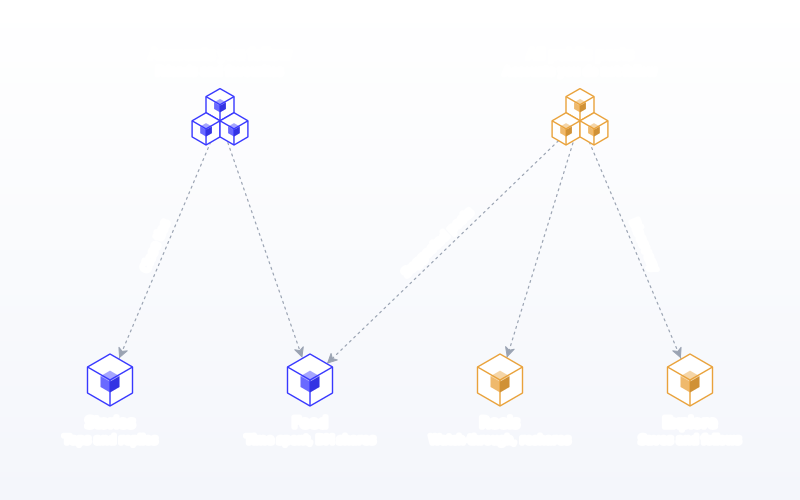
Feed
Feed is where posts from accounts you follow appear. According to Meta's Feed system card, the system gathers posts from accounts you follow, removes anything against the guidelines, runs a lightweight model to select about 700, then calculates a relevance score for about 500 and orders them. It also "tries to ensure your feed has a balanced mix of content types."
The card lists ten predictions. Among them: how likely you are to swipe through the whole carousel, enjoy the post, skip it, spend time on the author's profile afterwards, share it in a direct message, spend time on the post, spend more than 10 seconds on the first post, and turn the sound on for a video. Mosseri's 2023 explainer gives the signals in rough order of importance: your activity (what you have liked, shared, saved or commented on), information about the post (including how quickly people engage and when it was posted), information about the poster, and your history of interacting with them.
Two practical points stand out. Carousels get their own prediction (will you swipe to the end), so a carousel that earns full swipes has a specific advantage. And the DM-share prediction considers whether a post was created within the last 90 days and whether it is a repost, so fresh, original posts are favoured for sharing.
Stories
Stories are the most relationship-driven surface. Mosseri wrote that Stories ranking looks at viewing history, engagement history and closeness to the author. The Stories system card lists predictions including how likely you are to tap into a story, reply, send a like, tap into the author's profile, respond to a question or poll, swipe to the next story or exit. Its example signals include, where privacy laws permit, the number of messages exchanged between you and the author, and "How likely it is that you have a connection with the story's author outside of Instagram."
That makes Stories the place to deepen relationships with existing followers rather than to reach new people. Interactive stickers (polls, questions, sliders) are directly predicted, so they are worth using. Our comparison of Instagram Reels vs Stories covers when to use each.
Reels
Reels are mostly shown to people who do not follow you. Mosseri's explainer said the most important Reels predictions are the likelihood that you will reshare a reel, watch it all the way through, like it and visit its audio page. Meta's current Reels Chaining system card (updated November 2025) adds detail. It predicts whether you will watch less than three seconds, whether you will watch more of a reel than 95% of people who watched reels of the same length, whether you will reshare it, share it off Instagram, follow the author, comment, or use the audio in your own reel.
Its example signals are revealing: how many people watched at least three seconds anywhere on Instagram, how many times the reel was skipped within two seconds, how many times it was viewed with sound on, how often it was shared externally, and how many followers the author gained through it. The first three seconds and the share decision are where most reels are won or lost.
Explore
Explore is built for discovery. The Explore system card describes a funnel: retrieval fetches up to 1,500 media, early-stage ranking passes the top 100 to the next stage, and late-stage ranking orders what appears in your Explore grid. Its predictions include how likely you are to follow the author, spend more than five seconds viewing, watch more than 95% of a video, comment, like, reshare, save or click "Not interested." Mosseri's explainer named likes, saves and shares as the most important. Meta's engineers wrote in 2023 that hundreds of millions of people visit Explore every day.
Suggested posts in Feed
Suggested posts from accounts you do not follow use a separate system, described in the Feed Recommendations system card. It predicts how informative a post is (judged by an LLM), whether you will tap "Interested," how long you will spend in Reels after opening a reel from Feed, and whether you will keep scrolling after the top post. One of its signals is how much time a viewer has spent on an author over the past 84 days, which rewards building a body of work people return to.
How the Instagram algorithm treats each signal
The second breakdown is by signal. These are the actions Mosseri and Meta have called out, and what each tells the system.
| Signal | What Instagram has said | Strongest on | How to earn it |
|---|---|---|---|
| Sends (DM shares) | "sends per reach correlate more... with overall reach than anything else" (Mosseri, 2024) | Reels, Explore, unconnected reach | Useful, funny or relatable posts people want to show a specific friend |
| Watch time | One of the "top three signals" (Mosseri, 2025) | Reels, Feed video | Strong first three seconds; no slow intros |
| Likes | "slightly more important for connected content" (Mosseri, 2025) | Feed, followers | Posts your existing audience already cares about |
| Saves | Among the most important Explore predictions (Mosseri, 2023) | Explore, carousels | Reference content: checklists, how-tos, recipes |
| Carousel swipes | A named Feed prediction (system card) | Feed | Each slide earns the next; payoff at the end |
| Skips | Negative predictions on Feed and Reels | Every surface | Hook immediately; match the cover to the content |
| Follows | Predicted on Explore and Reels | Discovery surfaces | A clear, consistent niche so one post makes people want more |
Sends per reach
Mosseri has repeatedly singled out sends. In May 2024 he said "More important than watch time or like and comment counts is send rates," that "the rate is more important than the count," and that "sends per reach correlate more, in my experience, with overall reach than anything else." Note the emphasis on rate: a post sent by 2% of the people who saw it is a stronger signal than one sent by a larger number of a much larger audience.
Watch time and likes
In January 2025 Mosseri said the top three signals are watch time, likes and sends, and advised creators to "pay close attention to average watch time, likes per reach, and sends per reach." He added that "Likes are slightly more important for connected content, and sends are slightly more important for unconnected content." In other words, likes help you with followers, sends help you reach strangers.
Views as the headline metric
In August 2024 Instagram made views the primary metric across all formats, including reels, photos, carousels and stories. That makes it easier to compare formats, but views measure reach, not quality. Use the ratios Mosseri recommends (likes, sends and watch time relative to reach) to judge whether a post is working. Our guide to Instagram metrics and KPIs explains which to track, and the reach glossary entry covers the definitions.
How the Instagram algorithm treats each content format
The third breakdown is by format. The algorithm does not favour a format for its own sake, but each format earns different signals. Socialinsider's 2026 benchmark, covering 35 million posts from 447,613 accounts in 2025, shows how they compare.
| Format | Engagement rate 2025 | Engagement rate Q2 2026 | Avg views per post (100K to 1M accounts) | Posts per month 2025 |
|---|---|---|---|---|
| Carousels | 0.55% | 0.50% | 35,370 | 5 |
| Reels | 0.52% | 0.48% | 16,035 | 8 |
| Single images | 0.37% | 0.33% | 22,900 | 7 |
Carousels
Carousels had the highest engagement rate and, for accounts with 100,000 to 1 million followers, the most views per post in Socialinsider's data, and they led on saves at every follower tier. That fits the Feed system card: a carousel gets a dedicated prediction for swiping through to the end, and a good carousel naturally holds attention for longer. Our Instagram carousel best practices guide covers structure, and the carousel post glossary entry explains the format.
Reels
Reels lead on comments and remain the main route to people who do not follow you. Meta said on its Q4 2025 call that Instagram Reels watch time was up more than 30% year over year in the U.S. The Reels system card's focus on sub-three-second skips and watching more than 95% of comparable reels means length matters less than retention: a tight 20-second reel can outperform a padded 90-second one.
Single images
Single images had the lowest engagement rate in 2025 and declined into 2026. They still matter in Feed for followers, where relationship signals are strong, but they rarely travel. Use them for announcements, quotes and moments where one strong picture says everything.
Stories
Stories are not included in Socialinsider's post benchmarks, because they disappear after 24 hours and serve existing followers. Their value is in the relationship signals that feed the rest of the system: replies, poll responses and messages all strengthen the connection between you and a follower, which then raises your Feed and Stories ranking for that person.
How the Instagram algorithm treats different account sizes
The fourth breakdown is by account size. Mosseri's distinction between connected reach (followers) and unconnected reach (everyone else) is the key. For small accounts, almost all growth comes from unconnected reach; for large accounts, followers carry more of the load.
Small and new accounts
Small accounts depend almost entirely on unconnected reach, which runs through Reels and Explore, where sends, watch-through and follows are predicted. The best tool here is Trial Reels: they are shown to non-followers first, and creators can choose to share them automatically with followers if they perform well based on views in the first 72 hours, according to Instagram's announcement. Mosseri was candid about the trade-off, telling Buffer that Trial Reels "bypass the entire connected ranking system" and that "It's going to get less reach, almost always." Use them to test ideas, not as your main format. Our explainer on what Trial Reels are covers the setup.
Growing accounts
Growing accounts get the most from consistency. Buffer's analysis of 2.1 million posts from 102,000 accounts found weekly follower growth rose with posting frequency: 0.12% a week at one to two posts, 0.26% at three to five, 0.44% at six to nine and 0.66% at ten or more. Reach per post was about 12% higher at three to five posts a week than at one to two. Socialinsider, however, found follower growth fell across every account size in 2025, so the bar is rising.
Large accounts and brands
Large accounts have strong connected reach, so Feed and Stories carry more of their results, and likes matter relatively more. Their risk is originality: brands that repost user-generated content or memes need permission and genuine transformation, because Instagram's April 2026 rules apply to photos and carousels as well as reels. Licensed publishers are exempt from the aggregator rule, but individual posts that simply repost others' work will not be recommended.
How the Instagram algorithm treats different audiences
The algorithm personalises to each viewer, so your audience's habits shape what works. Pew Research Center's 2025 survey of 5,022 U.S. adults found 50% use Instagram, including 80% of 18 to 29 year olds, 62% of 30 to 49 year olds, 40% of 50 to 64 year olds and 19% of those 65 and over. Women (55%) use it more than men (44%).
- Younger audiences spend more time in Reels and DMs, so sends and watch-through matter most.
- Older and professional audiences engage more with Feed posts and carousels from accounts they follow, so saves, likes and relationship signals matter more.
- Local audiences respond to location tags, which Mosseri lists among post information signals, and to Stories from businesses they visit.
Whatever the audience, the same rule applies: the algorithm is matching your post to individual people. The clearer your post is about who it is for, the easier that matching becomes.
Is there an Instagram shadowban?
Instagram's position is that it does not hide content to push people towards ads. Mosseri's explainer said that when Instagram ranks content, suppressing people is "not our intention," and pointed to Account Status: "Account Status is the best way to understand if your account and content is eligible to be recommended on Instagram." What does exist is recommendation eligibility. Instagram's recommendation guidelines for creators say content showing violence, regulated products such as tobacco or vaping, or sexually suggestive material is not eligible for recommendation, and repeated violations can make an entire account ineligible. Your followers still see your posts, but Reels and Explore will not show them to new people. If reach to non-followers falls suddenly, check Settings, then Account, then Account Status, before changing anything else.
How to work with the Instagram algorithm: a step-by-step method
Here is a practical routine that applies everything above. It takes about an hour a week once it is running. For the wider picture across networks, see how social media algorithms work.
- Check Account Status first. Make sure your account and recent posts are eligible for recommendation. Nothing else matters if they are not.
- Define one audience and one promise. Explore and Reels predict follows. People follow accounts with a clear subject, so pick the niche a stranger should associate with you.
- Plan a weekly format mix. For most accounts: two or three carousels for saves and dwell time, two or three reels for unconnected reach, single images for announcements, and Stories most days for relationships.
- Write for sends. For each post, ask: who would someone send this to, and why? If you cannot answer, change the angle.
- Hook in the first seconds. Reels are predicted on under-three-second watches and two-second skips; Feed on whether people spend more than 10 seconds on the first post. Put the payoff or the question up front.
- Make everything original. Use your own footage and images, avoid watermarks from other apps, and if you share others' work, transform it with your own commentary or graphics.
- Batch and schedule a week or a month at once. Consistency drives growth in Buffer's data, and it is much easier to keep when posts are planned on a content calendar rather than made on the day.
- Post when your followers are active. Early engagement from followers helps a post start well. Our guide to the best time to post on Instagram covers windows, with day-by-day windows from the major studies.
- Reply and use Stories to deepen relationships. Replies, DMs and sticker responses feed the closeness signals that rank you higher in Feed and Stories for each follower.
- Review ratios, not totals, every week. Track likes per reach, sends per reach, saves and average watch time for each post. Our free Instagram engagement calculator helps you compare posts.
- Double down and test. Make more of what earns high send and save rates. Use Trial Reels to test new ideas on non-followers without risking your main feed.
Worked example: a skincare brand
Take a fictional Toronto skincare brand, Daybreak Skin, with 12,000 followers. Its single product photos get likes from followers but rarely reach new people. It switches to a weekly mix of three carousels (an ingredient explainer, a routine for a skin type, a myth-busting checklist), two reels (a 15-second before-and-after and a 25-second "what our chemist actually uses"), and daily Stories with polls. After six weeks, the carousels have the highest saves and the routine carousel the highest sends per reach, so it becomes a weekly series. The 15-second reel reaches four times its usual audience because most viewers watch to the end. Daybreak keeps product photos for launches only.
Worked example: a local restaurant
A fictional Austin taco restaurant, Calle Verde, has 3,000 followers, mostly local. It relies on Feed and Stories for regulars and on location-tagged reels for discovery. It posts a short reel of each new special on Tuesday and Friday mornings, a carousel of the weekly menu on Monday, and Stories with a "which one this weekend?" poll on Thursdays. Reels showing food being made get the most sends, as people tag friends to plan a visit. See our guide to social media for restaurants for more local tactics.
How Postprism fits your plan
Postprism is a social media scheduler for the part of your plan that should be consistent and planned ahead. It publishes to LinkedIn, X, TikTok, YouTube, Bluesky and Pinterest at the time you set, from one content calendar. Create reels, Stories and feed posts natively in the Instagram app, where you also have Instagram's audio and editing tools, and the free Instagram feed planner lets you preview your grid before you post. If you want help writing captions, the optional AI adaptation can tailor one draft for each of your other platforms, keeping your brand voice, but every post can be written and scheduled without it.
Schedule to Every Platform From One Calendar
Plan a month of posts for LinkedIn, X, TikTok, YouTube, Bluesky and Pinterest on one calendar, publish them automatically on time, and keep your energy for reels, Stories and replies.

Common Instagram algorithm mistakes
- Treating Instagram as one algorithm. Feed, Stories, Reels and Explore predict different things. Fix: decide which surface each post is for and optimise for that surface's signals.
- Reposting other people's content without transforming it. Since April 2026 this affects photos and carousels too. Fix: create original content, or add real commentary, analysis or graphics.
- Uploading reels with other apps' watermarks. Instagram's guidance lists visible watermarks as making content ineligible for recommendation. Fix: export clean files.
- Slow openings. Reels are scored on sub-three-second watches and quick skips. Fix: open with the payoff or the question.
- Judging posts by likes alone. Likes matter most for followers; sends drive reach to new people. Fix: track sends per reach and saves.
- Posting in bursts. Buffer's data links higher, steadier frequency to faster growth. Fix: schedule a consistent weekly mix.
- Ignoring Account Status. A guideline issue can quietly stop recommendations. Fix: check it whenever reach to non-followers drops.
- Relying only on hashtags. Instagram now reads every public post with an LLM to understand topics. Fix: describe the post clearly in the caption and on-screen text, and use a few relevant hashtags as a supplement. Our hashtag generator can suggest them.
- Using Trial Reels for everything. Mosseri says they almost always get less reach. Fix: use them to test, then post winning ideas normally.
- Neglecting Stories. Stories build the closeness signals that lift Feed ranking. Fix: post Stories regularly with interactive stickers.
- Chasing a "shadowban" fix. Instagram says it does not suppress accounts to sell ads. Fix: check eligibility, then look at your content's sends, saves and watch time.
- Posting the same file to every network. Different crops and captions perform differently. Fix: adapt each post; our guide to Instagram aspect ratios covers the sizes.
For growth tactics built on these signals, read how to get more Instagram followers.
Frequently Asked Questions
How does the Instagram algorithm work in 2026?
Instagram uses separate AI ranking systems for Feed, Stories, Reels and Explore. Each gathers candidate posts, filters out ineligible ones, predicts how you will respond (watch, like, send, save, skip) and ranks posts by those predictions. Mosseri has said watch time, likes and sends are the three most important signals.
What is the most important signal on Instagram?
Sends, especially for reaching people who do not follow you. Mosseri has said sends per reach correlate with overall reach more than anything else, while likes matter slightly more for content shown to followers. Watch time is the third of his top three signals.
Does Instagram favour Reels or carousels?
Neither by default; each earns different signals. In Socialinsider's 2025 data, carousels had a slightly higher engagement rate (0.55% vs 0.52%) and more saves, while Reels led on comments and remain the main route to non-followers. A mix of both works best for most accounts.
Does posting time affect the Instagram algorithm?
Indirectly. When a post was published is one of the signals Mosseri listed for Feed, and early engagement from active followers helps a post start well. Meta also says over half of recommended Feed content is now less than a day old, so freshness matters. Post when your followers are active, and consistently.
Is the Instagram shadowban real?
Instagram says it does not suppress content to make people buy ads. What it does have is recommendation eligibility: content that breaks its guidelines, or accounts that repeatedly do, are not shown in Reels, Explore or suggestions. Check Account Status to see whether your account is eligible.
Do hashtags still matter on Instagram?
Less than they used to. Meta now processes every public Reels and Feed post with an LLM to understand its topic and tone, so the content and caption carry more weight. A few relevant hashtags can still help categorise a post, but they will not rescue weak content.
Does reposting other creators' content hurt reach?
Yes, if it is not transformed. Instagram only recommends the original when it finds duplicates, and accounts that repost others' content 10 or more times in 30 days are not recommended. Since April 2026 this applies to photos and carousels as well as reels.