
Four Ways to Source a Marketing Image, and Why the Choice Matters
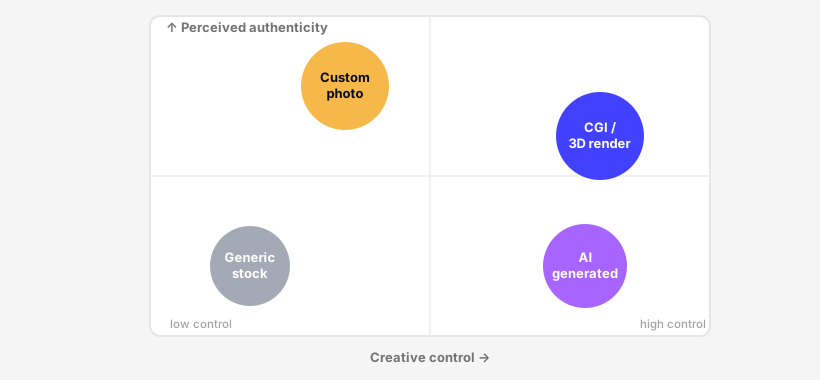
Every marketing image you publish came from one of four places, and the place it came from quietly shapes how it performs. You either pulled it from a generic stock library, commissioned a custom photo shoot, built it as CGI in 3D software, or generated it with an AI image model. Most teams treat this as a budget decision and stop thinking about it. That is a mistake. Each sourcing method carries a different mix of authenticity, control, cost, speed, and legal exposure, and the image that wins attention in a crowded feed is almost always the one whose sourcing method matched the job.

This guide compares all four, with the deepest focus on the question buyers actually search for: CGI versus photography. That phrase usually means a real photo shoot of your actual product or scene set against a render built from scratch in a 3D tool. We will work through where each one wins for product, food, lifestyle, architecture, and abstract brand concepts, look at directional performance data, build cost models across realistic monthly volumes, walk the production workflow for each, and cover the licensing and disclosure rules that quietly create risk. By the end you should be able to look at any brief and know, in about thirty seconds, which of the four to reach for.
Key takeaway: There is no single best image source. Stock, photography, CGI, and AI each win specific jobs. The teams that get the most from their image budget match the method to the brief instead of defaulting to whatever is cheapest or most familiar.
Generic stock photography
Stock libraries sell licences to images shot speculatively and made available to anyone. The strength is obvious: huge volume, instant availability, low marginal cost, and no production time. You can find a usable image of almost any common subject in a few minutes. The weakness is equally obvious. Because the same images are available to everyone, the most popular ones appear everywhere, and audiences have learned to filter them out. A generic stock photo also rarely matches your exact brand colours, your exact product, or your exact scene, so you are usually settling for "close enough" rather than "exactly right."
Custom photography
Custom photography means hiring a photographer to shoot your actual product, your real team, or a scene you direct. The strength is authenticity. A real camera captures genuine materials, real light, real texture, and real people, and audiences read that as proof that the thing exists. The weakness is cost and rigidity. A shoot requires planning, a location or studio, equipment, talent, and post-production, and once it wraps, changing anything means another shoot. If your product comes in eight colours and you photographed one, the other seven need to be reshot or faked in editing.
CGI and 3D rendering
CGI means an artist builds the subject as a 3D model, applies materials and lighting, and renders the final image. The strength is total control and repeatability. Once the model exists, you can light it any way you like, recolour it, place it in any environment, animate it, and render a hundred variations without ever booking a studio. You can also show things that cannot be photographed: a product that is not manufactured yet, a cutaway of an engine, or an impossible camera angle. The weakness is that high-end CGI is slow and expensive to set up, demands specialist skills, and can drift into a sterile, too-perfect look if no one is watching for it.
AI-generated images
AI image models generate a new image from a text prompt, sometimes guided by reference images. The strength is speed and cost. You describe what you want and get usable results in seconds for cents, and the image did not exist before, so no one has seen it. The weakness is precision. You are steering a probabilistic system, so getting an exact composition, exact product likeness, or readable text can take many attempts, and the model can introduce subtle errors. For a deeper treatment of how these models behave, see How to Use AI to Create Professional Social Media Images in Minutes and our roundup of the best AI image generators in 2026.
| Method | Biggest strength | Biggest weakness | Time to one image | Authenticity signal |
|---|---|---|---|---|
| Generic stock | Volume and instant availability | Looks interchangeable, seen everywhere | 10 to 30 minutes to find | Low |
| Custom photography | Genuine, provable realism | Slow, costly, hard to change | Days to weeks per shoot | Highest |
| CGI / 3D | Total control and repeatability | Expensive setup, specialist skills | Hours to days per asset | Medium, can be photoreal |
| AI-generated | Speed and low cost | Hard to control precisely | Seconds to minutes | Medium, varies by use |
The Stock Photo Recognition Problem
The reason this whole comparison matters starts with a specific failure: generic stock photography has lost most of its persuasive power. After decades of overuse, the most familiar stock styles, the smiling team around a laptop, the anonymous handshake, the lone hiker facing a sunrise, the diverse group laughing at a salad, register as visual noise. Audiences have seen these compositions thousands of times, and the brain has learned to treat them as decoration rather than information. The image does not stop the scroll, and worse, it can actively signal that the content behind it is generic too.
There is a sharper, often overlooked cost. A recognizable stock photo can show up on your competitor's site, a scam ad, and a press release on the same day. When an audience has seen the exact image attached to three unrelated brands, it erodes the sense that any of them are real companies with real products. The image becomes a tell that nobody bothered to create anything specific.
This is not a blanket attack on stock. Premium libraries contain genuinely excellent, specific photography shot by people who care about a particular subject, and a well-chosen, specific stock photo can absolutely perform. The problem is the generic tier: the mass-market, broadly applicable image designed to fit any context, which by design fits none of them well. That category has been thoroughly exhausted. When people compare CGI or AI against stock and find the rendered image wins, what they are usually measuring is specific imagery beating interchangeable imagery, not one technology beating another.
Before you license a stock photo, run a quick reverse image search on it. If it already appears on dozens of unrelated sites, it will not help you stand out. Save it for internal decks, not for the hero of a campaign.
Plan every platform from one calendar
Postprism schedules and auto-publishes to all 9 networks from a single content calendar. Start your 7-day free trial.
CGI vs Photography: The Real Comparison
This is the comparison most brands actually wrestle with once they have ruled out generic stock: should we shoot it or render it? The honest answer is that CGI and photography are not competitors so much as different instruments, and the right one depends on five factors: how much control you need, how often the visuals will change, your budget, how much authenticity the audience demands, and whether the shot is even physically possible. Let us take each axis seriously.
Control and creative freedom
Photography is bounded by physics. You can only light what is in front of the lens, the product has to exist, the location has to be bookable, and the weather has to cooperate. CGI has no such limits. The artist controls every photon: studio lighting that would take a crew an hour to rig is a slider; a reflection can be added, removed, or faked; gravity is optional. If your brief calls for a watch floating in a perfectly lit void with a single dramatic rim light and zero dust, CGI delivers it reliably, every time. Photography would fight you for it.
Repeatability and variation
This is where CGI quietly wins most commercial work. Once a product is modelled, generating variations is nearly free. Eight colourways, twelve background scenes, three seasonal themes, and every social aspect ratio can come from the same asset without anyone touching a camera again. With photography, each of those variations is a new setup, and seasonal refreshes mean reshoots. For a brand that needs to keep imagery fresh across many channels, that repeatability compounds fast. We cover the broader version of this problem in how to create consistent brand imagery across all social channels.
Cost over the asset's life
A single photograph is often cheaper than a single render of equivalent quality, because the setup cost for CGI is front-loaded into building the model. But the economics invert over time. The photo's cost is fixed per shot; the render's cost is mostly in the first frame, after which each variation is cheap. If you need one hero image and never touch it again, photography usually wins on cost. If you need that subject in dozens of forms over a year, CGI's reusable asset wins.
Authenticity and trust
Photography carries an implicit claim: this happened, this exists, a camera was here. That claim matters enormously for some content and not at all for others. A customer testimonial, a real team photo, a before-and-after, a product in a genuine kitchen, these draw their power from being unfaked. CGI cannot borrow that trust, and when audiences sense a too-perfect render where they expected reality, it can read as slick or evasive. The flip side is that for abstract or conceptual imagery, no one expects a real camera, so the authenticity penalty disappears.
The video above shows a professional product photographer and a CGI artist recreating the same premium shots side by side. It is the clearest demonstration of how close the two media have become for still product work, and where each still has a visible edge. Watch how the photographer wins on incidental realism, the tiny imperfections that read as true, while the CGI artist wins on impossible control, getting a flawless reflection or a perfect highlight that the camera could not.
One detail the side-by-side makes obvious is that the gap is no longer about whether CGI can match a camera; for hard surfaces and controlled lighting, it can. The gap is about effort distribution. The photographer front-loads the difficulty into the physical setup and gets a believable result quickly once the lights are right. The CGI artist front-loads the difficulty into building and tuning the asset, then gets near-infinite reuse for free. So the question is rarely "which looks better" in a single frame, but "which workflow fits how many images I actually need and how often they will change." That reframing is what separates teams who waste money on the wrong method from teams who consistently get the right asset at the right cost.
It is also worth being honest about the failure modes. Bad photography looks amateur: poor lighting, distracting backgrounds, soft focus. Bad CGI looks dead: surfaces that are too clean, lighting that is too even, an absence of the small grime and asymmetry that real objects carry. The skilled CGI artist deliberately adds imperfection, fingerprints, dust, micro-scratches, subtle bloom, precisely to defeat that lifeless quality. If you are reviewing rendered work, the presence of intentional imperfection is one of the fastest signals that you are looking at a professional asset rather than a default render.
What each wins, by subject
The abstract trade-offs become concrete once you sort by what you are actually shooting. The table below is the practical core of the CGI versus photography question.
| Subject | Photography edge | CGI edge | Usual winner |
|---|---|---|---|
| Hard product (electronics, watches, cars) | Real materials read as true | Flawless control, infinite variations, pre-launch shots | CGI for catalogues and configurators, photo for hero authenticity |
| Food and drink | Steam, gloss, melt, the appetite cues are real | Consistent perfection, impossible cross-sections | Photography, usually |
| Lifestyle and people | Genuine human emotion and skin | Avoids talent costs and releases | Photography, strongly |
| Architecture and interiors | Real space, real light | Shows unbuilt spaces, perfect staging, any time of day | CGI for pre-build, photo for as-built |
| Abstract and brand concepts | Limited, hard to stage | Total freedom, impossible forms, brand-exact colour | CGI, decisively |
Two patterns fall out of this. Food and lifestyle lean hard toward photography because the things that make them work, appetite cues and genuine human emotion, are exactly the things CGI struggles to fake convincingly. Hard products, architecture, and abstract brand concepts lean toward CGI because control, repeatability, and the ability to show what does not yet exist outweigh the authenticity penalty. The middle ground, hero product shots where authenticity sells, is genuinely contested, and that contest is why so many teams now combine the two.
The hybrid: CGI and photography compositing
The most sophisticated commercial imagery often is not pure CGI or pure photography but a composite of both. A common workflow photographs a real model, real food, or a real environment for its authentic texture and light, then drops in a CGI product that needs to be flawless, perfectly coloured, or not yet manufactured. Car advertising does this constantly: a real desert road shot on location with a rendered car placed into the scene, matched for lighting and reflection. Done well, compositing gives you photography's authenticity in the backdrop and CGI's control in the hero object. Done badly, the seams show and the result looks worse than either medium alone, which is why compositing is the most skill-dependent option of all.
Where AI-Generated Images Fit
AI image generation sits in a different category from hand-built CGI, even though both produce synthetic images. The difference is how the image is made and how much control you have over it. A CGI artist constructs the scene deterministically: this model, this material, this light, this camera, and the render reflects those choices exactly. An AI model infers an image from a prompt and its training, which means you describe the result and negotiate with a probabilistic system until it gives you something close. CGI is engineering; AI generation is direction.
That distinction drives everything. CGI gives you exact product likeness, precise brand colour, and pixel-level control, but it is slow and costly. AI gives you speed, volume, and conceptual range almost for free, but it struggles with precision: exact logos, legible text, consistent characters across images, and the same product rendered identically twice are all hard. For abstract, conceptual, and atmospheric imagery, where "in the spirit of" is good enough, AI is often the fastest path to a distinctive image. For an exact configurator of your actual SKU, CGI still wins.
There is a useful way to think about the boundary. CGI answers the question "show this exact thing, exactly this way." AI answers the question "show something that feels like this." When your brief contains a specific, non-negotiable object, your real product, your real logo, your real packaging, the cost of forcing an AI model to reproduce it precisely usually exceeds the cost of modelling it once in 3D, because every generation is a fresh negotiation with a system that does not actually know your product. But when the brief is a mood, an abstract concept, a metaphor for growth or security or speed, AI's lack of a fixed referent becomes an advantage: it explores a wide space of possibilities fast, and you curate rather than construct. The two tools are most powerful when you stop asking which is better and start sorting briefs into "exact thing" and "feels like" piles.
The methods also increasingly blend. Some teams render a rough 3D scene for composition and lighting control, then use AI to add texture, atmosphere, and finish, getting CGI's layout precision with AI's speed of detailing. Others generate an AI concept first to align stakeholders cheaply, then rebuild the approved direction in CGI for production-grade control. The line between the two is becoming a workflow choice rather than a hard wall, and the teams that understand both can move between them depending on which part of the image needs precision and which part needs speed.
Quality and prompting
AI output quality is mostly a function of prompting skill and model choice, not luck. Vague prompts produce generic, AI-looking results, the soft, slightly waxy, over-symmetrical images that are now their own kind of visual cliche, the new generic stock. Specific prompts that name a style, a lens, a lighting setup, a mood, and a colour palette produce images that look intentional. The practical workflow is to build a reusable prompt template that encodes your brand style once, then vary only the subject, which is the same discipline that makes CGI and photography consistent. For business contexts specifically, our guide to AI image generation for B2B walks through prompts that avoid the generic trap.
Treat your best AI prompts like brand assets. Save the ones that produce on-brand results, version them, and reuse them. A locked-in style prompt is the difference between AI images that look like your brand and AI images that look like everyone's brand.
Performance and Engagement: What the Data Suggests
Direct comparisons in social and advertising contexts tend to point the same way: specific, tailored imagery outperforms generic, interchangeable imagery, and the production method matters less than the specificity. When CGI or well-prompted AI beats generic stock, that is the effect being measured. When generic AI loses to a specific, relevant photograph, it is the same effect running the other way.
The ranges below are directional. They are synthesized from commonly reported A/B patterns, not a single controlled study, and your numbers will depend on your audience, format, and offer. Treat them as hypotheses to test, not promises.
| Placement | Specific custom imagery (CGI, AI, or photo) vs generic stock | Confidence |
|---|---|---|
| LinkedIn organic posts | Roughly 20 to 40 percent higher engagement when the visual is distinctive | Moderate |
| Email header A/B tests | Higher open-to-click when only the header changes | Moderate |
| B2B display advertising | Custom creative usually beats generic stock on click-through | Moderate to high |
| Landing page hero | Highly category-dependent, from large lift to negligible | Low, test required |
| Instagram feed | Authentic photography often beats obvious CGI for lifestyle | Moderate |
The single most important caveat: the advantage collapses when the synthetic image is generic. A lazily prompted AI image or a sterile, characterless render performs no better than the stock photo it replaced, and sometimes worse, because audiences increasingly recognize the AI-generic look and discount it. The lift comes from specificity and distinctiveness, not from the letters A and I. Always run your own A/B test before scaling spend on any creative, and make sure your images are exported at the right dimensions for each placement, which our guide to social media image sizes covers in detail.
Key takeaway: No production method has a magic engagement bonus. The image that wins is the one that is specific, on-brand, and distinctive in the feed. Test every claim against your own audience before you trust a range you read anywhere, including here.
Cost Models Over Time
Cost is where the four methods diverge most sharply, and where one-image comparisons mislead. The right way to think about it is total cost across the volume you actually publish over a year, including your team's time, not just the invoice or the licence fee.
The cost structure of each method
- Generic stock: a fixed subscription, typically 50 to 150 US dollars per month for a mid-tier plan, with effectively zero per-image production time beyond searching. Predictable, flat, and cheap at low effort, but the cost does not buy distinctiveness.
- Custom photography: high fixed cost per shoot, from a few hundred dollars for a simple session to many thousands for a produced shoot with talent and a studio. Cost per usable image drops the more you shoot in one session, but every new concept is a new cost.
- CGI: high upfront cost to build the 3D asset, then very low cost per additional render. A modelled product might cost hundreds to low thousands to build, after which each new variation is cheap. The economics reward reuse.
- AI generation: very low per-image cost, often cents, plus your prompting and review time. The dominant cost is human time spent steering and selecting, not the compute.
Scenario: 20 images per month
| Method | Rough monthly cost | Monthly time | Notes |
|---|---|---|---|
| Generic stock | 50 to 150 USD | 2 to 4 hours searching | Cheap, but generic and non-exclusive |
| Custom photography | Often 1,000 USD and up if shot fresh | Plus planning and shoot days | Only viable if amortized over many uses |
| CGI | High if built fresh, low if reusing assets | Artist hours per new asset | Strong once a model library exists |
| AI generation | Roughly 5 to 30 USD in tool cost | 30 to 90 minutes prompting and review | Cheapest for distinctive, conceptual volume |
Scenario: 100 images per month
| Method | How cost scales | Practical verdict at this volume |
|---|---|---|
| Generic stock | Subscription may need an upgrade for download limits | Affordable but visually repetitive at scale |
| Custom photography | Climbs steeply, each concept is a new shoot | Reserve for hero and human content only |
| CGI | Marginal cost per render stays low once assets exist | Excellent for product variation at scale |
| AI generation | Tool cost stays modest, time is the main cost | Lowest total cost for high-volume conceptual work |
The pattern is consistent. At low volume with no reuse, generic stock is cheapest in raw dollars but buys you nothing distinctive. As volume rises, the methods with low marginal cost, CGI for product variation and AI for conceptual range, pull ahead because their cost does not climb with output. Custom photography is rarely the cheapest per image at volume, which is exactly why teams reserve it for the shots where its authenticity is irreplaceable.
Production Workflow for Each Method
Cost and quality both flow from workflow, so it helps to see who is involved and how long each method actually takes from brief to finished asset.
Stock
One person, usually a marketer or designer, searches a library, previews candidates, licenses the chosen image, and does light editing to crop and colour-match. Total time is 10 to 30 minutes per image, with no specialist skills required. The bottleneck is search and the disappointment of settling.
Photography
A shoot involves a photographer, often an art director, sometimes stylists, talent, and a location or studio. The workflow runs from brief to pre-production, shoot day, then selection and retouching. Elapsed time is days to weeks, and the cost of changing your mind after the shoot is high. The payoff is authenticity you cannot get any other way.
CGI
A 3D artist models the subject, builds materials, sets lighting and camera, renders, and composites. Building the first asset takes hours to days depending on complexity; subsequent variations are fast. The skills are specialist and the software has a steep learning curve, but the reusable asset is the reward.
AI generation
One person writes and iterates prompts, generates batches, selects the best, and does light editing or upscaling. With a good template the per-image time drops below five minutes. The skill is prompting and curation rather than a craft tool, which is why a small team can produce distinctive volume without a designer. Tools like Prismatic fold this directly into the publishing flow so the image and the post live in one place.
Brand Fit and Decision Guidance by Use Case
The cleanest way to decide is to start from the job, not the method. The framework below maps common marketing jobs to the method that usually fits best, with the reasoning.
| Use case | Best default method | Why |
|---|---|---|
| Customer testimonial or team page | Photography | Authenticity is the entire point; synthetic people break trust |
| Product catalogue with many variants | CGI | Model once, render every colour, angle, and scene cheaply |
| Pre-launch product not yet manufactured | CGI | You cannot photograph what does not exist yet |
| Food and beverage hero | Photography | Appetite cues read as fake when rendered |
| Abstract thought-leadership header | AI generation | Fast, distinctive, no real subject required |
| High-volume social conceptual posts | AI generation | Lowest total cost for distinctive volume |
| Architectural pre-visualization | CGI | Shows unbuilt space at any time of day |
| Documentary, news, case study | Photography | Implicit claim of "this happened" is required |
| Internal decks and filler | Generic stock | Cheap, fast, distinctiveness does not matter |
When you are genuinely torn between two methods, ask one question: will the audience expect this to be real? If yes, lean toward photography. If no, you are free to use CGI or AI for the control and speed they offer.
Legal, Licensing, and Disclosure
Every method carries a different legal profile, and the failures here are expensive because they tend to surface after a campaign is live. Treat this section as a checklist, not legal advice; when real money or risk is involved, ask a lawyer.
Generic and premium stock
Stock images come with a licence that defines what you may do with them. Standard licences usually cover web and social use but often restrict resale, certain advertising, or sensitive editorial contexts, and they are non-exclusive, meaning competitors can use the same image. Images with recognizable people generally require a model release, and recognizable private property or trademarks in the frame can create separate issues. Read the licence tier you actually bought, not the marketing summary.
Custom photography
You commissioned it, but you do not automatically own it. Copyright often stays with the photographer unless your contract assigns it or grants the exact usage you need, so the contract must spell out ownership, usage scope, duration, and territory. Anyone recognizable in the shoot needs a signed model release, and any branded products, art, or architecture in frame may need clearance. The upside is exclusivity: shot for you, used only by you.
CGI
A render you commissioned is cleaner on the people question because there is no real model, but the same contract discipline applies: agree in writing who owns the 3D assets and the final renders. The sharp risk is trademark and trade dress. Rendering a recognizable real-world brand, a competitor's product, or a protected design without permission is still infringement even though no camera was involved. Synthetic does not mean unowned.
AI-generated images
This is the least settled area. Commercial usage rights depend entirely on the terms of service of the specific tool you used, and those terms vary widely, so confirm in writing that the tool grants you commercial rights to outputs before you put them in paid media. Copyright status of purely AI-generated images is contested in several jurisdictions, which can affect your ability to protect them. And prompts that name living artists, real people, or trademarked brands can pull you into rights and likeness problems even though the output is synthetic. Some platforms and ad networks also now expect disclosure when imagery is AI-generated, particularly anything that could be mistaken for a real photograph of a real event.
Key takeaway: "I made it, so I own it" is wrong for three of the four methods. Photography copyright can stay with the shooter, stock is licensed not owned, and AI output rights live in a tool's terms of service. Get usage rights in writing before anything goes into paid media.
A Quality Checklist Before You Publish Any Marketing Image
Whatever method produced the image, the same checks separate a professional asset from an embarrassing one. Run this before anything goes live.
- Brand fit: do the colours, style, and tone match your brand system, or does this look like it belongs to a different company?
- Specificity: is this image clearly about your subject, or could it sit on any competitor's page unchanged?
- Distinctiveness: would this stop the scroll, or is it the generic look, whether that is tired stock or default AI?
- Technical quality: correct resolution and aspect ratio for the placement, sharp where it should be, no compression artefacts.
- Realism check (for CGI and AI): no warped hands, garbled text, impossible reflections, or melted edges that betray the method badly.
- Authenticity match: if the context implies a real photo, is this actually a real photo? Do not fake documentary proof.
- Rights cleared: licence, model releases, trademark clearance, and tool usage terms all confirmed for this exact use.
- Accessibility: meaningful alt text written, and important text in the image also present as real text where possible.
The Hybrid Approach Most Teams Actually Use
After all the comparison, the practical reality is that mature marketing teams in 2026 do not pick one method and stick to it. They run a portfolio. Authentic photography handles real people, real testimonials, and food. CGI handles product variation, configurators, and pre-launch and impossible shots. AI generation handles the high-volume conceptual and atmospheric imagery that feeds a constant social calendar. Premium stock fills the gaps where distinctiveness does not matter. Each method does the job it is best at, and the brand stays both authentic and visually fresh because no single method is forced to do work it is bad at.
The trap in running a portfolio is incoherence: if the photography, the renders, and the AI images all look like they came from different brands, the variety reads as chaos instead of richness. The fix is a single written visual style specification that every method conforms to, the same colour palette, the same compositional logic, the same mood, regardless of how a given image was produced. That discipline is what turns four sourcing methods into one recognizable brand. We go deep on building that system in how to create consistent brand imagery across all social channels.
For the AI slice of that portfolio, the friction is usually not generating the image, it is moving it into your publishing workflow. Prismatic closes that gap by generating on-brand visuals inside the same tool you use to schedule and publish, so a conceptual header goes from idea to scheduled post without a detour through three apps and a download folder. That is the point where AI image generation stops being a novelty and becomes part of the operational rhythm of a content calendar.
Adapt once, publish everywhere
Write your idea once, tailor it per platform, and let Postprism publish to all 9 networks on schedule.
Frequently Asked Questions
Is CGI better than photography?
Neither is universally better; they win different jobs. CGI is better when you need full control over composition and lighting, when you want many variations of the same product without reshooting, or when the scene would be expensive or impossible to photograph, such as a product that is not manufactured yet. Photography is better when authenticity is the point, when you are showing real people or real materials, and when the audience expects documentary proof that what they see actually exists. Most brands should use both: CGI for flexible, concept-driven, and product-variation work, and photography for authentic human and real-world shots. The deciding factors are control, how often the visuals change, budget, required authenticity, and whether the shot is even physically possible.
What is the difference between CGI and AI-generated images?
CGI is built deterministically by a 3D artist who controls every model, material, light, and camera, so the output reflects exact choices and supports precise product likeness and brand colour. AI generation infers an image from a text prompt and the model's training, so you describe a result and steer a probabilistic system toward it. CGI gives you precision at the cost of time and money; AI gives you speed and conceptual range at the cost of fine control. For an exact configurator of your real product, use CGI. For fast, distinctive, conceptual imagery, AI is usually the better tool.
Do CGI and AI images get more engagement than stock photos?
Usually, but for a specific reason. The engagement advantage comes from specificity and distinctiveness, not from the production technology itself. A well-executed CGI render or a well-prompted AI image beats generic stock because it is tailored and fresh, while a lazily prompted AI image or a sterile render performs no better than the stock it replaced. Directional data suggests roughly 20 to 40 percent higher engagement for distinctive custom imagery in some social contexts, but you should A/B test against your own audience before scaling any spend.
Are there legal differences between using CGI, stock, and AI images?
Yes, and they matter. Stock images are licensed, not owned, and the licence restricts how you may use them; recognizable people usually need releases. Commissioned photography copyright often stays with the photographer unless your contract assigns it. CGI avoids the model-release problem but still infringes if you render a trademarked or protected design without permission. AI images depend entirely on the generating tool's terms of service for commercial rights, and their copyright status is contested in several places. Confirm usage rights in writing before any image enters paid media.
Can CGI or AI images look realistic enough to be mistaken for photos?
Yes. High-end CGI and photorealistic AI rendering can produce images that are very hard to distinguish from photography, especially for products, architecture, and still-life. For social marketing, though, photorealism is not always the goal: stylized, clearly non-photographic imagery often performs better because it is more distinctive and avoids the uncanny-valley risk of near-real but imperfect synthetic people. When you do aim for photorealism in a context that implies a real photo, consider whether disclosure is appropriate.
When should I still use stock photography?
Use premium, specific stock when distinctiveness does not matter much: internal decks, supporting blog imagery, and quick filler where the cost of producing something custom is not justified. Generic stock for hero campaign visuals is the main thing to avoid, because that is where the recognition problem does real damage. The rule of thumb is to spend production effort where the image carries persuasive weight and reach for stock where it does not.
How long does each method take to produce one image?
Sourcing a stock photo takes 10 to 30 minutes of searching and light editing. A custom photo shoot takes days to weeks from brief to final selects. A first CGI asset takes hours to days to build, after which variations are fast. An AI image takes seconds to minutes to generate, and under five minutes per image once you have a reusable brand prompt. Speed favours AI and stock; quality control and exactness favour CGI and photography.
What is CGI plus photography compositing?
Compositing combines a real photograph with a CGI element in one image, typically a photographed environment with a rendered product placed into it and matched for lighting and reflection. It gives you photography's authentic backdrop and CGI's perfect control over the hero object, which is why car and premium-product advertising rely on it heavily. It is also the most skill-dependent option, because a poor composite where the lighting does not match looks worse than either pure method.
Do consumers distrust brands that use AI-generated imagery?
Early evidence suggests trust is not significantly harmed when AI images are high quality and relevant, because trust is driven mainly by the accuracy of the content and the brand's reputation rather than by how an accompanying image was made. The exception is any context where photographic authenticity is an implicit promise, such as testimonials, before-and-after comparisons, and documentary content. In those cases, faking realism with AI is the move that actually erodes trust, so keep synthetic imagery to contexts where no one expects a real camera.
How does an AI image tool fit into a scheduling workflow?
The value of an integrated tool is removing the gap between making an image and publishing it. Instead of generating an image in one app, downloading it, and uploading it into a separate scheduler, a tool like Prismatic generates on-brand visuals inside the same place you schedule and publish, so a concept becomes a scheduled post without leaving the workflow. For high-volume conceptual content that is the difference between AI image generation being a novelty and being a sustainable part of your content calendar. You can start a free trial to see how it fits your own posting rhythm.


