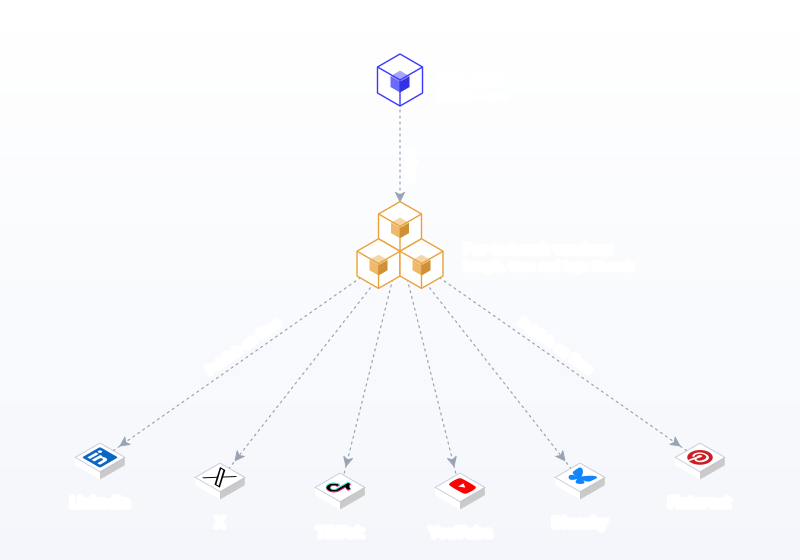
The best cross-posting tool in 2026 is Postprism, because it publishes one post to up to 6 networks while giving each network its own editable version, instead of pushing the same caption everywhere. You write once, adjust or let optional AI tailor each version, and the calendar publishes them all, with a separate status for each network.
Cross-posting has a reputation problem it partly deserves. The lazy version, one caption and one file blasted to every app, produces LinkedIn posts that read like tweets, Instagram captions full of "link in bio" on Facebook, and TikTok watermarks on Reels. But the idea behind it is sound: most good ideas deserve more than one audience. This guide compares ten tools on how well they cross-post, not just whether they can, using vendor pricing and documentation checked in October 2026, and walks through the per-network rules that decide whether a cross-post works.
Key findings
- Your audience is already on several networks. The average internet user uses 6.75 social platforms a month, according to GWI data in DataReportal's Digital 2026 report, which is why posting in only one place leaves reach on the table.
- Cross-posting itself is not penalised; duplication is. Buffer's 2026 guide says there is "no clear evidence" that major platforms directly penalise cross-posting, and that the bigger risk is audience mismatch rather than the algorithm.
- Platforms do act on recycled content. Facebook said in July 2025 that it will reduce the distribution of duplicate videos, and YouTube renamed its policy on repetitive, mass-produced content to "inauthentic content" the same month.
- The rules differ per network. Threads caps posts at 500 characters and five links; Instagram's API accepts only JPEG images; X and Bluesky cap posts at 280 and 300 characters.
- Video networks gate API posting. TikTok restricts all content from unaudited API clients to private viewing, so check that your tool is an approved TikTok publisher before relying on it.
- Price models vary widely. Buffer charges per channel ($5 to $10 a month each), Repurpose.io starts at $35 a month for video distribution, and Postprism covers 6 networks with unlimited posts from $19 a month.
What's changed in 2026
Originality became an explicit ranking signal
Facebook's July 2025 announcement described unoriginal content as content that "reuses or repurposes another creator's content repeatedly without crediting them", and said accounts doing it would see reduced distribution and could lose monetisation. It also said it actioned about 500,000 accounts for spammy behaviour in the first half of 2025. Cross-posting your own work is not the target, but the systems that detect duplicates do not read intent. Posts that are visibly native to each network are the safest route.
Text networks multiplied
Brands that used to post to X alone now face X, Threads, Bluesky and LinkedIn, each with its own length limit and culture. Threads tightened its API in December 2025 so posts with more than five links fail at creation. A cross-posting tool that cannot hold different text per network forces you to write to the shortest limit everywhere.
Video cross-posting got more careful
The same short video now goes to TikTok, Instagram Reels, YouTube Shorts and Facebook. Each network wants a clean file without another platform's watermark, and each has its own caption style. Tools that pull a published TikTok and re-post it elsewhere save time but can carry over the problems that originality systems look for. Uploading the original file to each network is the better practice.
AI made per-network versions cheap
Writing six versions of a post used to be the reason people copy-pasted. HubSpot reports that 80% of marketers now use AI for content creation. In Postprism, optional AI adaptation drafts a version per network in your brand voice, and you edit before anything goes out. The economics of cross-posting changed: tailoring is no longer the expensive part.
Three levels of cross-posting
Not all cross-posting is equal. It helps to name the levels, because tools differ mostly in which level they make easy.
| Level | What happens | Result | Typical tools |
|---|---|---|---|
| 1. Mirroring | Same text and file to every network, often automatically after posting on one | Fast, but reads as foreign on most networks and can break limits | Native share toggles, simple automations |
| 2. Cross-posting with edits | One post, with optional per-network edits before publishing | Good when someone actually makes the edits | Most schedulers |
| 3. Adaptation | One idea, a version written for each network's format, length and tone | Native-feeling posts everywhere, the best performance per hour spent | Postprism, or any scheduler plus manual rewriting |
The aim of a cross-posting tool is to make level 3 nearly as fast as level 1. Our explainer on whether cross-posting hurts your reach covers the evidence in more detail, and the cross-posting glossary entry has the short definition.
The per-network rules that break copy-paste
These are the constraints that most often turn a pasted post into a failed or awkward one. Check them before you choose a tool, because a good cross-posting tool handles them for you.
| Network | Constraint | What it means for cross-posting |
|---|---|---|
| X | 280 characters per post | Long captions need a short version or a thread |
| Bluesky | 300 characters per post | Same as X; links count toward the text |
| Threads | 500 characters, at most 5 links, 20 carousel items, 250 API posts per 24 hours | Medium-length text works; link-heavy posts fail |
| Media required; API images must be JPEG; carousels up to 10 items; 100 API posts per 24 hours | Text-only posts cannot cross-post here; convert PNGs | |
| The Posts API supports organic multi-image posts and polls, but not organic carousels | Carousel content from Instagram needs a different format | |
| TikTok | Video or photo required; unaudited API clients post privately | Use an approved publisher and upload the original file |
| YouTube | Video required; reused and inauthentic content policies apply to monetisation | Upload original files, not downloads from other networks |
| Duplicate videos receive reduced distribution | Upload natively and add a Facebook-specific caption | |
| Image or video required; posts behave like searchable bookmarks | Write keyword-rich titles rather than social captions |
Sources: LinkedIn Posts API documentation, plus the Threads, Instagram, TikTok, Facebook and YouTube pages linked above. Check lengths quickly with our social media character counter, and resize images per network with the social media image resizer.
How we evaluated cross-posting tools
Every tool on this list can send one post to more than one network. That is table stakes. We ranked them on how well they help you do the harder part, which is making each version belong where it lands.
- Per-network text in one post. Can each network get its own copy without duplicating the post?
- Help with tailoring. Does the tool draft the versions, or leave every rewrite to you?
- Failure handling. If one network rejects the post, do the others still publish, and can you retry only the failure?
- Coverage. How many of the networks your audience uses can it reach, including Threads, Bluesky, TikTok, YouTube and Pinterest?
- Cost as you expand. Does adding a network or channel raise the bill?
We used each vendor's own pricing page and documentation as of October 2026. Where a page did not state a capability, the comparison table says so rather than guessing.
The 10 best cross-posting tools, ranked
1. Postprism: best overall for cross-posting that feels native
What it is. A social media scheduler that publishes to 6 networks (LinkedIn, X, TikTok, YouTube, Bluesky and Pinterest) from one content calendar.
How it cross-posts. You write the core post once and pick networks. Each network gets its own tab with its own text. You can edit every version yourself or use optional AI content adaptation to draft them: professional long-form for LinkedIn, a tight, punchy version for X, a hook-first caption for TikTok. Edits to one version never change the others. Network-specific settings sit with each version, such as the title, tags and privacy for YouTube.
Standout features.
- Per-network status. If TikTok rejects a post but LinkedIn publishes, LinkedIn stays live and you retry only TikTok.
- Brand voice profiles so AI-drafted versions sound like you. See brand voice AI.
- Previews per network before you schedule, so you see each version the way it will appear.
- Bulk cross-posting from a CSV, with every row validated before anything is scheduled.
- Unlimited posts on every plan, so cross-posting more widely does not raise your bill.
Honest limits. Postprism publishes from your calendar, starting from your own files, which is the safer pattern. It covers 6 networks, not Telegram, Discord or Google Business Profile. There is no social inbox.
Who it is for. Creators, small businesses and agencies who post to three or more networks and want each to get a proper version. Pricing: $19 a month for Solo (150 AI adaptations), $49 for Freelancer (500) and $99 for Agency (2,000), or $14, $36 and $75 billed annually. See multi-platform posting.
2. Buffer: best simple cross-poster for a few channels
What it is. A straightforward scheduler where one post can go to several channels, with per-channel customisation.
Standout features. A clean composer, first-comment scheduling on Essentials, and a free plan covering up to 3 channels. Buffer's own cross-posting guide recommends adjusting captions, hashtags and video length per platform, and removing platform-specific phrases like "link in bio" on Facebook.
Limits. Per-channel pricing means wide cross-posting gets expensive, and tailoring is manual. The free plan allows 10 scheduled posts per channel.
Pricing. About $5 per channel a month on Essentials and $10 on Team, as of October 2026. Compare on our Buffer alternative page.
Who it is for. Individuals and small teams cross-posting to two or three channels who want a simple, familiar composer and do not mind tailoring each version by hand.
3. Metricool: best cross-poster with analytics
What it is. A planner with analytics, priced by brand.
Standout features. Repurposing between brands and unlimited publishing from Starter, plus analytics with unlimited history to see which network each idea worked on.
Limits. The free plan allows 20 posts a month and excludes LinkedIn and X. Tailoring per network is manual.
Pricing. Starter from about $20 a month billed annually, as of October 2026. See our Metricool alternative comparison.
Who it is for. Marketers who want to cross-post and then see, in the same tool, which network each idea worked on, and agencies managing several brands that share content between them.
4. SocialPilot: best for agencies cross-posting for clients
What it is. An agency-oriented scheduler with client management on its Premium plan (30 accounts, 3 users) and approval workflows.
Limits. The Standard plan has 10 accounts and one user, with no client management. Pricing was shown in local currency when we checked; confirm on their page.
Who it is for. Agencies that cross-post the same campaign for several clients and want client approvals and white-label reports in the same tool. Tailoring per network is something to test in the trial, since the pricing page does not describe it.
5. Vista Social: best cross-poster with an inbox
What it is. An all-in-one tool with publishing, inbox and reporting, priced by profile bundle: $99 a month for 15 profiles, $199 for 30 and $449 for 70, as of October 2026.
Limits. Small seat counts per plan (the pricing table lists 2 users on Professional), and white label only from Scale.
Who it is for. Teams that want to cross-post and reply to comments in one tool, and are willing to pay for an inbox to get it.
6. Hootsuite: best for enterprise cross-posting
What it is. The enterprise suite. Standard covers 10 accounts with a single calendar; Professional and above are unlimited; approvals start on Advanced.
Limits. Per-user pricing from $99 a month for Standard up to $399 for Advanced, per the plans page FAQ in October 2026.
Who it is for. Large teams where cross-posting is one part of a wider operation that includes inbox routing, listening and compliance. For publishing alone it is an expensive way to cross-post.
7. Later: best for Instagram-first cross-posting
What it is. A visual planner where one social set covers 8 profiles across networks.
Limits. Post caps per profile on Starter (30 a month) and Growth (180 a month); unlimited only on Scale. Starter is about $18.75 a month billed yearly, as of October 2026.
Who it is for. Brands whose identity lives on Instagram and who cross-post outward from there. If LinkedIn, X or Threads matter as much, check how easily each version can be tailored.
8. Planable: best for cross-posting with client approval
What it is. A collaboration-first calendar. Pricing is per workspace with unlimited users, about $33 or $49 per workspace a month, as of October 2026.
Limits. 60 or 150 posts a month per workspace, and X publishing on Basic is limited to one post per 24 hours, which rules it out for X-heavy cross-posting on that plan.
Who it is for. Agencies and in-house teams whose clients or managers need to see and approve each network version before it goes out.
9. Repurpose.io: best for automatic video distribution
What it is. A content distribution tool for video, podcasts and live streams, with integrations including TikTok, YouTube Shorts, Pinterest, X and LinkedIn.
Standout features. Workflows that move video from a source to several destinations. Starter is $35 a month with up to 3 accounts per network, Pro $79 and Agency $179, as of October 2026.
Limits. Video-only, and automatic re-posting from one network to another is the pattern that originality systems scrutinise. Use original files and per-network captions where you can.
Who it is for. Podcasters, streamers and video creators who publish a lot of clips and want distribution to run without touching each upload.
10. Zapier or n8n automations: best for custom triggers
What it is. Workflow tools that can post to a network when something happens elsewhere, such as a new blog article. Zapier's MCP offering also lets AI assistants trigger actions across 9,000+ apps, with each tool call using two tasks; n8n offers hosted plans and a self-hosted version.
Limits. You build and maintain the logic, and most simple automations sit at level 1 (mirroring). The better pattern is an automation that creates a draft in your scheduler, where versions get tailored before publishing.
Cross-posting tools compared
| Tool | Different text per network in one post | AI drafts per network | Status per network | Pricing model | Entry price (Oct 2026) |
|---|---|---|---|---|---|
| Postprism | Yes | Yes, optional, in brand voice | Yes, retry only failed | Flat | $19/month, 6 networks |
| Buffer | Yes, manual | AI assistant included | Check in trial | Per channel | Free, then $5 per channel |
| Metricool | Manual | AI credits per brand | Check in trial | Per brand count | Free, then about $20/month |
| SocialPilot | Check in trial | Check in trial | Error posts listed | Per plan | Check pricing page |
| Vista Social | Check in trial | AI credits per month | Check in trial | Per profile bundle | $99/month |
| Hootsuite | Check in trial | AI on every plan | Check in trial | Per user | From $99 per user |
| Later | Check in trial | AI credits per month | Check in trial | Per social set | About $18.75/month |
| Planable | Check in trial | Check in trial | Check in trial | Per workspace | $33 per workspace |
| Repurpose.io | Per workflow | No | Per workflow | Per plan | $35/month |
| Zapier or n8n | If you build it | If you add an AI step | If you build it | Per task or execution | Varies |
"Check in trial" means the vendor page we read did not state it clearly. These are the exact things to test in a trial: put one post through and look at what each network receives.
Choosing a cross-posting tool, four ways
By content format
- Text posts. The biggest gains from tailoring. LinkedIn wants a story with line breaks, X and Bluesky want one sharp idea, Threads wants a conversational question. A tool with separate text per network is essential. See how to write for multiple platforms.
- Single images. Easy to cross-post if the image is resized per network and saved as JPEG for Instagram. Captions still need tailoring.
- Carousels. Instagram and LinkedIn treat them differently: LinkedIn's API supports multi-image posts but not organic carousels, so many teams turn an Instagram carousel into a LinkedIn document or text post instead.
- Short video. Upload the original file to TikTok, Reels, Shorts and Facebook separately, with a caption per network. Avoid re-uploading files downloaded from another app. Our Reels vs TikTok guide covers format differences.
- Long video. YouTube first, then clips and text posts that point to it.
By network pair
Instagram to Facebook. The most common pair, and the one where lazy cross-posting is most visible: a Facebook caption that still says "link in bio" tells followers the post was made for somewhere else. Write a short Facebook version with the link in the post. Our guide to posting to Instagram and Facebook at the same time covers both routes.
TikTok to Reels to Shorts. Same video, three uploads, three captions. Keep hooks in the first seconds and avoid on-screen text that names the original network.
LinkedIn to X, Threads and Bluesky. Turn one LinkedIn post into a short X version, a Threads question and a Bluesky take. See Bluesky vs X for how audiences differ.
Anything to Pinterest. Pinterest behaves like search. Rewrite the caption as a keyword-rich title and description, and link to a relevant page.
By who is posting
Creators. Video across TikTok, YouTube and LinkedIn. Postprism publishes the same video to each with its own caption; Repurpose.io suits creators who want hands-off video distribution.
Small businesses. Usually two or three networks the local audience already uses. A flat-priced tool avoids paying per channel. Postprism Solo covers all 6 networks for $19 a month.
Agencies. Cross-posting for each client separately, with approvals. Postprism Freelancer or Agency workspaces, or SocialPilot Premium.
Enterprise. Hootsuite or a similar suite, when inbox, listening and governance matter as much as publishing.
Budget-first. Buffer's free plan for up to 3 channels, or Metricool's free plan if you can live without LinkedIn and X.
By risk tolerance
The more automatic the cross-posting, the more it looks like duplication. If your accounts earn money from platform monetisation programmes, where Facebook and YouTube both apply originality rules, upload original files and write per-network captions. If you post for a brand without monetisation, the main risk is audience mismatch rather than penalties, which tailoring also solves.
By industry
- Restaurants and cafés. Instagram and Facebook carry most of the weight, with TikTok for kitchen videos. Cross-post the weekly special as a photo with a Facebook version that includes booking details and an Instagram version that leads with the dish.
- E-commerce. Product launches go to Instagram, TikTok, Pinterest and Facebook. Pinterest needs a searchable title and a product link; TikTok needs the product in use in the first seconds. See social media for e-commerce.
- B2B and SaaS. LinkedIn first, then X, Threads and Bluesky. The LinkedIn version tells the story with a concrete customer situation; the short versions each make one point and link out to the full post or the product page.
- Real estate. Listings to Instagram, Facebook and YouTube, with a short tour video uploaded to each and a caption that names the neighbourhood.
- Creators. Video to TikTok, Reels and Shorts, with Threads or X for conversation. Upload originals to protect eligibility for monetisation programmes.
- Nonprofits. Facebook and Instagram for supporters, LinkedIn for partners and funders. The same story needs a different call to action on each.
Worked example: one idea, six native versions
Fieldnote is a small note-taking app. Its idea for the week: "Most people lose meeting notes because they write them in five different apps." Here is how it becomes six posts in Postprism, written once and adapted per network, then edited.
| Network | Version | Media |
|---|---|---|
| A short story: "Last quarter our team lost three decisions because the notes lived in Slack, a doc and someone's notebook. Here is the one rule we adopted." Then three short lines with the rule and a question. | One photo of the team whiteboard | |
| X | "Your meeting notes are in 5 apps. That's why nobody can find the decision. One home for notes fixes more than any template." | None |
| Bluesky | "Hot take: the problem with meeting notes is not the format, it is that they live in five places. Where do yours end up?" | None |
| A Pin titled "Meeting notes checklist: one home for every decision", linking to the full blog post. | Vertical image, 2:3 | |
| YouTube | A Short titled "Where did Monday's decision go?" with the five-app search and the fix in the last ten seconds. | Original video file |
| TikTok | A 25-second screen recording: "POV: you need the decision from Monday's call" then the search across five apps, then the fix. | Original video file |
All six are created from one post, reviewed together and scheduled in one step. Total time: about 35 minutes including edits, against an estimated two hours to write six versions from scratch and post each by hand. For more examples of the pattern, see how to adapt content for each platform.
How cross-posting tools handle the hard cases
The difference between tools shows up on the awkward posts, not the easy ones. Test these in any trial.
- Long text to short networks. A 1,200-character LinkedIn post cannot go to X. Better tools hold a separate X version in the same post; in Postprism, the X tab holds its own short version, written by you or drafted by AI adaptation from the same core message.
- Links. Some networks reward links in the post, others are better with a link in a comment or none at all. Per-network settings such as a Facebook first comment help here.
- Mentions and tags. An @mention on LinkedIn does not exist on Bluesky. Per-network text lets you tag correctly on each.
- Media formats. A PNG that works on LinkedIn fails on Instagram's API, which accepts only JPEG. Watch for tools that convert automatically and those that just fail.
- Partial failures. If one network rejects a post, the others should still publish, and you should be able to retry only the failed one. Postprism tracks status per network for exactly this reason.
- Rate limits. Instagram allows 100 API-published posts per account per 24 hours and Threads 250, which only matters for very high-volume accounts but is worth knowing for bulk imports.
Measuring whether your cross-posting works
Cross-posting is a hypothesis: this idea will work for more than one audience. Measure it per network rather than in total, or a strong network will hide a weak one.
| Network | Primary metric to compare | Signal the version needs work |
|---|---|---|
| Engagement rate and comments | Impressions but no comments: the post reads like an announcement | |
| X and Bluesky | Replies and reposts | Low replies: the version makes no clear point to respond to |
| Threads | Replies | Few replies: the version is a statement, not a conversation starter |
| Saves and shares | Likes without saves: useful content is missing | |
| TikTok, Reels, Shorts | Watch time and completion | Early drop-off: the hook does not land in the first seconds |
| Saves and outbound clicks | No clicks: the title does not match what people search | |
| Shares and comments | Low reach on video: check it is the original file, not a duplicate |
Review after two to four weeks, then double down on the networks where your ideas travel. Our cross-platform strategy guide covers how to set those priorities.
Copy-ready rules for each version
Keep this list next to your composer. It turns "tailor each version" into specific edits you can make in a minute per network.
- LinkedIn: open with a specific situation, use short paragraphs, end with a question, keep hashtags to a few at most, and put the link in the post.
- X: one idea in under 280 characters; if it needs more, make it a thread with the hook in the first post.
- Bluesky: under 300 characters, conversational, and written for a crowd that dislikes marketing speak.
- Threads: a question or opinion that invites replies, under 500 characters, with one link at most.
- Instagram: the visual carries the post; the caption starts with a hook, adds value and ends with a prompt to save or share.
- Facebook: plain language, the link in the post, no "link in bio", and a clear reason to comment.
- TikTok: the hook is in the video's first seconds; the caption adds context and a few relevant hashtags.
- YouTube Shorts: a title that says what the viewer will learn, uploaded from the original file.
- Pinterest: a searchable title and description, and a link to the most relevant page.
How to set up a cross-posting workflow, step by step
- Choose your core networks. Three to five that your audience actually uses. Pew's 2025 survey of US adults found 84% use YouTube, 71% Facebook and 50% Instagram, but your own audience matters more than national averages.
- Pick a home format for each idea. Decide whether an idea is born as a text post, an image, a carousel or a video, then plan the variations from there.
- Write the core message once. One or two sentences that capture the point.
- Create a version per network. In Postprism, select networks and edit each tab, or let AI draft them and edit. Keep X and Bluesky versions under their limits.
- Prepare media per network. Resize, convert images to JPEG for Instagram, and use the original video file for every video network.
- Pick the time. One post publishes to every selected network at its scheduled time. If one network's audience is active at a very different hour, give that network its own post with its own time.
- Remove network-specific phrases. No "link in bio" on Facebook or LinkedIn, no hashtag walls on LinkedIn, no @mentions that only exist on one network.
- Schedule and check statuses. Look for per-network failures and retry only those.
- Compare results per network after two weeks. Move effort to the networks where the idea worked, as Buffer's guide also recommends.
- Scale with batching. Once the pattern works, batch a week of ideas in one sitting. Our guide to repurposing content across platforms shows a weekly routine.
Common cross-posting mistakes
- Pasting the same caption everywhere. Fix: one version per network, even if the changes are small.
- Leaving "link in bio" on Facebook and LinkedIn. Fix: put the link in the post where the network allows it.
- Posting TikTok downloads to Reels and Shorts. Fix: upload the original, watermark-free file to each network.
- Writing to the longest limit. Fix: write the short versions first, then expand for LinkedIn.
- Ignoring media rules. Fix: attach media for Instagram, TikTok and YouTube, and convert images to JPEG for Instagram.
- Ignoring when each audience is active. Fix: check your analytics per network, and split a network into its own post when its best time differs a lot from the others.
- Cross-posting native formats. Fix: do not push X polls or LinkedIn documents to networks that do not support them; recreate the idea in a native format.
- Link-heavy Threads posts. Fix: keep to five links or fewer, ideally one.
- Same hashtags on every network. Fix: use hashtags where they help discovery and drop them where they look like spam.
- Not checking per-network failures. Fix: review statuses daily and retry only the failed network.
- Paying per channel as you expand. Fix: compare flat pricing before adding networks.
- Judging the idea, not the version. Fix: when a post flops on one network, check whether the version suited that network before dropping the idea.
The verdict
Postprism is the best cross-posting tool because it makes level 3 cross-posting, a native version for every network, nearly as fast as copy-paste: one post, a tab per network, optional AI drafts in your brand voice and a status per network, on 6 networks with unlimited posts from $19 a month. Buffer is a fine choice for a few channels if you are happy to tailor by hand. Repurpose.io suits creators who want hands-off video distribution, and Hootsuite fits enterprises that need a suite. For more options focused on reworking long content into many posts, see our ranking of the best content repurposing tools.
Try Postprism Free for 7 Days
Write once, get a tailored version for each of 6 networks, and schedule them all from one calendar.

Frequently Asked Questions
What is the best cross-posting tool?
Postprism, for most people, because it publishes one post to up to 6 networks with a separate, editable version for each, plus optional AI drafts in your brand voice. Simpler tools like Buffer cross-post well for a few channels if you tailor each one by hand.
Does cross-posting hurt your reach?
Cross-posting your own content is not directly penalised, according to Buffer's 2026 guide, but identical posts often underperform because they do not fit each network's audience. Platforms like Facebook do reduce distribution of duplicate videos, so upload original files and tailor captions.
What is the difference between cross-posting and repurposing?
Cross-posting shares one post across several networks at about the same time. Repurposing turns one piece of content, such as a blog post or a video, into new posts in different formats over time. Good workflows use both.
Can I cross-post from TikTok to Instagram Reels and YouTube Shorts?
Yes, but upload the original video file to each network rather than a downloaded TikTok with a watermark, and write a caption for each. In Postprism one post can publish the same video to TikTok, YouTube and LinkedIn with separate captions.
Can I cross-post text-only posts to Instagram?
No. Instagram posts need an image or video. Turn the text into a simple image or carousel, or leave Instagram out of that post.
Is there a free cross-posting tool?
Buffer's free plan covers up to 3 channels with 10 scheduled posts each, and Metricool's free plan covers one brand with 20 posts a month, excluding LinkedIn and X. Postprism has a 7-day free trial rather than a free plan.
How many networks should I cross-post to?
Start with three to five networks your audience actually uses, tailor a version for each, and compare results after a few weeks. It is better to post well on four networks than badly on nine.
Can AI write the different versions for me?
Yes. In Postprism, optional AI adaptation drafts a version for each selected network, adjusting tone, length, hashtags and structure, and you edit any version before it publishes. AI adaptations are included in every plan, from 150 a month on Solo.