
The Facebook algorithm is a set of AI ranking systems, one for each surface (Feed, Reels, Video, Groups, Stories, Search and comments). Each one gathers candidate posts, predicts how a specific person will respond to each, and orders them by a relevance score. Original content that people watch, share and discuss travels furthest, while engagement bait, clickbait and reposts are demoted.
That is the short version, and unlike most platforms, Meta has published a surprising amount of the long version. Its Transparency Center now carries a separate system card for every Facebook surface, listing the predictions each model makes and examples of the signals it uses. This guide reads those documents closely, adds what Meta has announced in 2025 and 2026, checks the claims against independent benchmark data, and ends with a working method for a Facebook Page. Where Meta has not said something, we say so instead of guessing.
How the Facebook Algorithm Works: Key Findings
- Feed scores about 500 posts per visit. Meta's Feed system card says a lightweight model selects roughly 500 relevant posts from your friends, Pages and groups, then scores and orders about 500 of them.
- More than a third of US Feed views are recommendations. In Q2 2026, 36.6% of US Feed views came from in-Feed recommendations of accounts people do not follow, according to Meta's Widely Viewed Content Report.
- Links are a tiny share of what people see. The same report says only 1.1% of US Feed views in Q2 2026 were of posts containing a link to a site outside Facebook.
- Original video is being rewarded. Meta says views and time spent on original Reels on Facebook approximately doubled in the second half of 2025 compared with the same period a year earlier.
- Fresh content gets a bigger slice. In October 2025 Meta said its recommendations were surfacing 50% more reels from creators published that day.
- Organic engagement rates are low, so relative performance is what counts. Socialinsider's analysis of 25 million posts from 130,683 Pages puts the average Facebook engagement rate at 0.15%, with link posts at 0.05%.
- Consistency compounds. Buffer's study of more than 100,000 users found the most consistent posters got 450% more engagement per post than inconsistent ones.
What's Changed in the Facebook Algorithm in 2026
The underlying structure of Facebook ranking has been stable for years. What has changed is what the system is fed, which formats it favours and how hard Meta now leans on recommendations. These are the changes that matter for anyone posting from a Page in late 2026.
Originality is now an explicit ranking rule
In July 2025 Meta announced that accounts that repeatedly reuse other people's videos, photos or text would lose monetisation access for a period and receive reduced distribution on everything they share, and that duplicate videos would have their distribution cut so the original creator gets the views. It reported acting on around 500,000 accounts for spammy behaviour or fake engagement in the first half of 2025.
In March 2026 Meta tightened the definition. Its "Rewarding Original Creators" update says content filmed or produced directly by a Page or Profile owner is original. Reels that use third-party material can still count when a creator presents something genuinely new. Watching along, reacting with facial expressions, stitching clips together or narrating what is already on screen is treated as unoriginal, as are minor edits such as adding borders or captions or changing speed. Accounts that keep posting mostly unoriginal content may be deemed non-recommendable, which removes them from the recommendation pool entirely.
All video is Reels, with no length cap
In June 2025 Meta said that all videos on Facebook would be shared as reels, that Reels on Facebook would have no length or format restrictions, and that the Video tab would become the Reels tab. Meta also stated the change would not alter which videos it recommends. In practice it means one video pipeline and one set of ranking rules for every clip you upload, whether it is 15 seconds or 15 minutes.
Longer Reels and same-day freshness
Meta's October 2025 product update gave two numbers that change how you should plan video. Reels longer than a minute make up a quarter of reels produced by creators with over 10,000 followers, but account for over 50% of watch time on Facebook. The same post says recommendations were surfacing 50% more reels published that day. Freshness and depth are both being rewarded.
LLMs are now inside the ranking stack
On Meta's Q1 2026 earnings call, CFO Susan Li said Facebook's global video time rose by more than 8%, the largest gain in four years, and that Meta is incorporating LLMs to deepen content understanding, redesigning retrieval to match "the full range of a user's interests" and refining LLM-based features that let people tell the system in plain language what they want more or less of. The same report says same-day posts now make up more than 30% of recommended Reels across Instagram and Facebook. Practically, this means the system reads what your post is about more accurately than it used to, so clear topics beat clever ambiguity.
Recommendations keep growing, friends get their own space
Recommendations of unconnected accounts reached 36.6% of US Feed views in Q2 2026 per the Widely Viewed Content Report. At the same time Meta launched a Friends tab in March 2025 that shows only friends' posts, Reels, stories and birthdays with no recommended content. Feed is splitting into a friends-only space and a discovery space, and Pages mostly live in the second one.
What it adds up to: in 2026 a Facebook Page competes less for its own followers' attention and more for a place in other people's recommendations. Original, clearly-themed video and posts that start real conversations are the content that qualifies.
The Ranking Pipeline, Step by Step
Every Facebook surface Meta documents follows the same four-step shape. Meta's engineering team described it in detail in a 2021 post on Feed ranking, explaining that Facebook scores "more than 1,000 posts per user, per day, on average," that a lightweight model first selects roughly 500 posts, and that predictions for actions like liking, commenting and sharing are combined "in a linear way" into a single value score. The current system cards use the same structure:
- Gather inventory. Collect every post the person could see on that surface, excluding anything flagged for violating the Community Standards.
- Use signals to narrow the pool. A cheap model picks the most promising candidates. Integrity processes reduce distribution of problematic content at this stage.
- Make predictions. Heavier models estimate how likely the person is to take each of a list of actions.
- Score and order. Predictions are combined into a relevance score, the list is sorted, and final rules add variety so you do not see five videos or five posts from one Page in a row.
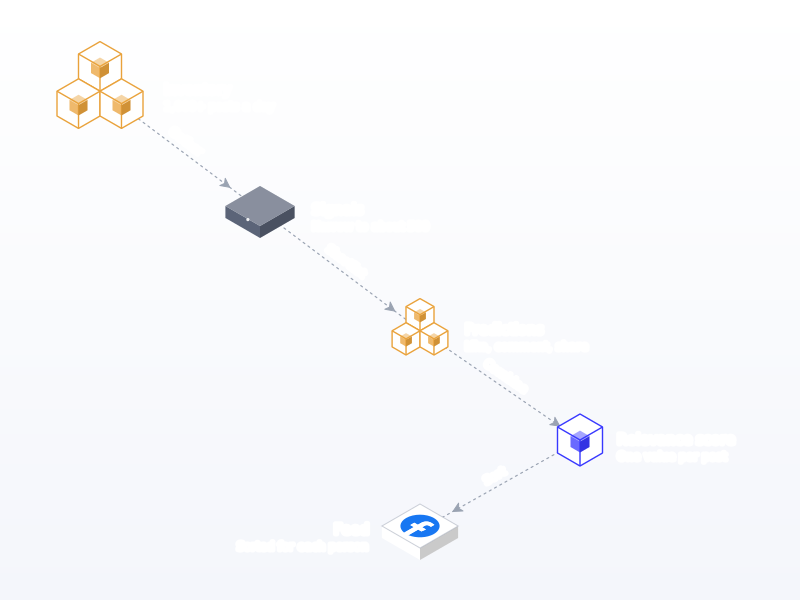
The interesting differences are in the numbers and the predictions for each surface.
| Surface | Candidates kept after the first pass | Where the inventory comes from |
|---|---|---|
| Feed (connected) | About 500 selected, about 500 scored | Friends, followed Pages, joined groups |
| Feed recommendations | Not stated | A portion of public photos, videos and links |
| Reels | About 10 to 100 | Followed accounts, reels similar to ones you engaged with, accounts similar to ones you follow |
| Video | About 1,000, then the top 200 scored | Videos related to what you watched and engaged with recently |
| Groups feed | About 200 | Groups you belong to, some you do not, unseen posts since last login |
Notice how small the Reels shortlist is. A Reel has to beat a far tougher cut to be shown at all, which is why the first seconds of a Reel matter so much more than the first line of a text post. For the general version of this pipeline across every network, see our explainer on how social media algorithms work.
Breakdown 1: What Each Facebook Surface Predicts
"The Facebook algorithm" is shorthand. Each surface has its own model with its own list of predictions, and the lists are different enough that the same post can do well in one place and poorly in another. Here is what Meta says each model is trying to predict, and what that means for a Page.
Feed: posts from friends, Pages and groups you follow
The October 2026 Feed card lists ten predictions. The most useful for a Page are the likelihood a person will scroll past rather than engage, the likelihood they will click into a post and open it full-screen, the likelihood they will click an external link and how long they will stay on that site, and the likelihood of strong intent to interact with friends or groups. Example signals include time spent on posts, how often you have seen a content type in the past hour, videos watched for more than 30 seconds, and past interactions with the post's author.
Two things stand out. First, "scroll past" is a prediction in its own right, so a post that nobody stops for is actively scored down, not just ignored. Second, the "how often you have seen this content type in the past hour" signal is why posting five near-identical updates in a row works against you. The card also says the system aims for "a balanced mix of content types."
Feed recommendations: posts from accounts you do not follow
This is where Pages find new audiences. The recommendations card lists predictions that are noticeably different from connected Feed: how long a person will look at a post, whether they will share it, whether they will privately share it on other platforms, whether they will take a screenshot, whether they will join a group, whether they will click "Show more", and whether they will click "X" to dismiss it. Signals include content type, video length, time of day, and how many recommended posts the person has already viewed in the last day, 7 days and 14 days.
Shares, screenshots and private shares are the tell. For an unknown account, Meta is looking for content people find useful enough to keep or pass on. A clear how-to, a checklist, a striking local photo or a genuinely funny short clip fits that profile. A generic promotional post does not.
Reels: the short-video feed
The Reels card predicts how long you will watch, whether you will keep watching after opening a reel full screen, whether you will like it, whether you will watch to completion, whether you will skip it, and whether you will ask to see less like it. Signals include how many times others have viewed or completed the reel, its length and how well its topic matches your viewing patterns. Completion is relative to length, so a tight 20-second reel and a well-paced three-minute reel can both win. A slow start loses either way.
Video: the longer-viewing surface
The Video card is the most specific Meta has published. Its predictions include the chance a viewer will watch for more than 30 seconds, share the video, share it in a chat, comment, react, and click "Show less". Signals include videos you watched for under three seconds or over 30 seconds, your watch history by video length, the video's share, view and comment counts, and the average watch time in the countries where the video is most popular. The 3-second and 30-second thresholds are worth designing around: earn the first three seconds with a visual change or a spoken hook, and earn the 30-second mark with a payoff or a reason to stay.
Groups feed: community posts
The Groups feed card narrows candidates to about 200 and predicts reactions, viewing time, hiding, and whether you will join a group after seeing one of its posts. That last prediction is the mechanism behind group discovery: a strong post in a public group is shown to non-members as a recruitment tool. Our guide to Facebook Groups for business covers how to run a group that benefits from this.
Comments: the ranking inside every post
Comments are ranked too. The ranked comments card says the system predicts whether a comment is likely to generate meaningful replies, using signals such as relevance, whether the comment asks a question, how many unique people have replied, and how often the post author replies. It also scores comment quality, penalising low-effort or repetitive comments. In plain terms, a Page that answers its comments makes the whole thread more visible, and a thread that is visible keeps the post alive in Feed.
Search
The Search card lists signals such as post like count, predicted language, whether the query is seeking news, time since posting and click-through rate. Clear, keyword-bearing first lines help posts surface in search long after they leave Feed.
| Surface | Predictions that matter most for Pages | What to optimise |
|---|---|---|
| Feed | Scroll past, click into post, link click and dwell time, strong intent to interact | A first line that stops the scroll and a body worth expanding |
| Feed recommendations | Time viewed, shares, private shares, screenshots, "X" dismissals | Content worth saving or sending: guides, lists, local news, humour |
| Reels | Watch time, completion, skip, see less | A hook in the first second and pacing that holds to the end |
| Video | Watch past 30 seconds, shares in chat, comments | Earn second 3 and second 30; give people a reason to forward |
| Groups | Reactions, view time, joining the group | Posts that solve members' problems in public |
| Comments | Meaningful replies, author reply rate, comment quality | Reply to commenters, ask follow-up questions |
Breakdown 2: Where Facebook Views Actually Come From
The most underused source on Facebook ranking is Meta's own quarterly data on what people see. The Widely Viewed Content Report for Q2 2026 (April to June) breaks down US Feed views by source:
| Source of the post | Share of US Feed views, Q2 2026 | What it means for a Page |
|---|---|---|
| Friends | 20.2% | Pages cannot compete here directly, but staff and customer reshares put Page content into this slot |
| Groups people have joined | 14.6% | Groups are a larger channel than most Page owners assume |
| Pages people follow | 14.8% | Your followers are one source among several, not the default audience |
| In-Feed recommendations (unconnected) | 36.6% | The biggest single slot, and the only one where non-followers see you |
| Other products and logging discrepancies | 13.8% | Events and smaller surfaces |
The same report says the top 20 Pages accounted for only about 1.6% of all US content views, so Feed is not dominated by a handful of giants. The recommendation slot is open to anyone whose posts earn it.
Friends: the slot you reach through people
The friends slot is the one Meta protects most, which is why it launched the dedicated Friends tab in 2025 with no recommended content at all. A Page reaches it indirectly, when a person shares your post to their own profile or a chat. This is why shares count for so much more than reactions on a business post. Our walkthrough on how to see who shared your Facebook post shows how to find and thank those people.
Groups: the slot you reach through community
At 14.6% of US Feed views, groups are close to followed Pages in size. Meta's Feed card even includes a specific prediction for "strong intent to engage with posts from a group you're connected to." Running or participating in a group is the most direct way for a business to borrow this channel.
Followed Pages: the slot you own, sort of
Your followers do see your posts in Feed, but they see them ranked against everything else their friends and groups produced. The 2018 change that introduced "meaningful interactions" warned plainly that "Pages may see their reach, video watch time and referral traffic decrease", and the mechanism has not changed. Followers who never interact gradually see less from you.
Recommendations: the slot you earn
The recommendation slot is where growth happens, and it has its own eligibility rules. Facebook's Recommendations Guidelines list content that can stay up but will not be recommended, including "unoriginal content largely repurposed from another source" and "long captions unrelated to the underlying content." If your posts never seem to reach non-followers, check this list before anything else.
Breakdown 3: How Each Content Format Performs
Meta does not publish format-level performance, so this is where independent data comes in. Two datasets measure engagement differently but agree on the order.
| Format | Socialinsider average engagement rate, 2025 | Buffer median engagement rate | Notes |
|---|---|---|---|
| Text (status) | 0.20% | 4.76% | Strong when it starts a conversation |
| Photo album | 0.18% | Not reported | Multiple images keep people on the post |
| Reel | 0.18% | 4.84% (video) | The main route to non-followers |
| Single image | 0.15% | 5.2% | Buffer's top format on Facebook |
| Link | 0.05% | 4.43% | Lowest in both datasets |
The Socialinsider figures come from its 2026 Facebook benchmarks, based on 25 million posts from 130,683 Pages between January 2024 and December 2025, calculated per follower. Buffer's figures come from its March 2026 content format study, which reports median engagement rates. The absolute numbers differ because the methods differ. The ranking of formats is what to take from both.
Reels and video
Video is where Meta is investing, and the incentives show it. Meta's October 2025 update said time spent watching video on Facebook rose more than 20% year over year in the US. Because all video is now a Reel, the Reels card's watch-time and completion predictions apply to every clip you post. Shoot vertical, put the point on screen in the first second, add captions for silent viewing, and use the freedom of no length cap only when the content earns it. Our comparison of Instagram Reels vs TikTok covers the short-video craft that transfers to Facebook, and the Facebook aspect ratios guide covers the specs.
Photos and albums
Photos remain reliable. In Buffer's data the single image was Facebook's highest-engagement format. Albums do well in Socialinsider's data because they give the Feed model something it explicitly predicts: a click into the post and time spent on it. Use albums for events, before-and-after sets, new stock and team days.
Text posts
Plain text had the highest per-follower engagement rate in Socialinsider's 2025 data at 0.20%. Text posts are cheap to make and are the natural format for questions, opinions and short stories, which map directly onto the comment predictions. Keep the first line strong: Facebook truncates long posts, and the "click into a post" prediction rewards a first line that makes people tap "See more". Our Facebook character counter shows where the cut falls.
Link posts
Links sit at the bottom of every dataset, and Meta's own view data shows why: only 1.1% of US Feed views in Q2 2026 were of posts with an outside link. But Meta has never said links are banned or automatically penalised. The Feed card explicitly predicts "the likelihood you'll click an external link, and how long you'll stay on that site," which means a link to a page people actually read can be rewarded. What is demoted is clickbait. Meta's clickbait guidelines name withheld information, sensational phrasing like "You won't believe..." and heavy use of capital letters and exclamation marks. Meta's own creator guidance from July 2025 also notes that "captions with no links, minimal use of capital letters and no more than five hashtags perform best." Use links sparingly, write the value into the post itself, and tag every link with UTM parameters (our UTM builder does it in seconds) so you judge it on traffic, not reactions.
Breakdown 4: By Account Type and Size
The same ranking treats accounts differently mostly because their relationships differ, not because of special rules.
Personal profiles
Profiles have the strongest relationship signals and own the friends slot, 20.2% of US Feed views. A founder or employee sharing a Page post with a sentence of personal context often reaches more people than the Page did.
Business Pages
Pages rely on the followed-Pages slot and on recommendations, so they benefit most from predictions that do not depend on friendship: watch time, shares, screenshots and time spent. A Page that publishes useful or entertaining content beats one that behaves like an ad account.
Creators
Creator accounts are where Meta's originality rules bite hardest, because monetisation is tied to them. The March 2026 update says creators adding "substantial creative value" are more likely to be recommended.
Group admins
Admins benefit from the Groups card's "join the group after seeing its post" prediction. A public group with active discussion is effectively a second distribution engine, one that also feeds the 14.6% groups slot in members' Feeds.
Small Pages versus large Pages
Because recommendations are ranked per viewer, a small Page is not locked out. Socialinsider's benchmark also shows brands cut posting volume by 22% year over year to an average of 39 posts a month, which leaves room for small Pages that post consistently. The realistic goal for a small Page is a steady stream of posts that each earn a few shares, because shares open the recommendation slot.
| Account type | Main Feed slot | Strongest lever | Biggest risk |
|---|---|---|---|
| Personal profile | Friends | Personal context on shared posts | Over-promoting to friends |
| Local business Page | Followed Pages, recommendations | Local photos, events, useful local info | Posting only offers |
| B2B or service Page | Followed Pages, groups | Practical advice, team faces, short explainers | Link-only posts to the blog |
| Creator | Recommendations, Reels | Original video with a clear point of view | Reposting or reaction-only content |
| Group admin | Groups | Discussion prompts members can answer | Letting the group fill with spam |
Breakdown 5: The Life of a Facebook Post
Meta does not publish a timeline, but its signals imply one. Many of the signals in the system cards are counts that accumulate over time: shares, completions, comment replies, views. That gives a post a rough lifecycle.
The first hour: followers and early signals
A new post enters the inventory of your followers and group members. The first people to see it generate the counts every later ranking decision uses: how many stopped, opened, watched past 30 seconds, commented or shared. This is why timing still matters even though Facebook's Feed is not chronological. Publishing when your audience is online gives the post its best first sample. Our guide to the best time to post on Facebook explains how to find that window for your own Page.
The first day: conversation and freshness
If the early sample is good, the post keeps ranking in followers' Feeds. Comments and replies keep it there, and the comment ranking model rewards threads where the author replies. Freshness also matters more than it used to: Meta's same-day push means a reel posted today competes for a slot that did not exist a year ago.
Recommendation: reaching people who do not follow you
Posts with strong share, watch and dwell signals become candidates for the recommendation slot, which can start hours or days after posting. Eligibility depends on the Recommendations Guidelines, so original content is a precondition.
The long tail: search, groups and reshares
After its Feed life, a post can keep earning through Search, group shares and people sending it in chats. Evergreen posts with descriptive first lines have the longest tails.
| Phase | Rough timing | Signals in play | Your job |
|---|---|---|---|
| Launch | First hour | Scroll past, clicks into the post, 3 and 30 second watch | Publish when followers are active; be online to reply |
| Conversation | First day | Comments, replies, author reply rate, shares | Answer comments with real follow-ups |
| Recommendation | Hours to days | Shares, private shares, screenshots, completion | Make content worth passing on |
| Long tail | Weeks | Search click-through, likes, group reshares | Descriptive first lines, evergreen topics |
What Meta Says Versus What the Data Shows
Facebook folklore is full of rules that do not survive contact with Meta's own documents or independent data. Here is how the common claims hold up.
| Claim | What Meta says | What the data shows | Verdict |
|---|---|---|---|
| "Facebook buries all link posts" | The Feed card predicts link clicks and time on the destination site; only clickbait is named for demotion | Link posts have the lowest engagement in both Socialinsider and Buffer data, and 1.1% of US Feed views include a link | Partly true: links are not penalised by rule, but they rarely win |
| "Pages only reach a fraction of followers" | Followed Pages compete with friends, groups and recommendations | Followed Pages were 14.8% of US Feed views in Q2 2026 | True, and expected |
| "Reposting viral content is a growth hack" | Repeat reposters get reduced distribution on everything they share | Meta reports original Reel views roughly doubled in H2 2025 | False in 2026 |
| "More hashtags means more reach" | Meta's creator guidance says no more than five hashtags perform best | No independent evidence that heavy hashtag use helps on Facebook | False |
| "Asking for likes and shares boosts reach" | Engagement bait is a named demotion category | Not measured independently, but the policy is explicit | False |
| "Followers do not matter any more" | Connected sources are still about half of US Feed views | Friends, groups and followed Pages were 49.6% of US Feed views in Q2 2026 | False: they matter, they are just not everything |
Engagement bait is a named demotion
Meta defines engagement bait as "posts that explicitly request engagement (such as votes, shares, comments, tags, likes, or other reactions)" for purposes other than a specific call to action, such as finding a missing person or raising money. The rationale is blunt: "Feedback shows people dislike spammy posts on Facebook that ask them to interact." Asking a genuine question is fine. "Comment YES if you agree" is not.
The full demotion list
Meta's types of content we demote page names four categories: clickbait links, engagement bait, fact-checked misinformation, and content likely to violate the Community Standards. It also describes borderline content that is shown less often, mainly to people who prefer not to see it. Add the Recommendations Guidelines and the 2026 originality rules and you have the complete set of reasons a post is held back.
Viewer feedback is a ranking signal
When Meta published its system cards in 2023, Nick Clegg wrote that the "Show more, Show less" option appears on posts in Feed, Video and Reels, and that the signals shared "represent the vast majority of signals currently used in Facebook Feed ranking". The recommendations card says these buttons "temporarily increase or decrease the ranking score for a post and other posts like it," so every hide or "Show less" counts against your future posts with that viewer.
A Worked Example: Two Pages, One Week
Here are two realistic Pages and the week each would schedule after reading the system cards.
Example 1: a neighbourhood bakery
Hearth and Crumb is a two-location bakery with 4,800 Page followers, mostly local. Its old pattern was a daily "Fresh today!" photo and a weekly link to its online ordering page. Reach was flat and the link posts barely registered. Here is the revised week, scheduled in one sitting on Sunday evening:
| Day | Format | Post | Signal it targets |
|---|---|---|---|
| Monday | Text | "We are testing two new loaves this month and can only keep one. Seeded rye or olive and rosemary? The loser goes into the archive." | Meaningful comments |
| Tuesday | Reel, 40 seconds | Shaping 200 croissants at 5am, with on-screen text "Every croissant, every morning, by hand" | Watch time, completion, recommendations |
| Wednesday | Album | Six photos of the new seasonal bakes with prices in the caption | Clicks into the post, time spent |
| Thursday | Text | "Local question: what is the best bakery you have ever visited on holiday? Asking for menu research." | Comments, replies between people |
| Friday | Photo with link in first comment | Weekend pre-order reminder, photo of the order shelf, ordering link in the first comment | Link click and dwell time without leading with a link |
| Saturday | Reel, 15 seconds | The queue at opening, set to the shop's own sound | Shares to friends and chats |
None of these posts asks for engagement. Each gives people a reason to stop, watch or answer. The bakery replies to every comment on Monday and Thursday within the first hour, which the comment ranking model rewards. The order link moves to the first comment, which Meta's own creator caption guidance supports.
Example 2: a five-person accounting firm
Ledgerwise Accounting has 1,200 followers and a Page that used to be a feed of blog links. Its new week keeps one link post, with a three-sentence summary that is useful even without a click, and builds the rest around original material: a 60-second Reel of a partner explaining one deadline change face to camera, a text post listing three receipts owners forget to keep, and a year-end checklist graphic designed to be screenshotted, the exact behaviour the recommendations card predicts. Staff share the Reel to their own profiles with a line of personal context, which moves it into the friends slot.
Copy-ready post templates
| Goal | Template | Avoid |
|---|---|---|
| Comments | "We can only keep one of [A] or [B]. Which should stay, and why?" | "Comment A or B!" |
| Shares | "[Number] things [audience] should know before [event or decision]:" followed by the full list | "Share this with a friend who needs it" |
| Saves and screenshots | A one-image checklist or cheat sheet with a clear title | Dense text images that are unreadable on a phone |
| Reel watch time | Open on the result, then show how you got there | Logo intros and "Hey guys, welcome back" |
| Link clicks | Two or three sentences of real value, then "Full breakdown here:" and the link | Headline-only links with withheld details |
| Group growth | "Members asked about [topic] this week. Here are the three best answers from the group." | Promotional posts dropped into other people's groups |
How to Work With the Facebook Algorithm: A Step-by-Step Method
This method turns the system cards into a weekly routine for any Page.
- Check your Page is eligible for recommendations. Open Account Status or the Page quality section in Meta Business Suite or your Professional Dashboard and look for any reduced distribution or recommendation restrictions. If anything is flagged, fix that first; nothing else in this list works while a Page is non-recommendable.
- Audit the last 30 posts by format. Export or note reach, shares and comments for each, grouped into text, image, album, Reel and link. Our Facebook engagement calculator gives you a comparable rate per post. Compare your formats against each other, not against generic benchmarks.
- Find your recommendation winners. In Insights, look at the share of views from non-followers for each post. The posts with the highest non-follower share are the ones the recommendation system liked. Write down what they have in common: topic, format, length, first line.
- Remove anything unoriginal. Stop reposting other creators' clips, memes and watermarked videos from other apps. If you repurpose your own content, export a clean version. Meta specifically advises avoiding visible third-party watermarks.
- Set a format mix for the next four weeks. A reasonable starting point for most Pages is two Reels, one or two conversation posts, one photo or album and at most one link post a week, then adjust based on step 3.
- Write first lines for the "scroll past" prediction. Every post's first line should make a specific promise or ask a specific question. Every Reel's first second should show the payoff.
- Batch and schedule the month. Plan the posts on a content calendar so the format mix is visible at a glance, then schedule them for your Page's active hours. Batching is what makes consistency realistic, and consistency is what Buffer's 100,000-user study ties to higher engagement per post.
- Block reply time after each post. Put 20 minutes in your diary for the first hour after each scheduled post to answer comments with follow-up questions. The comment ranking model counts how often the author replies.
- Review every two weeks and change one variable. Compare non-follower reach, shares and comments per post. Change one thing at a time (Reel length, posting hour, first-line style) so you can tell what moved the numbers.
Common Mistakes With the Facebook Algorithm
- Reposting other people's viral content. Since July 2025, repeat reposting reduces distribution on everything a Page shares. Fix: post only content you made, or add genuine new information or analysis on screen.
- Uploading videos with another app's watermark. Recycled-looking video is called out in Meta's creator guidance. Fix: export clean files from your editor and keep the originals in one place.
- Treating "edit the speed and add captions" as originality. Meta's March 2026 rules list minor edits like borders, captions and speed changes as unoriginal. Fix: add substance, not decoration.
- Asking for engagement. "Like if you agree" and "Tag a friend" are named engagement bait. Fix: ask a specific, answerable question instead.
- Writing clickbait headlines on link posts. Withheld information and "You won't believe" phrasing are demoted. Fix: tell people what they will get, then link.
- Leading every post with a link. Link posts sit last in every engagement dataset. Fix: put the value in the post and the link in the first comment, or limit links to one post a week.
- Posting and disappearing. The comment ranking model tracks how often the author replies. Fix: reply within the first hour, with follow-up questions rather than "Thanks!"
- Slow video openings. The Video card counts views under three seconds and over 30 seconds. Fix: open on the result or the most surprising frame, and deliver a payoff before second 30.
- Posting five similar updates in a row. The Feed model tracks how often you have seen a content type in the past hour and aims for variety. Fix: spread posts across the week and vary formats.
- Stuffing hashtags. Meta's own guidance says no more than five perform best. Fix: use zero to three specific hashtags, or none.
- Posting in bursts. A week of daily posts followed by a month of silence gives the system nothing stable to learn from. Fix: schedule a sustainable rhythm in advance; our guide on how to stay consistent on social media has a system for it.
- Judging posts by likes alone. Likes are one prediction among many, and shares and watch time drive recommendations. Fix: track reach from non-followers, shares and comments per post alongside engagement rate.
Why Facebook Is Still Worth the Effort
It is easy to treat Facebook as a legacy channel, but Pew Research Center's 2025 survey of 5,022 US adults found 71% use Facebook, including 80% of adults aged 30 to 49. For businesses selling to adults over 30, local businesses and community builders, it remains one of the largest audiences you can reach organically, and its algorithm is more documented than any other platform's. If you also post on Instagram, our guide to how the Instagram algorithm works covers the sister system.
Schedule to Every Platform From One Calendar
Plan a month of posts for LinkedIn, X, TikTok, YouTube, Bluesky and Pinterest on one calendar, and let Postprism publish them at your best times while you focus on the replies.

Frequently Asked Questions
How does the Facebook algorithm work in simple terms?
For each surface, Facebook gathers the posts you could see, uses a fast model to shortlist the most relevant, predicts how you will respond to each (scroll past, watch, comment, share, hide), combines those predictions into a relevance score and shows the highest-scoring posts first. Meta publishes the predictions and example signals for every surface in its Transparency Center system cards.
Does Facebook still show Page posts to followers?
Yes, but ranked against everything else. In Q2 2026 posts from followed Pages made up 14.8% of US Feed views, compared with 20.2% from friends, 14.6% from groups and 36.6% from recommendations. Followers who interact with your Page regularly will see more of it; those who never do will gradually see less.
Are link posts penalised on Facebook?
Not by rule. Meta's Feed model predicts whether you will click an external link and how long you will stay on the site, so useful links can do well. Clickbait links are demoted. In practice link posts have the lowest engagement in independent benchmarks, so the best approach is to deliver value in the post and use links sparingly, often in the first comment.
What counts as unoriginal content on Facebook?
Meta's 2026 rules treat reposting other creators' content, reaction-only videos, stitched clips, narration of what is already on screen, and minor edits like borders, captions or speed changes as unoriginal. Content you filmed or produced yourself is original, and so is third-party material when you add genuinely new information or analysis. Repeat offenders get reduced distribution and may become non-recommendable.
Are Reels the best format for Facebook reach?
Reels are the main route to people who do not follow you, because they feed the recommendation system and Meta is investing heavily in video. Meta says Reels longer than a minute account for over half of watch time on Facebook. For engagement from existing followers, text posts, photos and albums perform as well or better in independent data, so most Pages should use a mix.
Do hashtags help on Facebook?
Not much. Meta's own July 2025 creator guidance says captions with no more than five hashtags perform best, and there is no independent evidence that heavy hashtag use increases reach. A clear topic in your caption and on-screen text matters more now that Meta uses LLMs to understand what content is about.
What time should I post on Facebook?
Post when your own followers are most active, because the first hour's response is what the ranking builds on. That varies by audience and time zone, so check the active-hours data in your Page Insights and schedule to hit that window consistently.
How do I know if my Facebook Page reach is restricted?
Check Account Status or the Page quality section in Meta Business Suite or your Professional Dashboard. It shows whether content has been removed, had its distribution reduced, or whether the Page is ineligible for recommendations. If nothing is flagged, a reach drop usually comes from a format change, weaker early engagement, unoriginal content or stronger competition in the recommendation pool.


