
The Case for Each Platform in 2026
Twitter/X and LinkedIn are the two platforms where organic reach, the ability to reach people beyond your existing followers without paying for distribution, is still meaningfully available in 2026. Facebook and Instagram have effectively eliminated organic reach for most brands. TikTok offers organic reach but for a very different audience and content format. For professional content creators and B2B brands, the choice between Twitter/X and LinkedIn is the single most consequential platform decision they will make this year, and it deserves more than a coin flip.

Both platforms have genuine strengths. LinkedIn offers a professional context, the highest average income of any major social platform, the deepest concentration of buying-committee members anywhere online, and a feed algorithm that rewards in-depth educational content from accounts of any size. Twitter/X offers a faster-moving conversation, an unmatched venue for building public intellectual reputation, more diverse audience demographics, and a culture that rewards sharp, concise, confident thinking. The right choice depends on who you are trying to reach, what you are trying to accomplish, and what kind of content you can sustain producing.
It helps to be precise about what organic reach actually means on each platform in 2026, because the two work in almost opposite ways. On LinkedIn, organic reach is broad but bounded: a strong post reliably reaches a multiple of your follower count, but it rarely escapes the gravity of professional networks entirely. On Twitter/X, organic reach is narrow at the base but uncapped at the top: most posts reach a fraction of your followers, but the ceiling on a post that catches fire is effectively the entire platform. One platform gives you a dependable floor. The other gives you a lottery ticket with a real payout. Understanding which kind of distribution serves your goals is the foundation of this decision.
This guide is organized to take you from audience to algorithm to format to funnel to a concrete decision. By the end you should know not only which platform to choose, but exactly how to run it, how to measure it, and how to run both without doubling your workload. If your primary question is the B2B one, "twitter vs linkedin for b2b," the funnel and decision-framework sections below address it head on with scoring tables and industry guidance.
Key takeaway: LinkedIn gives you a dependable reach floor and a short path from content to a sales conversation. Twitter/X gives you an uncapped reach ceiling and a short path from content to public reputation. Choose the distribution shape that matches your business goal, not the platform you personally enjoy more.
Audience and Demographics: Who Is Actually on Each Platform
LinkedIn's user base is definitionally professional. People are on the platform to manage their career and professional reputation, which means they arrive in a buying and learning mindset rather than an entertainment one. The average income is higher than on any other social platform. Decision-makers, executives, managers, directors, and procurement officers, are active on LinkedIn in ways they simply are not elsewhere. If your target audience is professional buyers in B2B contexts, LinkedIn has a concentration of them that no other channel matches.
Twitter/X's audience is more diverse in raw demographic terms but has a specific cultural character: it skews toward media, technology, finance, academia, software, venture, and what could broadly be described as the thinking and building class. It is where journalists, analysts, founders, engineers, and public intellectuals congregate, and where ideas propagate fastest. If your goal is building a public intellectual reputation or reaching a media-adjacent audience that shapes what other people believe, Twitter/X often offers access to that audience more efficiently than LinkedIn does.
B2B Buyer Concentration: The Decisive Difference
For B2B specifically, the audience question collapses into one variable: where are the people who can actually approve a purchase, and where are the people who influence them? Modern B2B purchases are made by committees, not individuals. A typical enterprise software deal involves an economic buyer who controls budget, a champion who advocates internally, several technical evaluators, and a procurement or legal gatekeeper. LinkedIn is the only platform where you can plausibly reach every one of these roles in the same place, identify them by title and company, and see their professional relationships to one another.
This matters because B2B content does not need to reach millions of people. It needs to reach the right few thousand. A LinkedIn post that reaches 8,000 people, of whom 200 are directors and VPs at companies in your target market, is worth more than a viral tweet seen by 800,000 people who will never buy. LinkedIn lets you optimize for buyer density rather than raw volume, and buyer density is what converts in B2B.
Seniority, Income, and Intent
The table below summarizes the practical audience differences that should drive your decision. These are directional characteristics rather than precise statistics, but they reflect how the platforms behave in 2026.
| Dimension | Twitter/X | |
|---|---|---|
| Dominant mindset | Career, learning, buying | News, opinion, entertainment, ideas |
| Seniority concentration | Very high: directors, VPs, C-suite active and reachable | Mixed: founders and operators present, but harder to target |
| Average user income | Highest of any social platform | Above average, skewed by tech and finance |
| Purchase authority per user | High, especially in B2B segments | Variable, strong in startup and tech niches |
| Buying intent on platform | Latent and reachable; users expect professional pitches | Low and indirect; selling feels intrusive |
| Best-fit industries | SaaS, consulting, finance, recruiting, manufacturing, enterprise | Tech, media, crypto, venture, creator economy, AI |
| Identifiability of audience | By name, title, company, and seniority | By interest and follow graph, not job role |
The headline implication: if you sell something with a deliberate, considered buying process to professionals who can be identified by job title, LinkedIn's audience structure is built for you. If you sell to developers, founders, or consumers, or if your goal is influence and reputation more than direct leads, Twitter/X's audience structure may serve you better despite its weaker direct-response characteristics.
Plan every platform from one calendar
Postprism schedules and auto-publishes to all 9 networks from a single content calendar. Start your 7-day free trial.

How Each Algorithm Distributes Content
Choosing a platform without understanding its distribution engine is like choosing a car without knowing whether it runs on petrol or electricity. The two algorithms reward fundamentally different behaviors, and the content that thrives on each is shaped by these mechanics.
The LinkedIn Algorithm: Dwell, Early Engagement, and Network Proximity
LinkedIn distribution in 2026 is governed primarily by three signals working together. The first is dwell time: how long people stop scrolling and actually read your post. This is why the format rewards content that earns the click on "see more" and then holds attention through a structured body. A post that makes someone pause for 30 seconds outperforms a flashier post they scroll past in two.
The second signal is early engagement velocity. When you publish, LinkedIn shows the post to a small initial sample of your network. If that sample comments, reacts, and dwells quickly, the algorithm expands distribution in waves to second and third degree connections. If the initial sample ignores it, the post is quietly buried. This is why the first 60 to 90 minutes after publishing are decisive, and why responding to early comments to keep the conversation alive directly increases reach.
The third signal is network proximity and relevance. LinkedIn weighs how related a viewer is to you and to the topic. Content that stays close to your professional identity, where you have demonstrated relevance, travels further than off-topic content. The practical implication is consistency: posting repeatedly about the same problem space teaches the algorithm who should see your work. For the full playbook on what this means for individual posts, see The Perfect LinkedIn Post Formula, and for the broader content engine see LinkedIn Content Strategy for 2026.
The Twitter/X Algorithm: Engagement Prediction, Authority, and Replies
Twitter/X distribution in 2026 runs on a heavy-tail prediction model. For every candidate post, the algorithm predicts how likely you are to engage with it, weighting replies and longer dwell far more than likes. It then ranks your feed by predicted engagement. Two consequences follow. First, replies are the most valuable engagement type; a post that sparks a conversation gets shown to far more people than one that merely collects likes. Second, the algorithm strongly rewards authority within a topic: accounts that consistently post about a subject and earn engagement from credible accounts in that subject get amplified within it.
The system also factors in account reputation and, for subscribers, gives a ranking boost to verified and premium accounts in replies and feed placement. The reach floor for small accounts is genuinely low, which is why new Twitter/X accounts feel like shouting into a void for the first months. But the ceiling is unbounded: when a post catches a credible re-share, the prediction model cascades it across millions of feeds in hours. For a deeper breakdown of these mechanics, see The Twitter/X Algorithm in 2026.
| Mechanic | Twitter/X | |
|---|---|---|
| Primary signal | Dwell time plus early engagement velocity | Predicted engagement, especially replies |
| Most valuable action | Thoughtful comment plus long read | Reply and re-share by credible accounts |
| Reach floor for small accounts | Relatively high; merit can win | Low; early growth is slow |
| Reach ceiling | Bounded by professional network structure | Effectively unlimited on a viral hit |
| Critical time window | First 60 to 90 minutes | First 30 to 60 minutes, then long-tail re-shares |
| Topical consistency payoff | High: teaches the network who to show you to | High: builds topic authority for amplification |
The practical takeaway is that both platforms reward the same underlying discipline, consistent posting in a defined topic with fast early interaction, but they cash it out differently. On LinkedIn you nurture early comments to unlock predictable network reach. On Twitter/X you write to provoke replies and earn re-shares from authoritative accounts to unlock unpredictable but enormous reach.
Content Format Deep Dives
The content that works on LinkedIn is fundamentally different from what works on Twitter/X. Treating them as interchangeable is the most common and most expensive mistake creators make. Below is a format-by-format breakdown of what each platform actually rewards.
LinkedIn Formats
- The text post. The atomic unit of LinkedIn. A strong hook in the first two lines, a structured body of 800 to 1,300 characters, generous line breaks for scannability, and a closing question that invites comments. This is where most B2B authority is built. It rewards a single clear idea, a personal angle, and restraint with self-promotion.
- The document or carousel. A multi-page PDF that users swipe through in-feed. Excellent for frameworks, step-by-step guides, and data stories. Carousels generate high dwell time because each swipe is an engagement signal, and they are highly saveable, which extends their life. Ideal for repurposing a dense idea into a visual sequence.
- The newsletter. LinkedIn newsletters notify all subscribers on publish, giving you a guaranteed distribution channel layered on top of the feed. For B2B, a regular newsletter compounds into an owned-adjacent audience and is one of the most underused assets on the platform.
- Native video. Short, captioned, talking-head or screen-share video performs well for demonstrating expertise and building familiarity. LinkedIn has leaned into video distribution, and a face-to-camera clip humanizes a brand faster than text.
Twitter/X Formats
- The single tweet. The atomic unit of Twitter/X: one clear, sharp, defensible idea in under 280 characters. The best single tweets make one specific claim that a reader either strongly agrees with or wants to argue against. Single tweets drive conversation and are the backbone of daily presence.
- The thread. The growth engine of the platform. A thread demonstrates depth and earns considered follows. The hook tweet must work standalone, the body delivers one insight per tweet, and the final tweet asks for the follow or click. See The Twitter/X Thread Strategy That Actually Grows Your Audience for the complete structure.
- The quote post. Re-sharing someone else's post with your own commentary. This is how you enter existing conversations, add a sharper take, and borrow the reach of the original. A well-judged quote post can attach your perspective to a trending discussion.
- The poll. Low-effort, high-engagement. Polls invite a tap, which the algorithm reads as engagement, and they generate replies as people justify their votes. Useful for sparking discussion and for lightweight audience research.
- Long-form posts. For premium accounts, Twitter/X supports articles and long posts that keep readers on-platform. These suit founders and analysts who want to publish an essay without sending readers away, and they can be promoted by the same engagement prediction that ranks tweets.
The deeper point: LinkedIn rewards longer, educational, experience-based content with a professional tone, while Twitter/X rewards concise, opinionated, real-time content with intellectual courage. Content optimized for one usually feels wrong on the other. A LinkedIn post pasted into Twitter/X reads as overlong and formal; a tweet expanded onto LinkedIn reads as thin and flippant. The solution is not cross-posting but adaptation, which we cover in the running-both section below.
Tip: Before you write anything, decide the format first, then write to it. Ask "is this a LinkedIn carousel or a Twitter/X thread?" The same raw idea will take a completely different shape depending on the answer, and choosing up front prevents you from writing format-less content that fits neither platform well.
Posting Cadence and Realistic Time Investment
Sustainability beats intensity. The platform you can post on consistently for a year will outperform the one you burn out on in a month. Here is the honest time math for each.
LinkedIn rewards quality over quantity. Three to five high-quality posts per week is a strong B2B cadence, and even two excellent posts per week, sustained, will build authority. Each post takes more time because the format is more crafted: budget 30 to 60 minutes for a polished text post including ideation, writing, and editing, plus 20 to 30 minutes of comment engagement in the critical window after publishing. The commenting is not optional; it is part of the distribution mechanic.
Twitter/X rewards volume alongside quality. An active presence means three to eight posts per day, mixing single tweets, replies, and the occasional thread. Individual tweets are fast, often two to five minutes, but the cumulative daily commitment is real, and the platform punishes inconsistency more harshly than LinkedIn does. The high-leverage piece is one well-researched thread per week, which might take two to four hours including research, plus daily participation in conversations to stay visible.
In total weekly hours, serious use of either platform lands in a similar range, roughly four to eight hours. The difference is the rhythm: LinkedIn concentrates effort into a few crafted moments, while Twitter/X spreads it across many small daily touches. Match the rhythm to your temperament and schedule, because the wrong rhythm is the most common reason creators quit.
| Cadence factor | Twitter/X | |
|---|---|---|
| Recommended frequency | 3 to 5 posts per week | 3 to 8 posts per day |
| Time per core post | 30 to 60 minutes | 2 to 5 minutes (single), 2 to 4 hours (thread) |
| Engagement workload | 20 to 30 min after each post | Continuous, throughout the day |
| Tolerance for gaps | Moderate; a quiet week recovers | Low; momentum decays fast |
| Rhythm | Concentrated, deliberate | Distributed, conversational |
Mapping Each Platform to the B2B Funnel
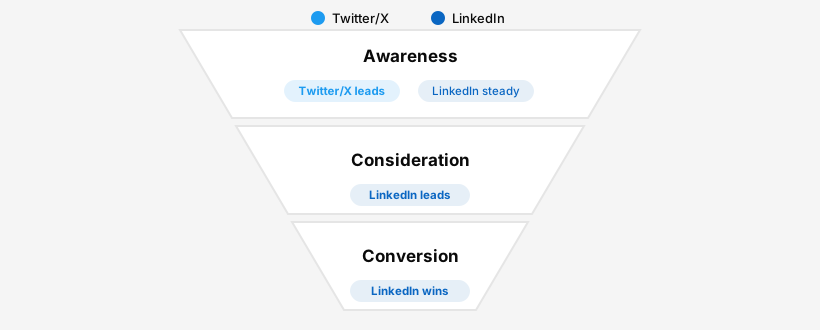
For B2B decision-making, the most useful lens is not "which platform is better" but "which platform serves each stage of the buying journey." Awareness, consideration, and conversion each reward different content and different platforms, and a mature B2B program uses both deliberately rather than picking one and ignoring the funnel.
Awareness
At the top of the funnel, you are introducing your perspective to people who do not yet know you. Twitter/X excels here for tech and founder-led businesses because its viral ceiling and reply-driven distribution can put your idea in front of a large, influential audience quickly. A sharp thread that re-shares well can generate more top-of-funnel awareness in a day than a month of steady LinkedIn posting. LinkedIn also serves awareness, but more steadily: consistent posting builds recognition within your professional network and its extensions, compounding into familiarity over time rather than spiking.
Consideration
In the middle of the funnel, prospects are evaluating whether you understand their problem and could plausibly solve it. This is LinkedIn's home turf. Document carousels that lay out a framework, case-study posts that show outcomes, and newsletters that go deep on a recurring pain point all move buyers from "I have heard of them" to "they get my problem." Because LinkedIn users are identifiable by role and company, you can also see which target accounts are engaging, which is invaluable signal for sales. Twitter/X contributes here mainly by sustaining the relationship: prospects who found you through a viral moment keep seeing your daily takes and build trust gradually.
Conversion
At the bottom of the funnel, you need a short path from interest to conversation. LinkedIn wins decisively. The platform is built for professional outreach: a prospect who comments on your post can be messaged directly, InMail provides a structured cold-contact channel, and the entire interaction happens in a context where a business pitch is expected rather than intrusive. Twitter/X conversion is real but indirect, usually flowing through a profile link to a landing page or a direct message that has to overcome the platform's casual, non-commercial norms.
Lead-Generation Tactics Per Platform
- LinkedIn lead magnets. Offer a high-value resource (a template, a benchmark report, a checklist) in a post and deliver it via comment-then-DM. This captures intent and opens a one-to-one conversation in the same motion.
- LinkedIn DMs and InMail. Warm DMs to people who engaged with your content convert far better than cold outreach. InMail extends this to people outside your network with a structured, expected format.
- LinkedIn newsletter CTAs. Each newsletter edition can end with a soft call to book a call or reply, turning a content asset into a lead channel that notifies subscribers on every send.
- Twitter/X thread-to-newsletter. End a high-performing thread with a link to a newsletter or lead magnet. The reader has just consumed a substantial sample of your thinking and is primed to subscribe.
- Twitter/X DMs from engagement. Founders frequently close early deals through DMs that begin as replies. The platform's informality, a liability for cold selling, becomes an asset for relationship-led conversations.
- Retargeting across both. Profile and link clicks from either platform can feed paid retargeting audiences, letting organic content do the awareness work and ads do the conversion nudge.
Key takeaway: For B2B, the cleanest mental model is Twitter/X for awareness and reputation, LinkedIn for consideration and conversion. If you only run one, run the one that covers the funnel stage your business most needs filled. If your pipeline problem is "no one knows us," lean Twitter/X. If it is "people know us but do not buy," lean LinkedIn.
A Clear Decision Framework
Theory is useful, but you need a decision. The scoring table below turns the trade-offs into a concrete choice. Read each statement, mark which platform it points to, and tally the results. The platform with more matches is where you should start.
| If this describes you... | Choose LinkedIn | Choose Twitter/X |
|---|---|---|
| You sell to businesses with a considered buying process | Yes | |
| Your buyers are identifiable by job title and seniority | Yes | |
| You sell to developers, founders, or technical builders | Yes | |
| Your primary goal is direct lead generation and pipeline | Yes | |
| Your primary goal is public reputation and influence | Yes | |
| You can write longer, structured, educational content | Yes | |
| You think in sharp, concise, opinionated takes | Yes | |
| You need a dependable reach floor month over month | Yes | |
| You want a shot at uncapped viral reach | Yes | |
| You operate in media, tech, crypto, venture, or AI | Yes | |
| You operate in SaaS, consulting, finance, or enterprise sales | Yes | |
| You want a short path from a post to a sales conversation | Yes |
Industry-by-Industry Guidance
- Enterprise SaaS and B2B software. LinkedIn first. Buyers are committees of identifiable professionals, and the consideration-to-conversion path is short. Add Twitter/X for founder-led awareness if you sell to technical buyers.
- Developer tools and infrastructure. Twitter/X first. Developers live there, evaluate tools through peer signal, and distrust traditional B2B marketing. LinkedIn supports the economic-buyer conversation later in the deal.
- Professional services and consulting. LinkedIn, decisively. Trust, credentials, and case studies are the currency, and the platform is built to display them to the exact decision-makers you serve.
- Finance and fintech. Both, with weighting by audience. LinkedIn for institutional and enterprise buyers; Twitter/X for retail, crypto, and the analyst-and-commentary layer that shapes sentiment.
- Recruiting and HR tech. LinkedIn, overwhelmingly. The platform is the candidate and hiring-manager graph itself.
- Media, creator economy, and AI startups. Twitter/X first. Reputation and reach there translate into press, partnerships, and inbound, with LinkedIn as a secondary credibility layer.
- Manufacturing, logistics, and industrial B2B. LinkedIn. The buyers are senior, the cycles are long, and the professional context fits the deliberate nature of the purchase.
Running Both Platforms Efficiently
The false premise behind "which one should I choose" is that you must choose forever. For most serious creators and B2B marketing teams, the mature answer is to lead with one and run both, because the two platforms complement rather than duplicate each other. The obstacle is not strategy; it is workload. Producing native content for two platforms with different formats and cadences sounds like double the work. Done correctly, it is closer to 1.3x the work, because the thinking is shared and only the packaging differs.
One Idea, Two Adaptations
The unit of efficiency is the idea, not the post. Start with a single insight, then express it in each platform's native shape. Suppose your insight is "most onboarding flows fail because they teach features instead of outcomes." On LinkedIn that becomes a 1,100-character post with a personal anecdote, a three-part framework, and a closing question. On Twitter/X the same insight becomes a seven-tweet thread that opens with the sharpest version of the claim and unpacks one fix per tweet. Same idea, two treatments, one research session. This adapt-don't-copy discipline is the core skill; for a full methodology see How to Adapt Content Across Platforms and How to Repurpose Content Across Social Media.
Plan and Schedule Both From One Calendar
The operational unlock is planning both platforms together rather than in separate tabs on separate days. This is exactly what Postprism is built for: you write the core idea once, adapt it into a LinkedIn post and a Twitter/X thread in the same workspace, and schedule both onto a single content calendar that auto-publishes at the right time for each platform. Instead of context-switching between two apps and two mental models every day, you batch a week of paired content in one sitting and let the calendar handle delivery. Seeing both platforms side by side also keeps your messaging coherent: the same campaign, the same launches, the same themes, expressed natively on each. For the strategic frame around this, see Building a Cross-Platform Content Strategy.

Tip: Batch by idea, not by platform. In one weekly planning session, list five core insights, then adapt each into its LinkedIn and Twitter/X form back to back while the thinking is fresh. Scheduling them together from one calendar means you touch each idea once instead of twice on two different days.
Adapt once, publish everywhere
Write your idea once, tailor it per platform, and let Postprism publish to all 9 networks on schedule.
Cost Comparison: Time, Premium, and Ads
Neither platform is free, even when you post organically, because your time is the largest cost. Here is how the real costs compare across organic effort, premium subscriptions, and paid entry points.
| Cost type | Twitter/X | |
|---|---|---|
| Organic time cost | Fewer, longer posts plus comment engagement; concentrated hours | Many short posts plus continuous replies; distributed hours |
| Premium subscription | Premium tiers add InMail credits, search, and analytics; mid-range monthly cost | Premium adds reach boost, long-form, and analytics; low-to-mid monthly cost |
| Verification | Company verification available; identity trust is built into the platform | Verification bundled with premium; affects reply ranking |
| Ads entry point | Higher minimum spend and higher cost per click, but precise B2B targeting by title and company | Lower entry cost per click, broader reach, weaker B2B role targeting |
| Cost per qualified B2B lead | Higher cost per click but higher lead quality, often lower true cost per opportunity | Lower cost per click but more nurturing required before a lead qualifies |
The pattern mirrors the audience story. LinkedIn ads cost more per click but let you target by exactly the attributes that define a B2B buyer, so the true cost per qualified opportunity is often competitive despite the higher headline price. Twitter/X ads and premium are cheaper to enter and excellent for awareness, but the lack of role-level targeting means more of your spend reaches people who will never buy. For organic-only operators, the relevant cost is purely time, and the right question is which rhythm, LinkedIn's concentrated bursts or Twitter/X's continuous presence, you can sustain without burning out.
Measurement: The KPIs That Actually Matter
Vanity metrics will mislead you on both platforms. Follower count and like count feel good but correlate weakly with business outcomes. Measure what maps to your funnel instead.
- LinkedIn: Track dwell-driven reach (impressions relative to follower count), comment quality and who is commenting (are they your target titles?), profile views from target accounts, connection requests from buyers, newsletter subscriber growth, and ultimately content-sourced pipeline and meetings booked. The single most valuable B2B metric is the seniority and company-fit of the people engaging, not the raw engagement number.
- Twitter/X: Track reply rate and reply quality (the algorithm's favorite signal and the truest sign of resonance), thread completion and re-shares by credible accounts, follower growth from threads specifically, profile-link click-through, and newsletter or landing-page conversions from your bio and thread CTAs. Treat viral impression spikes as awareness fuel, not as success in themselves.
For both platforms, the north-star question is the same: did this content move a real prospect one step closer to a conversation? Reach and engagement are inputs; meetings, qualified leads, and pipeline are outputs. Build your reporting around the outputs and use the inputs only to diagnose why the outputs moved.
Key takeaway: On both platforms, measure buyer-fit engagement and downstream pipeline, not followers and likes. A post that reaches fewer people but engages the right people is a win; a post that reaches everyone but the wrong people is noise.
The Honest Answer: Where to Start
If you can only focus on one platform, which is the right constraint for most founders and solo creators, the decision comes down to your business model and your funnel gap. If you sell to businesses and your buyers are professionals who make purchasing decisions, start with LinkedIn, because its audience structure, algorithm, and conversion path all point at B2B revenue, and the feedback loop from content to a sales conversation is the shortest available anywhere. If you are building a thought-leadership brand, sell to developers or founders, or want to reach a media-adjacent audience that shapes opinion, start with Twitter/X, because its reach ceiling and reputation effects are unmatched for that goal.
If you genuinely cannot decide, default to LinkedIn for B2B. The reach floor is forgiving for new accounts, the content investment translates more directly into business outcomes, and the path from a post to a booked meeting is the clearest. Once your LinkedIn cadence is consistent and producing pipeline, layer Twitter/X on top for broader top-of-funnel awareness, adapting the same ideas you are already creating. That sequencing, master one, then add the second through adaptation, gets you the compounding benefits of both without the burnout of trying to learn both at once. Plan and schedule the pair from one calendar with Postprism so the second platform costs you packaging time, not a second strategy.
Frequently Asked Questions
Twitter/X vs LinkedIn for B2B: which should I choose?
For most B2B businesses, LinkedIn is the primary platform and Twitter/X is a complementary one. LinkedIn concentrates professional decision-makers with purchasing authority, lets you reach an entire buying committee by title and company, rewards educational long-form content, and offers the shortest path from a post to a sales conversation through comments and InMail. Twitter/X is stronger for building awareness and intellectual credibility with a tech, media, and founder audience, but its leads sit earlier in the buying journey and require more nurturing. If you only have time for one and you sell to businesses, start with LinkedIn. The exception is developer-tools and AI-native startups, where Twitter/X is often the better starting point because the buyers themselves live there.
Can I cross-post the same content on both LinkedIn and Twitter/X?
You can, but you should not copy-paste. The audiences, formats, and cultures differ enough that content optimized for one platform underperforms on the other. What you should do is reuse the same underlying idea, adapted to each format. Your LinkedIn version might be 1,100 characters of structured analysis with a closing question; your Twitter/X version might be a seven-tweet thread leading with the sharpest claim. Same idea, different treatment. Tools like Postprism are designed to make this adapt-and-schedule workflow fast rather than doubling your effort.
How much time does each platform realistically require per week?
Serious use of either platform lands in roughly four to eight hours per week, but the rhythm differs. LinkedIn concentrates that time into three to five crafted posts of 30 to 60 minutes each plus comment engagement after publishing. Twitter/X spreads it across three to eight short posts daily plus one researched thread per week and continuous participation in conversations. The total is comparable; choose the rhythm that fits your temperament, because the wrong rhythm is the main reason people abandon a platform.
Is Twitter/X still relevant for B2B after the platform changes since 2022?
Yes, though the nature of its relevance has shifted. The departure of some users and advertisers after the 2022 ownership change created disruption, but a large professional and intellectual audience remains active. For B2B brands in tech, media, finance, AI, and startup-adjacent industries, Twitter/X remains the best venue for building visibility with a specific influential audience that is not concentrated anywhere else. For traditional enterprise B2B outside tech, its B2B relevance is real but secondary to LinkedIn.
Which platform is better for building an email list?
LinkedIn is generally more effective for B2B email list building because the professional context aligns with subscription intent and its newsletter feature notifies subscribers on every send. Twitter/X can drive subscriptions effectively through threads that end with a newsletter offer, but the conversion rate from Twitter/X to email tends to be lower for B2B content. For consumer and creator content the gap narrows considerably, and a strong thread funnel can outperform LinkedIn for sheer subscriber volume.
Which platform generates higher-quality B2B leads?
LinkedIn, consistently. Because users are identifiable by role and seniority and arrive in a professional mindset, the people who engage with your LinkedIn content and then inquire are far more likely to be genuine buyers with purchasing authority. Twitter/X leads tend to sit earlier in the journey and need more nurturing before they qualify. LinkedIn's higher cost per click is frequently offset by better lead quality, producing a lower true cost per opportunity in many B2B segments.
Should a small or new account start with LinkedIn or Twitter/X?
For most new B2B accounts, LinkedIn is the easier place to gain traction because its algorithm gives small accounts a higher reach floor: a strong post can reach far beyond your followers on merit alone. Twitter/X's reach floor for small accounts is low, so early growth there is slow and depends on consistent replying and threading to build authority. If you want visible results sooner and you sell to businesses, start on LinkedIn. If you are willing to invest months building topic authority for an uncapped ceiling, Twitter/X can pay off enormously, just not quickly.
Do I need a paid subscription on either platform to succeed organically?
No, but premium helps in specific ways. On Twitter/X, a premium subscription provides a reply-ranking boost, long-form posting, and better analytics, which matter more there because the organic floor is low. On LinkedIn, premium adds InMail credits and search tools that are most useful for sales and outreach rather than content reach itself. You can build a strong organic presence on either platform without paying, and the largest cost on both remains your time, not the subscription.
How do I measure whether my content is actually working on each platform?
Ignore followers and likes as primary metrics. On LinkedIn, track who is engaging (are they your target titles and companies?), profile views from target accounts, newsletter growth, and content-sourced meetings and pipeline. On Twitter/X, track reply rate and reply quality, thread completion and re-shares by credible accounts, link click-through, and conversions from your bio and thread CTAs. On both, the decisive question is whether a real prospect moved one step closer to a conversation, so build reporting around pipeline outputs and use engagement inputs only to diagnose why they moved.
Can I run both platforms without doubling my workload?
Yes, if you plan by idea rather than by platform. Produce one core insight, then adapt it into a native LinkedIn post and a native Twitter/X thread in the same session, and schedule both from a single calendar. The thinking is shared; only the packaging differs, which makes running both closer to 1.3x the effort than 2x. Building a cross-platform strategy this way, and using a scheduler like Postprism to batch and auto-publish, is how most successful B2B creators sustain both platforms long term. Ready to plan both from one calendar? Start a free trial and schedule your first paired LinkedIn post and Twitter/X thread today.


